Best Online Reputation Companies in the United States (2026)
Nobody Googles “best online reputation companies” because they’re bored. Whatever your reason for being here, something is already probably wrong. It may be a bad article on page one, or reviews that no longer accurately reflect your business, or maybe you just Googled your name on your phone and weren’t thrilled with what came up.
Regardless, the decision you’re about to make is actually important. The reputation industry has exploded in the last few years in the States, and I think this is at least partially because AI search has turned what used to be a slow-burning branding problem into something that can kill your business in an instant. AI isn’t just a list of links anymore; it reads all the information available on you, forms an opinion, and has a confident little summary ready to go to anyone who asks. And if the information landscape around your name is a mess, so is this summary.
So while the decision to choose one company over another may seem like a relatively minor one, it’s actually about which company is best able to shape the story that’s told about you across Google, ChatGPT, Perplexity, and all the other ways people are making decisions before they ever even click on your site.
So, here are the companies doing this work well in 2026, what makes each company different, and how to determine which company is right for you.
Quick comparison
| Rank | Company | Best For | What Stands Out |
|---|---|---|---|
| 1 | TheBestReputation | High-touch ORM and AI search strategy | Fully custom campaigns, aggressive suppression, AI narrative optimization |
| 2 | ReputationDefender | Individuals and personal privacy | Long track record, privacy-first services, structured packages |
| 3 | WebiMax | ORM bundled with digital marketing | Transparent reporting, full-service agency, strong SEO backbone |
| 4 | BrandYourself | DIY and guided reputation tools | Affordable entry point, education-first, software plus service hybrid |
| 5 | Igniyte | High-profile executives and public figures | Global reach, crisis PR integration, strategic positioning |
| 6 | Search Manipulator | Stubborn negative content | Specializes in hard cases, technical suppression, legal-adjacent work |
| 7 | SEO Image | SEO-driven reputation repair | Deep technical SEO, long agency track record |
| 8 | Brand24 | Monitoring and sentiment tracking | Real-time alerts, strong listening tools, analytics-focused |
| 9 | Birdeye | Review management for multi-location businesses | Review generation, automation, wide SMB adoption |
| 10 | Podium | Local businesses and customer messaging | SMS-driven review capture, local focus, easy setup |
Why picking the right firm matters more now than it did two years ago
Before we get into the individual breakdowns, it’s worth understanding why this decision has gotten more complicated.
The old version of reputation management was mostly about Google page one. Push bad stuff down, create better content, wait. That still matters. But AI has added an entirely new layer that most companies haven’t adapted to yet.
Ahrefs’ 2026 study found that when Google displays an AI Overview on a search results page, clicks to the top organic result drop by 58%. More than half the traffic that used to flow to whoever ranked first just vanishes into Google’s own summary. And these overviews aren’t occasional. They now appear on roughly 25% of all searches, per Conductor’s analysis of 21.9 million queries.
It gets worse from a reputation standpoint. AirOps and Kevin Indig’s research found that about 85% of brand mentions in AI-generated answers come from third-party pages, not your own website. So it’s not your homepage shaping these summaries. It’s Reddit threads, news articles, review sites, and forum posts.
And Superlines data from March 2026 confirms that Reddit is actually the most-cited domain across all of AI search. Not Wikipedia. Not your corporate blog. Reddit.
The point is: whatever reputation firm you choose needs to understand this new reality. If they’re still running the same 2019 playbook, they’re not going to protect you from how AI is reshaping first impressions.
1. TheBestReputation
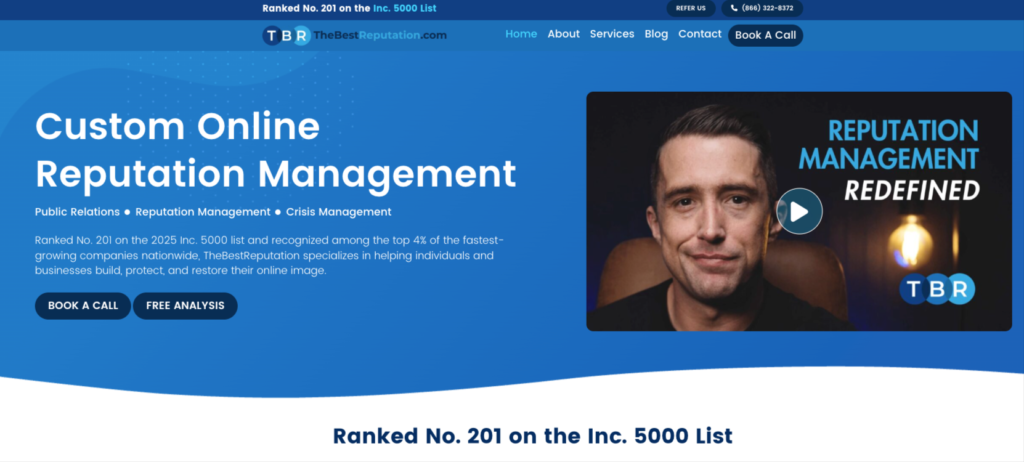
I’ll be upfront. TheBestReputation is at the top of this list because they’ve adapted to the AI search shift faster and more thoroughly than most firms in the space.
Most reputation companies will tell you they handle AI. TBR actually built a dedicated AI reputation management program around it: AI visibility audits, competitive snapshots of how your brand shows up versus competitors in AI summaries, technical optimization so AI tools can parse your content properly, and ongoing monitoring of high-impact platforms like Reddit and Quora that feed into AI outputs.
But it’s all built on top of what they already do well. Every campaign is custom. No templates. No cookie-cutter packages. They look at what’s actually going on, determine what’s causing the most damage, and build a plan around that. Aggressive with their suppression efforts. Credible with their media placement strategy. And they can see what’s working with enough granularity to actually understand what’s moving and why.
They’ve landed at number 201 on the 2025 Inc. 5000 list. That means they’re in the top 4% in the US for fastest-growing companies. That’s not something that happens at a reputation firm unless clients are actually seeing results and sticking around.
Best for: Complex situations where lots of things need to be going at once. Think negative press, AI summary issues, weak branded search results, and an inconsistent online presence all at the same time. They’re also great for executives, founders, and other professionals who need discretion and a deep strategy, not a dashboard and a report.
2. ReputationDefender

They’ve been around since 2006, which makes them one of the original players in this space. And they’re now part of Gen Digital, which owns Norton, Avast, and LifeLock. So they’ve got some serious infrastructure and brand credibility that’s tough to replicate.
Their big differentiator is their focus on privacy. Their product, ExecutivePrivacy, scans over 100 data broker and people search engine sites to get your personal data removed. So if you’re not worried about what Google has to say about you, but you’re worried about how much data is floating around on the internet, they’re probably your best bet. And they’re offering a free reputation report card to start, which is nice.
Their process for handling Online Reputation Management involves suppression, development, and monitoring. And they’ve had good feedback on how responsive they are. The only area where they’re not a good fit is for complex business needs or situations that require a totally customized approach. They’re a bit more “package-oriented,” which is fine for most people but might be frustrating for some.
Best for: Individuals with personal reputation issues who want a well-resourced, established company. Privacy-focused clients. Professionals who want a structured, predictable engagement.
3. WebiMax
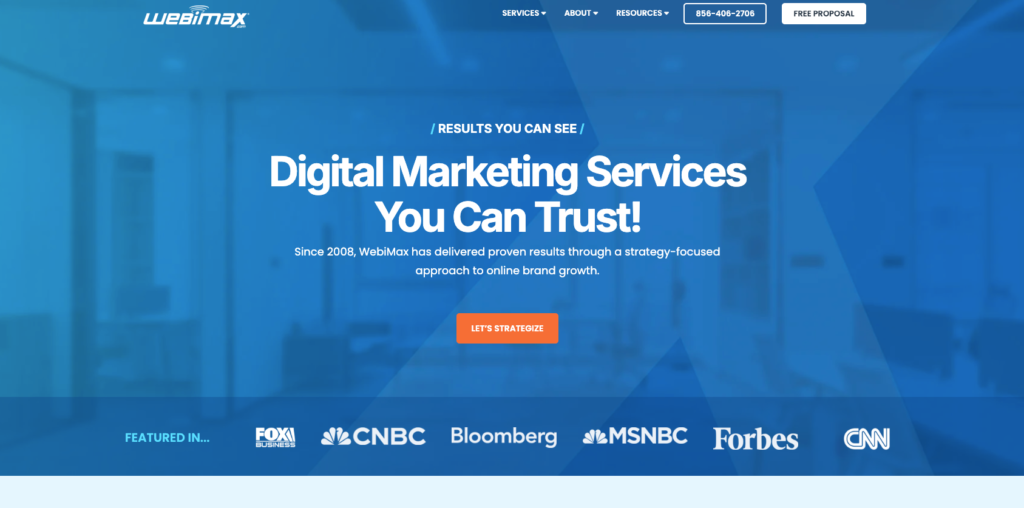
Since 2008, WebiMax has worked as a complete digital marketing team. Its services go beyond online reputation management. Instead, they fold in SEO, pay-per-click campaigns, social platforms, and website creation. When visibility struggles tie into messy branding or weak content, juggling separate experts can slow progress – here, everything moves under one roof. Problems rarely show up alone; neither should solutions. One company manages the whole picture, so nothing slips through cracks.
It turns out honesty in reporting actually stands out more than expected. Most firms in ORM tend to send foggy summaries each month without clear results. What sets them apart is the real numbers they share – exactly what actions were taken and whether they worked. Instead of just hiding negative pages, they also push positive stories forward. Clear updates come alongside managed reviews and active social presence shaping.
Depth takes a hit here. Doing it all means less focus on rep work compared to someone who only handles that one thing. Yet when you’re medium-sized and need online image efforts blended with wider outreach plans, these full-service firms actually make sense.
Best for: Businesses that want reputation work bundled into a broader digital strategy. Companies looking to consolidate vendors. Teams that value transparent, data-driven reporting.
4. BrandYourself
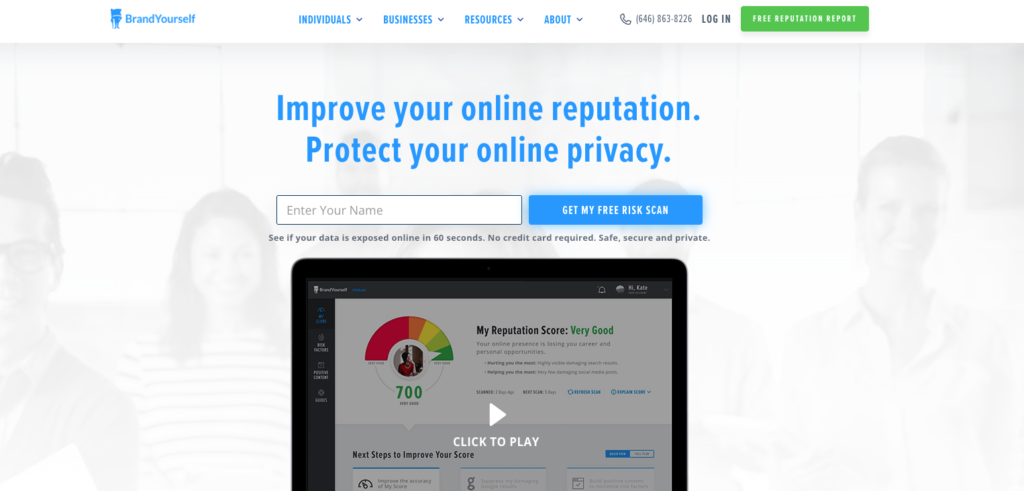
BrandYourself took a different path than most reputation companies, and it deserves credit for it. They built actual software that lets people scan their online presence, identify risk factors, and improve their search results on their own. Then they layered managed services on top for people who want more hands-on help.
The DIY platform is genuinely clever. You get a “Reputation Score” that quantifies how your online presence affects your professional prospects, plus a prioritized action plan: claiming profiles, optimizing social accounts, building personal websites, and cleaning up things dragging your score down. For someone with a mild issue or someone early in their career, it’s a lot of value for relatively little money.
They also lean into education in a way most firms don’t. BrandYourself actually teaches you how reputation management works, which makes their clients smarter consumers regardless of where they end up. That’s an ethical approach that sets them apart.
For more complex situations, their managed team handles content creation, SEO suppression, and ongoing monitoring. But their sweet spot is individuals and professionals building or repairing a personal brand, not high-stakes crises or major business reputation problems.
Best for: Individuals on a budget who want to do some of the work themselves. Professionals building a personal brand. People who want to understand how ORM works before committing to a full-service firm.
5. Igniyte
Igniyte is UK-based with global reach, and they work primarily with executives, public figures, and organizations where a reputation misstep can affect stock price, board appointments, or international business relationships. They operate at a higher level of stakes than most firms on this list.
Their approach blends PR, digital strategy, and crisis communications in a way that feels more like strategic advisory than a typical ORM shop. They build proactive positioning strategies, not just reactive cleanups. One of their standout differentiators is multilingual and multi-market reputation work. If your issues span multiple countries, or you need someone who understands GDPR and the differences between search landscapes in the UK, EU, and U.S., Igniyte is one of the few firms equipped for that.
They also handle content removal from Google and combine it with longer-term suppression and brand building. It’s not a quick-fix approach. It’s sustained, strategic work.
The main consideration is that they’re geared toward high-stakes, high-budget engagements. If your issue is relatively straightforward, they may not be the right fit. But for the clientele they serve, they’re genuinely among the best in the world.
Best for: C-suite executives and public figures with complex, high-stakes challenges. Companies with international reputation concerns. Clients who need crisis communications integrated with ORM and multilingual expertise.
6. Search Manipulator
The name is blunt, and so is the approach. Founded in 2010 by engineers, Search Manipulator focuses on the hard cases where negative content is deeply entrenched or tied to legal issues that make simple suppression difficult.
They offer both software tools and managed services, and their software has earned strong reviews from users who’ve tried other platforms first. On the managed side, they handle content removal from Google, YouTube, BBB, Yelp, RipoffReport, Justia, and similar platforms. Their work sits in the space between reputation management and legal strategy, which is exactly what certain clients need. They also offer a money-back guarantee, which is uncommon in this space and signals confidence.
Not the best fit if your issue is mild or if you want broader brand-building alongside cleanup. But if the problem is specific, stubborn, and hasn’t responded to other approaches, they’re worth a serious look.
Best for: Entrenched negative content that’s resisted other approaches. Platform-specific removal (Google, YouTube, review sites). People who’ve been disappointed by other ORM firms and want an engineering-driven approach with a guarantee.
7. SEO Image
SEO Image has been in the game since 2002, making them one of the longest-running agencies in the reputation and SEO space. They come at reputation management from a fundamentally technical angle. If negative content is outranking your own properties, they know how to fix the plumbing.
What makes them stand out is how they handle the nuts and bolts of search – tweaking pages, earning links, organizing content, while steadily lifting visibility through consistent effort. Healthcare and law firms make up part of their background, fields where one wrong listing might mean losing someone who needed help. Beginnings matter to them, so it kicks off with a no-cost chat and a look at your current standing, followed by shaping key materials and getting those messages seen.
Not flashy, and they’re not pitching AI narrative control. But for businesses that need reliable, technically sound reputation repair, they deliver consistently. Sometimes the most effective work is the least glamorous.
Best for: Businesses with ranking-related reputation issues. Healthcare and legal professionals. Companies that have decent content but need SEO muscle to make it visible.
8. Brand24
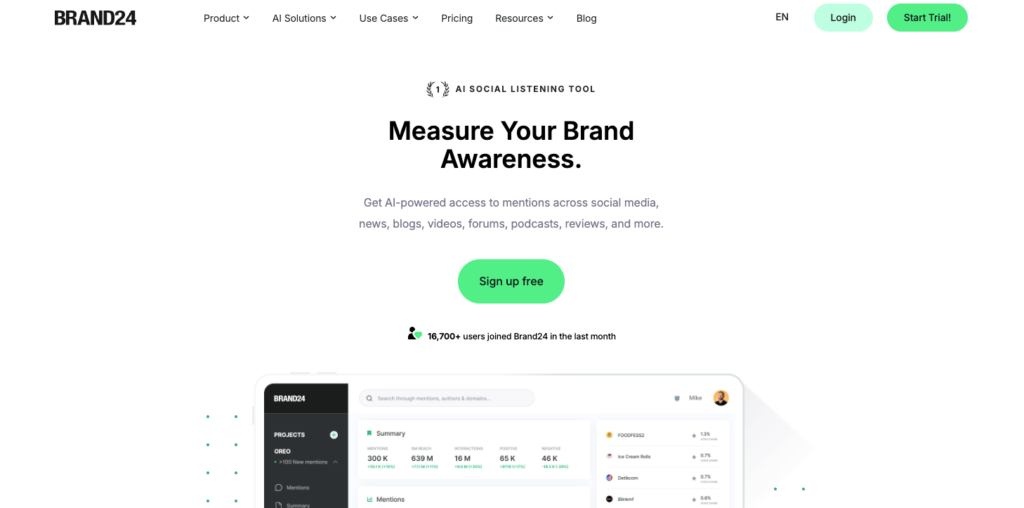
Brand24 isn’t an agency. It’s a monitoring platform, and a genuinely good one. It tracks brand mentions across social media, news, blogs, forums, podcasts, and the broader web in real time, with sentiment analysis that gives you actually useful signal.
Setup takes minutes, the dashboard is clean, and the filtering is solid. They also offer competitive benchmarking, so you can see how your brand’s conversation compares to competitors in volume, sentiment, and reach. For marketing teams that need to report on brand health, that’s a legitimately useful feature.
Think of Brand24 as the early warning system. It won’t fix your reputation, but it’ll help you catch problems before they snowball. Speed matters in this space, and the difference between catching something on day one versus day thirty can save you months of work. A lot of companies use it alongside a reputation firm, which is probably the smartest play.
Best for: Businesses that want real-time visibility into online mentions. Marketing teams that need sentiment data and competitive benchmarking. Anyone who’s been caught off guard by a reputation issue and wants an early warning system.
9. Birdeye
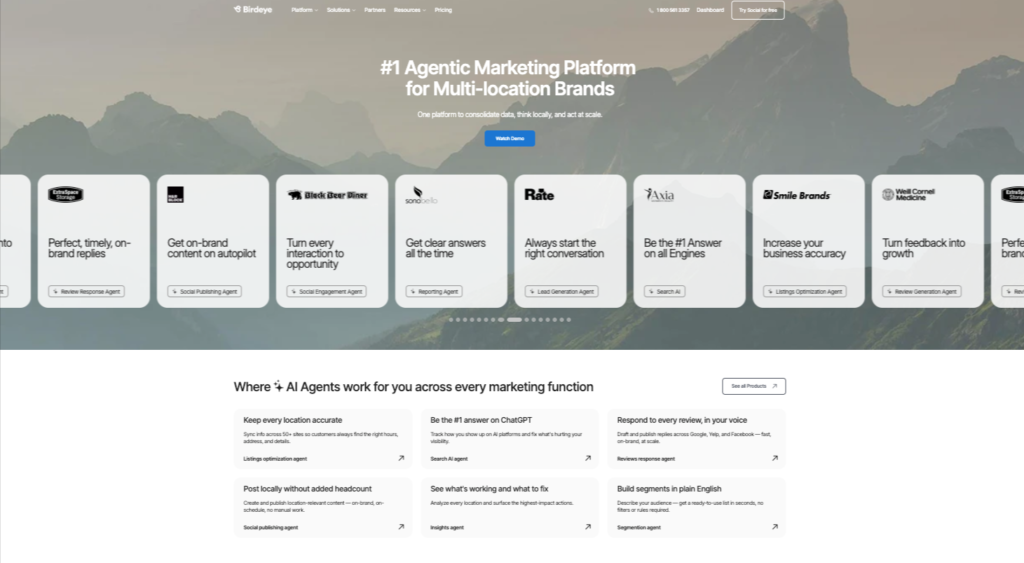
Birdeye is built for businesses that live and die by reviews. Restaurants, dental offices, law firms, home services, auto dealerships, any industry where a star rating directly affects whether someone picks up the phone.
The platform automates review requests via email and SMS, lets you respond to feedback across Google, Facebook, Yelp, Healthgrades, and dozens of other platforms from one dashboard, and tracks how your review profile trends over time. For multi-location businesses, that centralization is a lifesaver. They’ve also expanded into listings management, webchat, and surveys, making it more of an all-in-one customer experience platform than a pure review tool.
The ROI case is straightforward: more reviews leads to higher ratings, which leads to more customers. For a local business owner who doesn’t have time for AI search strategy or content suppression, Birdeye solves the problem they actually have. It just won’t help with news articles, forum threads, or AI summaries. For that, you’ll need something more specialized.
Best for: Multi-location businesses that need review management at scale. Local service businesses where star ratings drive revenue. Companies where reviews are the primary reputation battleground.
10. Podium
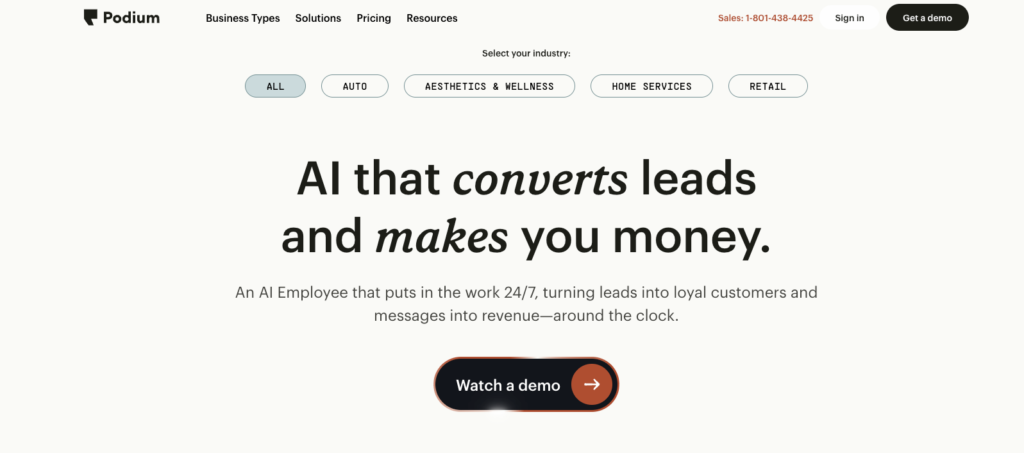
Podium takes a similar approach to Birdeye but leans even harder into communication. Their SMS-based system lets you ask for reviews, respond to messages, collect payments, and run webchat, all through text. Customers can leave a review in under a minute without downloading anything, and that friction reduction is a bigger deal than it sounds. Most happy customers don’t review you because it’s too much effort. Podium removes that barrier.
Getting it running takes hardly any time. The layout feels clear right away. People on your team usually jump in without needing help. This part is key. A system people engage with works better than one that sits untouched, no matter how advanced.
Podium works much like Birdeye – both handle reviews and customer messages, nothing more. When problems go deeper than feedback, another tool has to step in. Yet within its limits, performance stands out clearly. Companies that start using it usually keep using it.
Best for: Local businesses that want more reviews without more complexity. Service-based companies where speed and communication matter. Teams that need a tool their whole staff will actually adopt.
How to figure out which firm is right for you
This is the part most “best of” articles skip, and it’s arguably the most important.
Not every reputation firm on this list solves the same problem. Picking the wrong one is worse than picking none, because you’ll spend money, wait months, and end up back where you started.
Here’s how I’d think about it:
If your main issue is negative search results or press coverage, you need a firm that specializes in suppression and content strategy. That’s TheBestReputation, Search Manipulator, or SEO Image, depending on the severity and complexity of what you’re dealing with.
If your concern is personal, maybe your name shows up next to something you’d rather it didn’t, ReputationDefender or BrandYourself are both solid options, with BrandYourself being the more affordable route.
If you’re a local business and the problem is reviews, Birdeye or Podium will do the job. They’re not reputation firms in the traditional sense, but they solve the specific problem you have.
If your reputation issue is tied to AI-generated summaries, not just Google’s organic results, that narrows the field considerably. Most firms haven’t caught up to this yet. TBR’s AI reputation management work is specifically built for this, which is a big part of why they’re at the top.
If you’re a business that also needs help with SEO, paid media, or marketing more broadly, WebiMax is worth a look because they bundle everything together.
If you genuinely aren’t sure what you need, start with an audit. It costs nothing and takes about ten minutes. TBR offers free consultations that can at least help you understand the scope of the problem before you commit to anything.
The bigger picture
The role of online reputation companies has changed. A few years ago, this was mostly about damage control. Push something bad down, publish something good, move on.
Now it’s bigger than that. With AI Overviews showing up on a quarter of all Google searches, with ChatGPT processing over a billion queries a day, and with 85% of brand mentions in AI answers coming from pages you don’t control, your reputation isn’t just shaped by what’s on page one of Google anymore. It’s shaped by what AI decides to say about you in a summary that most people read and trust without questioning.
Reality hits each of these firms in its own way. Reviews pull one direction. Monitoring pulls another. Strength in SEO tugs from yet another angle. A small number, TBR included, move beyond fragments – tying legacy search, AI results, outside sites, and storylines into something whole.
Start now, whatever path you pick. Time feeds this cycle. Today’s three-month image repair might stretch to nine months later – each day piles up new posts, trains more algorithms, shapes how others see you through those results.

