Online Reputation Repair: DIY Steps and When to Hire a Pro

Online reputation repair is the process of restoring accurate, trustworthy content to the top of search results for your name or brand, pushing harmful material down or removing it entirely. If you’re dealing with a damaging article, a flood of negative reviews, or unwanted personal data surfacing on Google, here are three actions to take right now:
- Run an incognito search audit. Open a private browser window, search your name and business name, and screenshot every result on page one. Note the URL, ranking position, asset type (review, news article, social profile, forum post), and whether you control it.
- Preserve evidence. For anything that may be defamatory, false, or a privacy violation, capture timestamped screenshots and save the full URL. This documentation supports platform reports and, if needed, legal claims.
- Set up monitoring alerts. Create a Google Alert for your name, business name, and key executive names so new mentions surface immediately.
Thebestreputation is an expert resource available for any stage of this process, from a free initial audit to a full managed campaign. The phased repair approach of triage, suppression, proliferation of positive assets, and ongoing monitoring is the practical standard the industry relies on, and it ties directly to measurable revenue protection.
Table of Contents
- What is online reputation repair, and what can it realistically achieve?
- How does the reputation repair process actually work?
- Which content can be removed, and what are the realistic limits?
- How long does reputation repair take?
- What does reputation repair cost?
- What can you do yourself to repair your reputation right now?
- How do you keep your reputation healthy after repair?
- How do you choose the right reputation management agency?
- How Thebestreputation approaches reputation repair
- Key Takeaways
- Why most reputation repair advice misses the hardest part
- Thebestreputation’s free audit: what to expect and how to get started
- Useful sources and resources
What is online reputation repair, and what can it realistically achieve?
Online reputation management, or ORM, is the established industry term. “Online reputation repair” describes the remediation phase specifically: the targeted effort to correct, suppress, or remove harmful content that is damaging how others perceive you or your business in search results and on review platforms.
The goals are concrete. Repair work aims to restore accurate, authoritative content to page one of branded searches, improve trust signals that prospects and stakeholders see before they decide to engage, and reduce the conversion loss that negative results cause. A business with a 3.2-star average rating loses customers to a competitor with a 4.5 before a single conversation happens.
Ethical repair is not about hiding facts. The goal is to surface truth and context, not to manufacture a false image. Suppression replaces harmful content with more authoritative, accurate material. It is fundamentally different from deception, which involves fabricating reviews, planting false articles, or manipulating platforms in ways that violate their terms of service. Any agency that offers those tactics is a liability, not an asset.
Pro Tip: When you assess your current search results, separate what is factually false from what is simply unflattering. False content has legal remediation paths. Unflattering-but-true content requires a different strategy: building a stronger, more complete narrative around it.
How does the reputation repair process actually work?
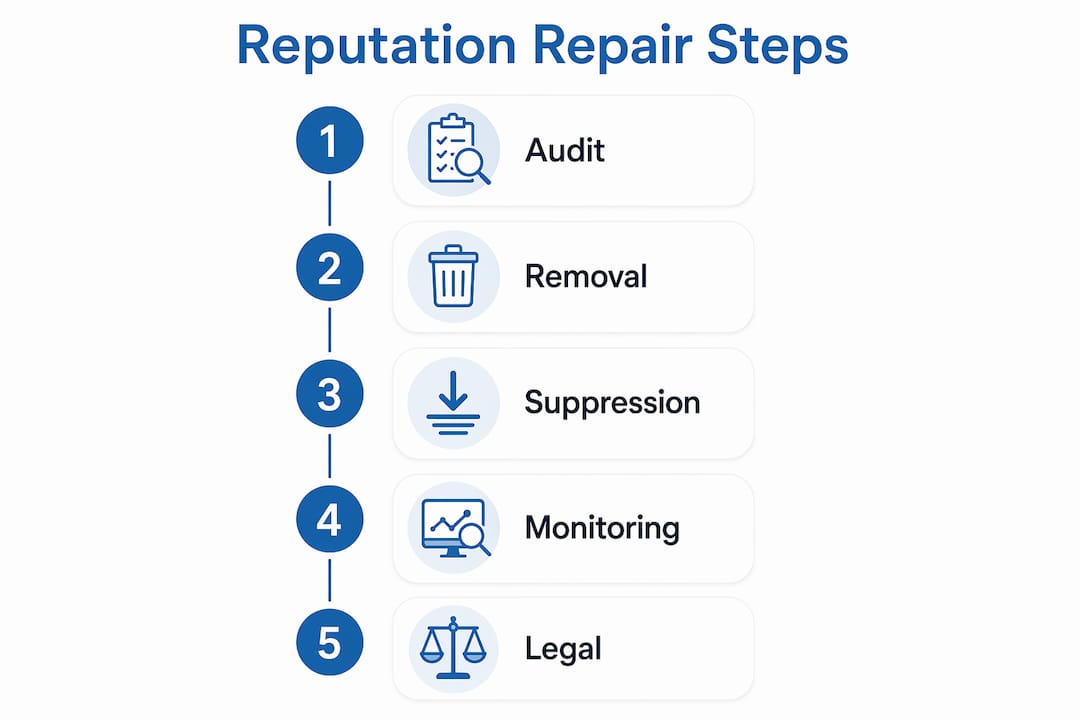
Effective repair follows a phased playbook that practitioners treat as the industry standard: triage, removal or reporting, suppression through SEO and PR, proliferation of high-quality positive assets, and ongoing monitoring. Skipping triage is the most common mistake; without it, effort gets wasted on low-risk assets while high-risk ones continue to rank.
Phase 1: Triage and audit
A proper reputation audit maps every harmful asset by query, ranking position, asset type, control status, risk level, and recommended action path. Control status is the key variable:

| Asset type | Control status | Primary action path |
|---|---|---|
| Your own website pages | Owned | Edit, optimize, or de-index |
| Your social profiles | Owned | Update, expand, optimize |
| Review platform listings | Influenced | Respond, report, solicit new reviews |
| Third-party news articles | Out of control | Suppression via SEO/PR; legal if defamatory |
| Forum posts / Reddit threads | Out of control | Report if policy violation; suppress otherwise |
| Mugshot / public records sites | Out of control | Removal request (varies by state); suppress |
| Videos (YouTube, etc.) | Out of control | Report for policy violations; suppress |
Phase 2: Removal and reporting
For owned assets, deletion or de-indexing is straightforward. For third-party content, removal requires either a platform policy violation (doxxing, explicit content, impersonation, copyright infringement) or a legal standard such as defamation. Google grants removals for narrow categories; most negative articles and reviews do not qualify. Submit removal requests where policy applies, document every attempt, and move to suppression for everything else.
Phase 3: Suppression via SEO and PR
Serious suppression campaigns publish clusters of branded assets and build authority signals to displace negatives over months. This means creating and optimizing profiles, publishing authoritative content, earning media placements, and building quality links to positive assets. The volume required is significant: practitioners commonly publish 20–50 assets and support them with high-quality links to move entrenched negative results.

Phase 4: Monitoring and measurement
Once suppression is underway, consistent monitoring tracks whether positive assets are gaining ground. Key metrics include share of page-one assets you control, average review rating trajectory, and sentiment shifts in media mentions.
When to escalate to legal counsel: If content is provably false and damaging (defamation), involves private information shared without consent, or constitutes impersonation, consult an attorney before taking public action. Public responses to defamatory content can sometimes complicate legal claims.
Which content can be removed, and what are the realistic limits?
The honest answer is that most harmful content cannot be deleted outright. Understanding the distinction between removable and suppressible content saves time and prevents wasted legal fees.
Content that can often be removed:
- Your own pages and profiles (full control)
- Reviews that violate platform policies (spam, fake, conflict of interest)
- Doxxing, explicit images, or personal safety threats (Google, social platforms have specific policies)
- Copyright-infringing content (DMCA takedown process)
- Impersonation accounts (platform reporting)
- Certain personal data on data-broker and people-search sites
Content that is typically suppression-only:
- Accurate negative news articles on high-authority domains
- Archived or cached content from major publications
- Legitimate third-party commentary and opinion
- Court records and public legal filings
- Old social media posts you do not own
Legal thresholds matter. Removal often depends on platform policy or a legal standard, not simply on your preference. Defamation requires proving a false statement of fact that caused harm. Privacy claims vary by state. Mugshot removal is possible on many sites but depends on state law and whether you have a record expungement. If you believe content crosses a legal line, gather evidence first and then consult counsel.
Pro Tip: Document everything before you act. For each harmful asset, save a timestamped screenshot, the full URL, the date you first observed it, and any identifying information about the author or publisher. This record supports platform reports, legal filings, and your agency’s audit if you hire one.
How long does reputation repair take?
Timelines vary based on the domain authority of the hostile asset, the age of the content, how competitive the search query is, and the volume and quality of positive assets you can deploy. Here is a realistic reference table:
| Tactic | Typical time range | Success signal |
|---|---|---|
| Platform removal request (policy violation) | 1–4 weeks | Content removed or de-indexed |
| Google removal request (doxxing, explicit) | 1–3 weeks | URL removed from search results |
| Profile claiming and optimization | 1–2 weeks to index | Profile appears in top results |
| New content indexing by Google | 2–6 weeks | Pages appear in search results |
| SEO suppression (measurable shift) | 3–8 months | Negative result moves to page 2+ |
| Review rating improvement | 2–6 months | Average rating increases |
| PR placements (earned media) | 4–12 weeks per placement | Authoritative article ranks for brand query |
| Legal takedown (defamation, copyright) | 1–6 months | Content removed or court order obtained |
| Durable reputation improvement | 6–18 months | Sustained page-one control |
Early wins are real. Profile fixes and policy-based removals can produce visible changes within weeks. Suppression of entrenched negative results on high-authority domains is a longer game, typically 3–8 months for measurable movement and 6–18 months for durable improvement.
What does reputation repair cost?
Pricing reflects the complexity of the problem, not just the hours involved. A single negative review on a low-authority site is a different project than a damaging Forbes article ranking for an executive’s name.
Typical pricing bands:
- DIY: Free to a few hundred dollars (monitoring tools, basic SEO tools, time investment)
- Small contained projects: $500–$2,500 (profile optimization, a handful of removal requests, basic content publishing)
- Ongoing retainer campaigns: $1,000–$10,000+ per month, depending on the number of negative assets, domain authority of hostile results, content production volume, and PR outreach required
Primary cost drivers:
- Number and ranking position of negative assets
- Domain authority of hostile results (a Wikipedia article costs more to suppress than a forum post)
- Need for legal action (attorney fees are separate from agency fees)
- Content production volume and quality required
- PR outreach and media placement effort
- Monitoring tool subscriptions and reporting cadence
Pricing reality check: Practitioners link a one-star increase in average review rating to measurable revenue improvement. For most businesses, the cost of inaction, lost leads, lower conversion rates, and damaged partnerships, exceeds agency fees within the first year of a serious problem.
Red flags in pricing proposals:
- Guaranteed removal of specific content (no ethical agency can guarantee this)
- Long lock-in contracts (12+ months) with no performance milestones or exit terms
- Vague deliverables with no reporting cadence
- No itemized breakdown of audit depth, content production, link outreach, monitoring, and legal coordination
A credible quote should itemize each service component and tie deliverables to measurable milestones.
What can you do yourself to repair your reputation right now?
DIY steps are effective for contained problems. If you have one or two negative results, a manageable review situation, or a thin online presence that needs building up, the following checklist covers the most impactful actions.
- Run your incognito audit. Search your name, business name, and common misspellings. Screenshot every page-one result and note the URL, asset type, and whether you control it.
- Claim and optimize your major profiles. Google Business Profile, LinkedIn, Facebook, Yelp, and industry-specific directories. Complete every field, use consistent NAP (name, address, phone), and add professional photos. Claiming key profiles is one of the fastest ways to add controlled assets to page one.
- Respond to negative reviews calmly and publicly. Write for future readers, not to win an argument with the reviewer. Acknowledge the concern, offer a resolution path, and keep it brief. Same-day responses on high-visibility platforms signal active management to prospects.
- Request removals where policy applies. Submit reports to Google, Yelp, Glassdoor, and other platforms for reviews that violate their policies (fake, spam, conflict of interest). Document every submission.
- Publish authoritative owned content. A well-written About page, a LinkedIn article, a press release, or a case study gives search engines positive, accurate material to index. Optimize each piece for your name and brand keywords.
- Create and optimize social profiles. Active, complete profiles on LinkedIn, X (formerly Twitter), and relevant platforms rank for branded searches and push down weaker negative results.
- Set up layered monitoring. Google Alerts for basic coverage; paid tools like Mention or Brand24 for cross-platform volume and social listening. Check the top monitoring tools to find the right fit for your budget.
- Solicit reviews from genuinely satisfied customers. Ask directly after a positive interaction. Avoid incentivized reviews that violate platform terms.
When to stop DIY and hire an agency:
- Multiple page-one negative results on high-authority domains
- An executive name or personal brand under sustained attack
- An ongoing smear campaign with coordinated negative content
- Any situation involving potential defamation, impersonation, or privacy violations
- A crisis that is actively affecting revenue, hiring, or partnerships
Response tone guidance: Keep public responses factual, brief, and forward-looking. Never share private details about a customer or situation. Never get defensive or accusatory. The goal is to demonstrate professionalism to the next person who reads the thread, not to settle a score.
How do you keep your reputation healthy after repair?
Prevention is significantly cheaper than repair. Once you have stabilized your search results, a consistent monitoring and response routine keeps problems from compounding.
Monitoring tools and cadence:
- Google Alerts: Set up for your name, business name, key executives, and brand misspellings. Check weekly at minimum.
- Mention or Brand24: For businesses with active social presence or media exposure, these paid tools catch mentions across blogs, news, forums, and social platforms that Google Alerts miss.
- Review platform dashboards: Check Google Business Profile, Yelp, and industry-specific review sites at least weekly. Assign a team member to own this task.
Preventive policies every business should have:
- A written review-handling workflow: who responds, within what timeframe, and what tone guidelines apply
- An escalation path for complaints that may become public (who decides when to involve legal counsel or a PR firm)
- A monitoring-and-response playbook that documents your process so it survives staff turnover
Review generation best practices: Ask satisfied customers directly and promptly after a positive experience. A simple, personal request outperforms automated mass emails. Never offer discounts, gifts, or incentives in exchange for reviews; this violates platform policies and can result in penalties that undo months of work.
Pro Tip: Assign reputation monitoring as a named responsibility, not a shared one. When everyone is responsible, no one checks. One person, one dashboard, one weekly report keeps the function alive.
How do you choose the right reputation management agency?
Hiring the wrong agency can make your situation worse, either through black-hat tactics that trigger platform penalties or through wasted months on vague deliverables. Use this checklist when evaluating vendors.
- Ask for their audit methodology. A credible agency maps each harmful asset’s control status, risk level, and action path before proposing a scope of work. If they skip the audit and go straight to a proposal, that is a warning sign.
- Request anonymized case studies. Ask for examples of problems similar to yours: the type of content, the platform, the timeline, and the measurable outcome. Vague success stories without specifics are not evidence.
- Confirm the reporting cadence. Monthly reports at minimum, with clear KPIs: share of page-one assets controlled, review rating trajectory, sentiment shifts, and removal request status.
- Clarify the scope of services. Does the agency handle removal requests, content production, link outreach, PR placements, and monitoring? Or do they subcontract some of these? Know what you are buying.
- Ask about their escalation path to legal counsel. Ethical agencies know when a situation requires an attorney and have relationships with counsel who specialize in defamation and privacy law. If an agency claims they can handle everything without ever involving a lawyer, be skeptical.
- Review the contract carefully. Watch for: lock-in terms longer than six months without performance milestones, vague deliverable language (“reputation improvement”), no data-ownership clause (you should own all content produced), and no clear termination or exit deliverables.
Red flags that disqualify a vendor:
- Guaranteed removal of specific URLs or articles
- No clear KPIs or reporting structure
- Tactics that involve fake reviews, fake profiles, or manufactured press
- Pressure to sign quickly without a discovery call or audit
For businesses and individuals who want a proven process backed by measurable results, Thebestreputation offers a free audit as the first step, with no obligation to proceed until the scope and timeline are clear.
How Thebestreputation approaches reputation repair
Thebestreputation’s methodology follows the same phased structure that industry research identifies as the reliable path: audit, removal and reporting, SEO suppression combined with PR, and ongoing monitoring with KPI tracking. What distinguishes the firm is the integration of public relations with technical SEO, a combination that most agencies treat as separate disciplines.
Core methodology:
- ✅ Audit: Map every harmful asset by control status, risk level, ranking position, and action path
- ✅ Removal and reporting: Submit platform reports for policy violations; coordinate legal referrals for defamation and privacy claims
- ✅ SEO suppression: Publish clusters of branded assets, optimize owned properties, and build authority signals to displace negative results
- ✅ PR outreach: Secure earned media placements in authoritative publications to create high-authority positive assets
- ✅ Monitoring and KPI tracking: Track share of page-one assets controlled, review rating trajectory, and sentiment shifts on a defined reporting cadence
Types of clients who benefit most:
- Business owners dealing with a damaging review pattern or a hostile article ranking for their brand name
- Executives whose personal name search results include negative press, legal records, or outdated information
- Professionals in regulated industries (legal, medical, financial) where a single negative result can affect licensing or client acquisition
- Brands recovering from a public crisis that generated sustained negative media coverage
Thebestreputation was ranked No. 201 on the 2025 Inc. 5000 list, a recognition that reflects the firm’s growth trajectory and client results. The firm’s integrated PR and SEO approach is described in detail on its ORM methodology page.
Success metrics Thebestreputation tracks for clients include: percentage of page-one results controlled by the client, improvement in average review rating, volume and authority of earned media placements, and reduction in negative sentiment in brand mentions over time. The phased playbook (triage, suppress, proliferate, monitor) is the practical standard for reputation repair and is directly linked to measurable revenue protection.
Key Takeaways
Effective online reputation repair requires a structured audit, realistic expectations about what can be removed versus suppressed, and consistent execution over months, not days.
| Point | Details |
|---|---|
| Start with a structured audit | Map every harmful asset by control status, risk level, and ranking position before taking any action. |
| Removal is the exception, not the rule | Most negative content requires suppression via SEO and PR; removals apply only to policy violations or legal standards. |
| Timelines are measured in months | Measurable suppression typically takes 3–8 months; durable page-one control usually requires 6–18 months of consistent effort. |
| DIY works for contained problems | Claim profiles, respond to reviews, publish owned content, and set up monitoring; escalate to an agency when multiple page-one negatives persist. |
| Thebestreputation offers a free audit | Ranked No. 201 on the 2025 Inc. 5000, Thebestreputation provides a phased repair process integrating PR and SEO for individuals and businesses. |
Why most reputation repair advice misses the hardest part
The conventional framing of reputation repair focuses on tactics: claim your profiles, respond to reviews, publish positive content. That advice is correct but incomplete. The part most guides skip is the prioritization problem.
Not all negative content carries equal weight. A one-star review on a low-traffic directory is a nuisance. A damaging article on a high-authority domain, ranking in position two for your name, is a structural problem that costs you real business every day it sits there. Treating both with the same urgency is how people waste months on the wrong assets.
The audit is not a preliminary step. It is the strategy. Until you know the control status, domain authority, and ranking mechanics of every harmful asset, you are guessing. Practitioners who skip straight to publishing content or submitting removal requests without a proper audit often find that six months later, the original negative result is still ranking, and the new content they published is scattered across page two and three with no authority signals supporting it.
The other underestimated factor is response tone. Responses to negative sentiment should be written for future searchers, not for the person who left the review. A defensive, detailed public response to a negative review often draws more attention to the problem than the review itself. The goal is to demonstrate professionalism and care to the next hundred people who read the thread, not to win a debate with one unhappy customer.
If you are protecting a crisis situation, the crisis reputation guide from Thebestreputation covers the high-pressure, time-sensitive version of these decisions in more depth.
Thebestreputation’s free audit: what to expect and how to get started
Negative search results cost real money. For most businesses, the revenue impact of a damaging page-one result, whether a hostile article, a low review rating, or outdated information, exceeds the cost of professional repair within the first year of inaction.
Thebestreputation offers a free initial audit that covers your current search result profile, the control status of key assets, and a prioritized action path. Services include reputation repair campaigns, removal requests and legal coordination, SEO suppression, PR outreach and earned media placement, review management, and ongoing monitoring with monthly reporting. The firm’s integrated PR and SEO methodology, recognized by the 2025 Inc. 5000, is designed for individuals, business owners, executives, and brands facing high-stakes reputation problems.
To get started, have your primary search queries ready (your name, business name, and any known negative URLs), along with any documentation you have already gathered. Then request your free audit and receive a clear picture of where you stand and what it will take to fix it.
Useful sources and resources
- Fix Online Reputation: 2026 Guide to Repair & Grow — Detailed phased playbook covering triage, suppression, and monitoring with practical audit methodology.
- Online Reputation Repair: How Long It Takes & What To Expect — Realistic timeline expectations and removal vs. suppression distinctions.
- What Is Online Reputation Management? A Definitive Guide — Broad ORM overview covering monitoring tools, response best practices, and review management.
- 5 Easy Steps to Repair Your Online Reputation — Practical DIY steps for individuals and small businesses with contained problems.
- For legal guidance: The American Bar Association’s lawyer referral directory (americanbar.org) connects you with attorneys who specialize in defamation, privacy, and internet law.
- For monitoring tools: Thebestreputation’s monitoring tool guide covers free and paid options across social, news, and review platforms.
- Document your removal attempts: Keep a running log of every platform report submitted, including the date, URL, reason cited, and outcome. This record is valuable evidence for escalation to legal counsel or a managed campaign.
This article is general information, not legal or professional advice. For situations involving potential defamation, privacy violations, or legal liability, consult a qualified attorney familiar with your state’s laws and your specific circumstances.

