Brand and Reputation Management: The 2026 Playbook
A founder types the company name into Google after a customer posts a harsh review. The website ranks first, but a forum thread appears below it, an outdated article supplies the Knowledge Panel, and an AI answer repeats a claim nobody at the company recognizes. The founder didn’t lose control of the brand in one dramatic moment. The company failed to govern the information that other people and systems use to judge it.
That situation now affects local operators, executives, recruiters, journalists, investors, and procurement teams. Brand and reputation management is no longer a cleanup exercise for public relations. It’s an operating system that connects search visibility, media relations, customer feedback, content governance, AI-search accuracy, and crisis readiness.
The commercial stakes are direct. 75.5% of consumers trust online reviews, 63.3% always read reviews before buying, and 67.9% trust brands rated four stars or higher, according to reputation management statistics compiled by Thrive My Way. A reputation program must therefore do more than create attractive messaging. It must make the public record accurate, current, credible, and useful at the point of decision.
Table of Contents
- The Moment You Realized Search Results Are Your Reputation
- What Brand and Reputation Management Means
- Why It Now Lives at the Intersection of SEO, PR, and AI Search
- The Core Framework for a Modern Reputation Program
- How SMBs, Multi-Location Brands, and Enterprises Build It Differently
- Crisis Communication as an Always-On Operating Discipline
- Measurement That Goes Beyond Star Ratings
- Bringing It All Together and Your First 90 Days
The Moment You Realized Search Results Are Your Reputation
The owner of a regional professional-services firm noticed the problem during a routine search. A former customer had published a negative review after a billing dispute, and the owner expected the issue to sit on a review platform. Instead, a discussion thread appeared prominently in search, an old press mention framed the company without context, and an AI-generated summary blended both sources into a confident but incomplete description.
The owner could explain every detail internally. That didn’t matter. Prospects weren’t reading the internal explanation. They were scanning the first page, checking recent reviews, looking at the company profile, and deciding whether the risk was worth a sales call.

One public surface, many inputs
Your Google results, Knowledge Panel, Glassdoor profile, review pages, AI Overview citations, Reddit discussions, YouTube mentions, and company website aren’t separate reputation problems. They form one stacked reputation surface.
A prospect might begin with a branded search, validate the company through reviews, inspect an executive’s background, and ask ChatGPT or Perplexity for an independent assessment. A journalist may perform the same process before requesting comment. A candidate might weigh Glassdoor alongside the careers page. Each audience sees a different route into the same public record.
Search and review ecosystems now shape perception alongside direct brand messaging. Thrive My Way reports that 97% of customers search for a brand’s reputation on Google, while 85% actively look for negative reviews before purchase. Those figures make one point unavoidable: silence doesn’t preserve neutrality. It leaves other sources to define the company.
Practical rule: Treat every branded search, review profile, and AI citation as part of one decision environment.
The fix isn’t to react faster every time someone discovers a problem. It’s to build the systems that make accurate information easier to find, credible third-party evidence easier to verify, and operational failures less likely to become public incidents.
What Brand and Reputation Management Means
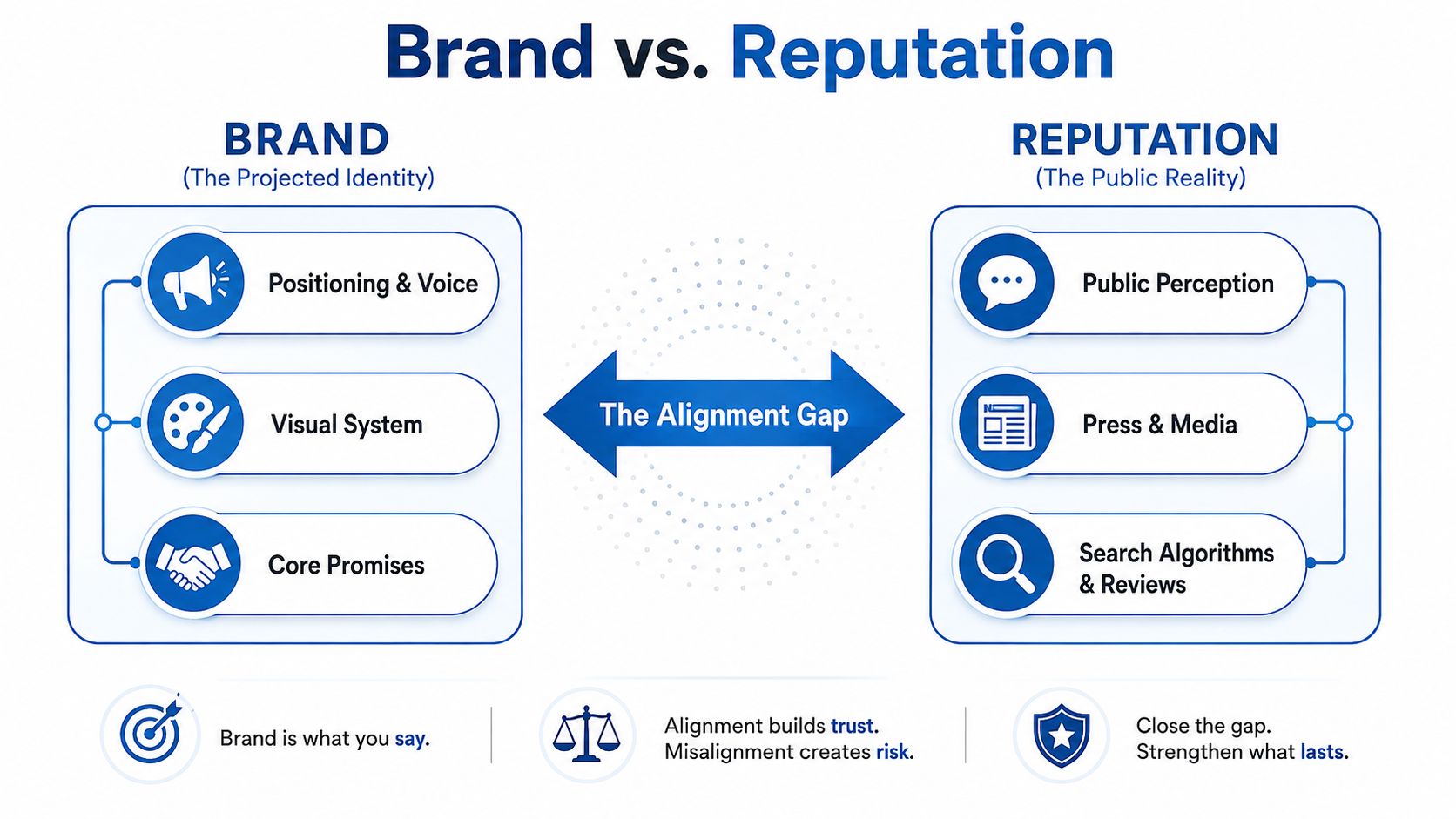
A company can present itself as responsive, expert, and trustworthy while search results and customer experiences communicate something else. Brand is the identity a company projects. It includes positioning, voice, visual standards, customer promises, executive messaging, and the experience the organization intends to create.
Reputation is the public reality surrounding that identity. It appears in search results, reviews, media coverage, employee commentary, citations, forum discussions, and AI-generated summaries. Leadership controls much of the brand output. Customers, employees, journalists, platforms, and AI systems shape the signals that determine reputation.
Find the alignment gap
Brand and reputation management earns its keep where those systems diverge. A company may promise responsive support while reviews describe delays. An executive may claim category expertise while search results offer little evidence beyond a corporate biography. A healthcare practice may promise clarity while its listings show inconsistent names, services, or contact details.
Start with an evidence review:
- Review the promise: List what the brand claims about quality, speed, expertise, safety, and service.
- Inspect the proof: Compare those claims with reviews, articles, profiles, customer comments, and factual sources.
- Correct the record: Fix inaccurate profiles, refresh stale pages, resolve legitimate service failures, and publish evidence that closes important information gaps.
- Govern the system: Assign owners for reviews, media statements, executive profiles, AI-search monitoring, and escalation.
This work is an operating system, not a logo exercise or a posting calendar. SEO improves discoverability, PR supplies credible third-party context, review operations expose service failures, and AI-search governance checks whether machines repeat accurate information. Crisis readiness connects the same controls when scrutiny rises.
The program must serve both a small business and a global enterprise. The scale changes, but the requirement does not: connect public signals to accountable owners and operating fixes. Legitimate criticism needs a visible response and a remedy, not suppression.
For a broader definition, consult this 2026 guide to online reputation management. Ask one practical question: if a buyer, employee, reporter, or AI system queried the company today, would the answer reflect the organization accurately and consistently?
Why It Now Lives at the Intersection of SEO, PR, and AI Search
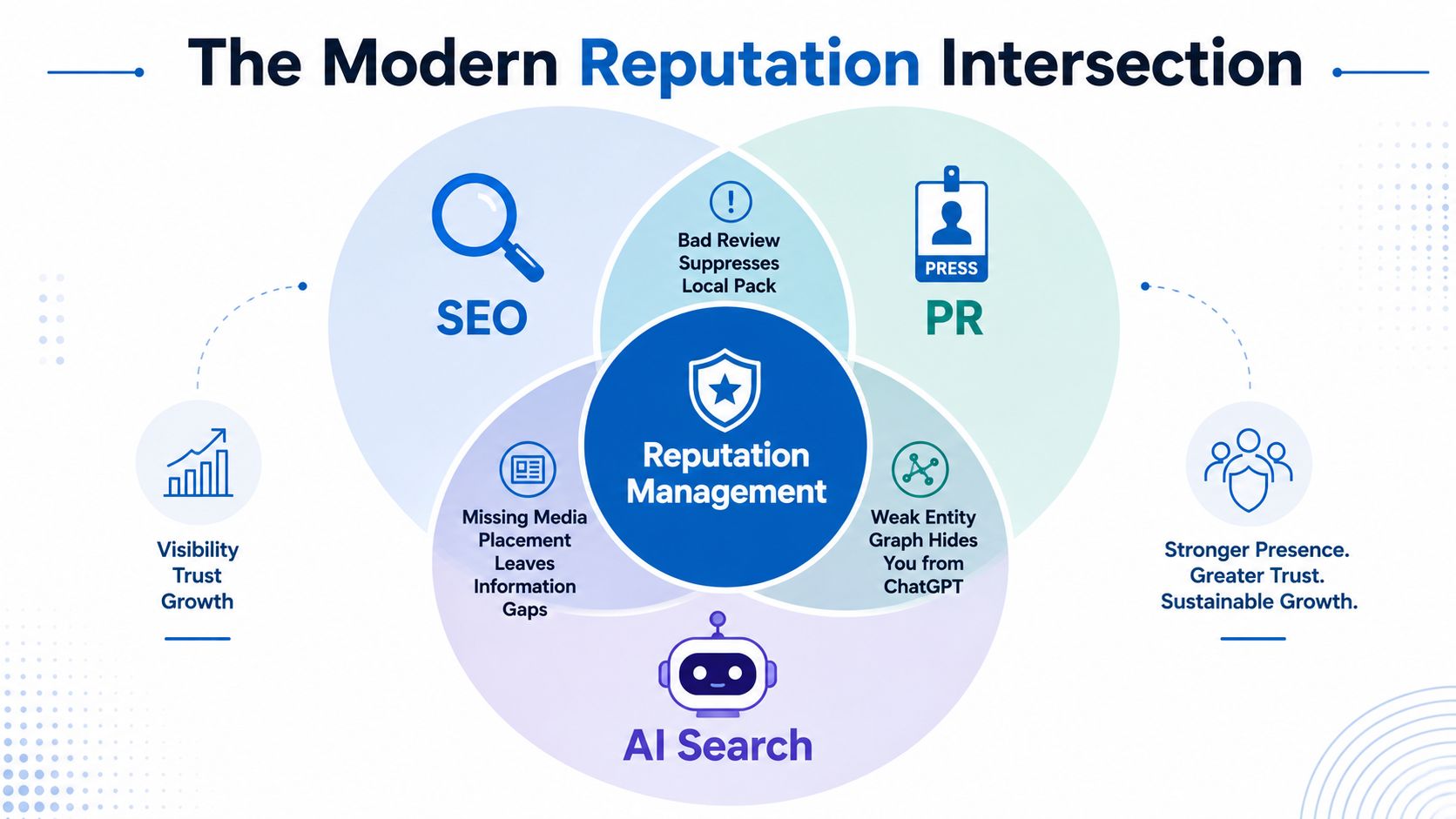
A customer sees a poor review, a reporter finds an incomplete executive profile, and an AI system fills a missing fact with an unverified forum post. Those events look separate inside a company. Buyers experience one reputation. That gap is why SEO, PR, review operations, content, and AI-search governance must run as one operating system.
Traditional departmental boundaries fail because public signals cross them. A negative review can weaken local trust and create a customer-service story. A thin executive profile can leave search engines and AI systems without reliable context. Missing media coverage can leave an information gap that another source fills.
AI search has accelerated this integration. Research published by AuthorityTech reports that trust in AI search fell from 82% to 54% in one year, while usage rose 70%. The same research says 27% of marketers report inaccurate brand descriptions in AI-generated responses, and 14% report a customer, sales, or public-relations impact. Visibility alone is no longer enough. Information must be accurate, attributable, and supported by sources that systems can interpret.
What changes when the functions connect
SEO becomes entity and source optimization. Teams still need technically sound pages and relevant content. Reputation work also requires consistent facts about people, products, locations, ownership, expertise, and relationships.
PR becomes citation building. Media relations should earn coverage that adds independent authority, not merely distribute announcements. Strong coverage gives search engines and AI systems additional sources to connect with the entity.
Content becomes evidence. An About page, executive biography, product explanation, customer story, or security statement should answer the questions prospects and automated systems ask. Each asset needs a clear owner and a factual review process.
Review management becomes trust governance. Review velocity, recurring topics, response quality, and platform credibility matter alongside average rating. Google reviews were trusted by 71% of respondents, while Trustpilot was trusted by 58%, according to consumer trust research on online reviews.
AI-search governance should set source transparency, human review for important claims, disclosure rules, and consistent facts across Google, AI Overviews, ChatGPT, Gemini, Perplexity, Reddit, YouTube, and review platforms. The goal is not to manipulate every answer. Make the correct answer the easiest one to assemble.
A practical AI search optimization guide for controlling a brand story belongs in the same program as technical SEO and media relations. AI search has not replaced either function. It has made their coordination mandatory.
The Core Framework for a Modern Reputation Program
A serious program has six connected layers. Weakness in one layer creates work for the others, so leadership shouldn’t fund review responses while ignoring security controls, or commission content without auditing the entity footprint first.
1. Baseline audit
Start with reality, not assumptions. Search the brand, founders, products, services, subsidiaries, and locations. Capture branded search results, Knowledge Panel details, review profiles, media references, employee commentary, and AI answers. Record which sources each system cites and where facts conflict.
The audit should identify both visible problems and missing authority. A company may have no damaging result but still lack reliable pages that explain its ownership, expertise, leadership, or customer outcomes.
2. Positioning strategy
Translate the audit into a target public record. Define the claims the company needs audiences to understand, then map each claim to evidence. For important branded queries, identify the owned, earned, and third-party pages that should occupy prominent search positions.
Don’t publish generic thought leadership. Build authoritative profiles, service explanations, executive pages, location content, and customer proof around the questions that create commercial or reputational risk.
3. Content and PR engine
The content team should produce structured, factually precise assets. The PR team should earn mentions that add independent authority. Useful outputs include schema-supported About and Contact pages, executive bylines, expert commentary, customer education, industry coverage, and digital PR campaigns.
4. Review workflow
Set response ownership, service-level expectations, escalation triggers, and legal review rules across Google, Trustpilot, Glassdoor, G2, and vertical platforms. A response should acknowledge the issue without exposing private information, then move resolution into an appropriate channel.
Review authenticity matters. 67% of consumers say fake reviews and fake reviewers make them distrust online reviews generally, according to BrightLocal’s consumer review survey. Never manufacture praise or pressure customers into scripted language.
5. Crisis readiness
Prepare holding statements, spokesperson rules, approval paths, evidence checklists, and incident-specific FAQs before an event. Legal, communications, security, customer support, and executive leadership need defined roles.
6. Measurement loop
Connect search coverage, review health, media authority, AI accuracy, pipeline, churn, hiring signals, and incident response performance. The dashboard should expose where the system is failing, not merely celebrate sentiment.
How SMBs, Multi-Location Brands, and Enterprises Build It Differently
The right program depends on operating complexity. A single-location business shouldn’t imitate an enterprise communications department, and an enterprise shouldn’t manage reputation through one shared spreadsheet.
A local business needs control and consistency first. Claim every major profile, make Google Business Profile the primary surface, create a review request process, and assign someone to respond within a defined service window. The owner or general manager may lead the program, with specialist support for local SEO, content, or serious incidents. Businesses dealing with inaccurate listings or an escalating Google Business Profile crisis need a documented escalation route rather than improvised replies.
A multi-location brand needs central governance with local execution. Headquarters should provide templates, facts, approval rules, and reporting. Regional or franchise teams need room to address local circumstances without changing the core promise or publishing inconsistent information.
Enterprise and executive programs require entity governance across subsidiaries, executives, products, and markets. They also need media relations, share-of-voice analysis, board-level reporting, and a crisis war room that includes legal, communications, security, and customer operations.
| Dimension | SMB / Local | Multi-Location | Enterprise / Executive |
|---|---|---|---|
| Primary owner | Owner, general manager, or marketing lead | Central reputation lead with regional operators | Communications, legal, security, SEO, and executive teams |
| Core surfaces | Google Business Profile, website, major review platforms | Location listings, local search, review networks, social channels | Corporate, executive, subsidiary, investor, media, employee, and AI surfaces |
| Operating model | Lean, founder-led, documented response workflow | Central templates with local adaptation | Entity governance, formal approvals, monitoring, and crisis command |
| Investment logic | Prioritize accuracy, response discipline, and foundational content | Fund dashboards, location content, training, and scalable review operations | Fund specialist teams, digital PR, measurement, legal readiness, and incident response |
| Movement timeline | Local improvements can appear after consistent execution, but timing varies by market and issue | Results depend on location authority, content quality, and operational adoption | Complex entity and media changes require sustained governance |
| Biggest failure mode | Owner responds inconsistently or ignores reviews | Branches create conflicting facts and uneven customer experiences | Teams optimize their own channels while no one owns cross-platform accuracy |
The trade-off is straightforward. Smaller teams gain speed but lack redundancy. Larger teams gain resources but lose speed through approvals. Build the smallest governance model that can reliably handle your risk.
Crisis Communication as an Always-On Operating Discipline
Crisis communication is no longer a specialist function activated after the story breaks. Cybersecurity breaches were identified as the leading pain point in brand-reputation discussions, while crisis communication speed was identified as the leading challenge for marketers in independent 2026 reporting from Brand24.
That combination changes the operating requirement. Teams must prepare for incidents before they appear in search, reviews, social feeds, or AI summaries.
Prepare for the likely failure modes
Map the incidents most relevant to the organization:
- Data breach: Coordinate security facts, customer notification, legal obligations, and public messaging.
- Executive misstep: Define who verifies the event and who speaks for the organization.
- Product or safety issue: Prepare customer guidance and evidence-based updates.
- Employee exposé or vendor scandal: Separate confirmed facts from allegations and assign investigation ownership.
- Deepfake or manipulated media: Verify provenance before amplifying the false material.
- Coordinated review attack: Preserve evidence, use platform reporting channels, and avoid accusing customers without proof.
- Lawsuit or regulatory action: Align public statements with legal strategy.
- AI hallucination: Publish an authoritative correction and monitor whether systems adopt it.
For each scenario, pre-write a holding statement, factual FAQ, internal escalation notice, approved visual assets, and contact list. The first response should be usable, not perfect.
Speed requires decision rights
Define thresholds for legal sign-off, executive involvement, external counsel, customer notification, and platform escalation. A polished statement delayed by internal confusion leaves the public record to screenshots, speculation, and copied summaries.
Crisis research emphasizes that effective responses combine sincere apologies, explanations, corrective action, real-time updates, accountability, and a formal plan. Use the crisis communication plan template as a planning reference, then adapt it to the organization’s actual decision chain.
Verification deserves its own protocol. Screenshots, voicemails, AI-generated video, and anonymous posts should be treated as unverified until the responsible team confirms the source, timestamp, context, and affected systems.
After the event, review what ranked, what AI systems cited, which messages created confusion, and where approvals failed. A crisis program improves only when the incident changes the playbook.
Measurement That Goes Beyond Star Ratings
A star average is useful, but it hides the variables that make a profile believable. A 4.7-star profile with reviews posted within the last 30 days was trusted more than a 4.9-star profile whose newest review was six months old, according to research on consumer trust in online reviews. Freshness, volume, topic mix, and response quality belong in the dashboard.
The same principle applies to sentiment. A favorable score won’t reveal that an AI system misidentified the company, that an essential executive query returns outdated information, or that a negative theme is spreading across a high-authority source.
Four measurement layers
Owned search presence tracks branded-result coverage, factual consistency, entity confidence, Knowledge Panel accuracy, and the visibility of priority pages.
Third-party validation tracks review depth, velocity, recency, topic mix, platform distribution, and responses across Google, Trustpilot, G2, and industry sites.
Earned authority tracks relevant media coverage, share of voice, sentiment-weighted visibility, source quality, and links that reinforce the entity.
AI-surface visibility tracks whether ChatGPT, Perplexity, Gemini, and Google AI Overviews mention the brand accurately, cite reliable sources, and distinguish the company from similarly named entities.
| Layer | Traditional Metric | Entity-Accuracy Metric | Business Signal |
|---|---|---|---|
| Owned search presence | Ranking position | Correct facts, ownership, services, and locations | Branded conversion and qualified inquiries |
| Third-party validation | Average rating | Freshness, topic coverage, provenance, and response quality | Purchase confidence and service recovery |
| Earned media authority | Mention count | Relevant source, accurate attribution, and contextual link | Referral quality and stakeholder confidence |
| AI surfaces | Citation frequency | Correct summary, source transparency, and entity match | Answer visibility and reduced misinformation risk |
Tie the dashboard to commercial signals rather than presenting a vanity report. Review pipeline quality, customer churn, hiring interest, sales objections, and incident response outcomes alongside search and media metrics. A quarterly leadership review is a practical cadence, with faster reporting during active incidents.
For teams that need a more rigorous content measurement layer, B2B content performance analytics can help connect content activity with the outcomes leadership cares about.
Bringing It All Together and Your First 90 Days
Brand and reputation management becomes manageable when leadership sequences the work instead of launching disconnected tasks.
Weeks one and two
Create a baseline:
- Capture branded searches for the company, executives, products, and locations.
- Inventory reviews across Google, Trustpilot, Glassdoor, G2, and relevant industry platforms.
- Test AI answers and record citations, inaccuracies, and missing context.
- Establish a media and forum mention baseline.
- Assign owners for urgent factual corrections and review responses.
Weeks three through six
Build the foundation. Claim and standardize entity profiles, publish cornerstone pages that explain the company accurately, create a legitimate review-request workflow, and align SEO and PR around a shared story map. Correct service failures before amplifying promotional content. Prospects trust evidence more than slogans.
Weeks seven through twelve
Install the operating rhythm. Review the dashboard monthly, run a crisis simulation quarterly, maintain a consistent owned-content cadence, and connect reputation indicators to pipeline, churn, hiring, and customer-service data. Test AI summaries again after meaningful changes, because a correction isn’t complete until the public systems reflect it.
Reputation compounds through repeated accuracy, credible proof, visible accountability, and operational follow-through. Treat it like SEO with governance, not like a one-time brand rescue.
TheBestReputation combines SEO and SERP audits, digital PR, content governance, review workflows, crisis monitoring, and reputation reporting for brands, executives, local businesses, and enterprise teams. Visit TheBestReputation to request a structured reputation audit and turn page-one risk into an operating plan.

