Google Reputation Management: The Complete Guide for 2026
When searching for your company, most people will automatically turn to Google as the first site of their choice. The information they see when doing so – your star rating, the reviews left by other customers, and the articles associated with your name – determines whether or not they choose to do business with you before you have even been contacted. And that is why google reputation management has become an essential function for any business.
The term “google reputation management” describes the continual process of monitoring, managing, and positively changing the way a particular business is represented on Google – including its Google Business Profile, star ratings, customer reviews, and more generally its overall Google presence. When done effectively, it can earn a businesses trust and money. This is the exact problem TheBestReputation works with businesses to solve every day.
Why Google Reputation Management Matters
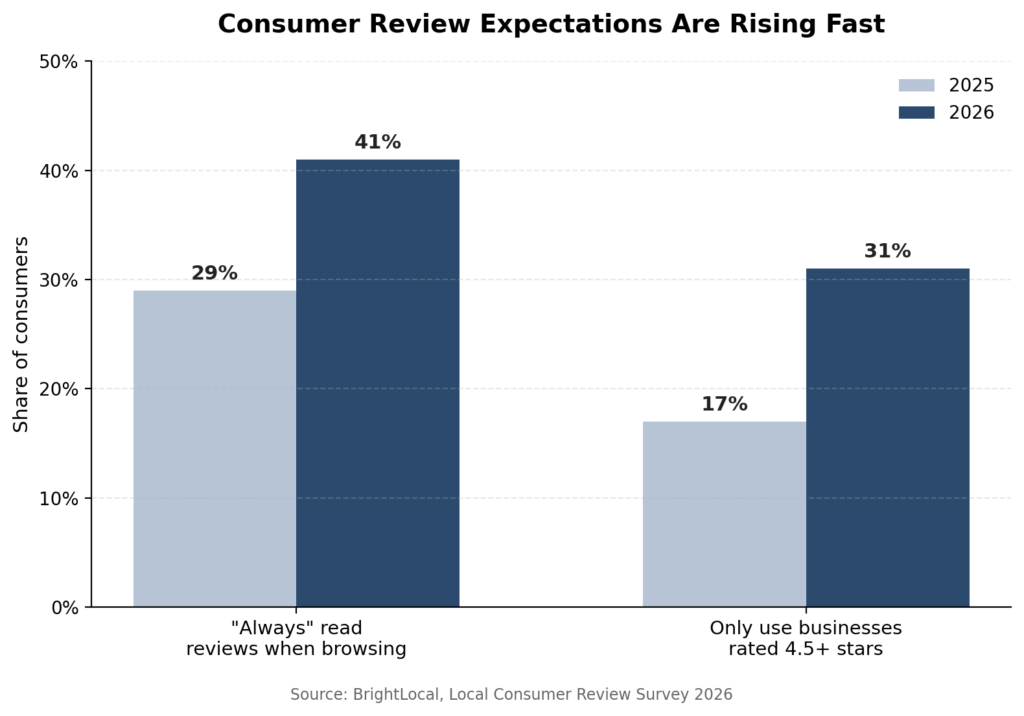
The numbers make the case clearly. According to BrightLocal’s Local Consumer Review Survey 2026, 97% of consumers now read online reviews when researching a local business, and 41% say they “always” read reviews when browsing, up from just 29% the year before. The same research found that 31% of consumers will only consider a business rated 4.5 stars or higher, a sharp jump from 17% the prior year, while 92% say star ratings factor directly into their buying decision.
There is indeed a monetary implication to this behavioral trend among consumers. Organizations that have improved their reviews and ratings have definitely benefited in terms of increased sales and opportunities, whereas those organizations that lack reviews and ratings altogether or those that have negative reviews are simply filtered out long before the potential customer even picks up the phone. In other words, your Google presence will determine whether or not you get chosen as a vendor.
How Google Actually Ranks Local Businesses
To manage a reputation on Google effectively, it helps to understand how Google decides which businesses to show in the first place. According to Google’s own Business Profile Help documentation, local search results are based primarily on three factors: relevance, distance, and prominence.
Relevance refers to how relevant the business profile is to what the individual is looking for. Distance refers to the closeness of the business to the individual. The third criterion, prominence, is the reputation of the business. It is clearly stated by Google that “More reviews and positive ratings can help your business’s local ranking.” The statement makes reputation management and local search engine optimization interdependent. This is because reviews are important as trust signals for customers as well as ranking factors for Google.
The Core Pieces of a Google Reputation Management Strategy
1. A Fully Optimized Google Business Profile
Your Google Business Profile serves as the basis of everything else that you do. Proper categorization, correct operating hours, a thorough business description, and updating your pictures are all factors that contribute to the ranking system used by Google.
2. Consistent Review Generation
A few reviews collected a couple of years back will not suffice. Both the consumer and Google impose a discount on old reviews, and therefore, consistent new reviews are more valuable than a one-time effort to solicit them. Neither is it about scoring perfection; a large number of mostly positive reviews, which also contains some negative ones, would appear more credible than a few flawless ones
3. Responding to Every Review
Answering reviews, whether they are good or bad, is a way for the company to show that it is active. It is worth noting that a good answer to a bad review might prove even more effective in establishing trust between the business and future customers than the bad review itself was in spoiling the relationship.
4. Monitoring Your Broader Search Presence
Google reputation management extends far past just your Business Profile. Google reputation management also entails the information that will pop up when you search for your business or executive names through Google. Creating such an automatic process allows you to identify any issues before they develop into anything large enough to influence your first page ranking.
5. Publishing Fresh, Authoritative Content
Companies which continuously put out good content and get credible mentions about themselves on other websites will have an easier time managing their first page of search results, where they can make sure to push everything old or negative to the bottom.
Handling Negative Reviews the Right Way
Negative reviews will come eventually, but they aren’t always bad by themselves. It’s all about what you do with them. Professionalism, no defensiveness, and taking the discussion behind closed doors keeps the harm to a minimum. For reviews which break the rules of a website, such as those which include hate speech, spam, or anything else fake, there is an official process for getting them taken down, though the proper course for negative reviews of something that actually happened is to deal with them. When a business isn’t sure whether a review crosses that line, this is exactly the kind of judgment call TheBestReputation helps clients work through.
Measuring What’s Working

An analyst uses a computer and dashboard for data business analysis and Data Management System with KPI and metrics connected to the database for technology finance, operations, sales
By CL STOCK
The Google reputation management campaign needs to be measured in the same way as any other growth strategy. In order to measure the success or otherwise of your campaign, you need to look at the trajectory of star ratings over time, review velocity, the speed of your responses, and finally the keyword and content that comes up when people search for your business name.
The Bottom Line
Reputation management with Google is not a one-time project; it’s an ongoing practice that involves aspects such as local SEO, customer experience, and reputation management altogether. With AI-powered search engines analyzing and summarizing information about reviews and reputation even before the customer clicks through to your site, companies that realize that their Google profile is a tool to be managed and not just an addition are those that will continue to win the customers searching for their products. It’s the same philosophy TheBestReputation brings to every business it works with.

