SEO for Reputation Management: The Complete Playbook
You're staring at page one again, and the same problem keeps showing up. A negative review, an old complaint, a weak directory listing, maybe an unhelpful article you didn't ask for. Before a buyer calls, before an investor replies, before a hiring manager clicks, search has already started writing the story for you.
That's why SEO for reputation management has become its own discipline inside Online Reputation Management. Search results aren't just traffic sources anymore, they're the first screen people use to decide whether you're credible, safe, or worth a second look. The work is less about vanity and more about control, the kind that affects conversations, conversions, and confidence.
Table of Contents
- Why Your Search Results Are Your Real Business Card
- Running a Query-by-Query SERP Audit
- Building Authority Assets That Actually Rank
- Scaling Local and Multi-Location Reputation Governance
- Preparing for AI Search and Answer Engines
- Measuring What Matters and Responding to Crises
- Your Prioritized Action Plan for Reputation Control
Why Your Search Results Are Your Real Business Card
A founder searches her own name five minutes before a board meeting and sees a complaint thread, an outdated bio, and a low-quality article from years ago. Nothing on that page is technically a crisis on its own, but the collection does exactly what bad search results are supposed to do, it creates doubt before she enters the room.
That's the reality behind search engine reputation management. Search results have become a first-impression layer for customers, partners, employers, and investors, which is why reputation work can't sit inside PR alone. When page one controls trust, SEO controls what people believe first, and the economic stakes are easy to understand once you look at click behavior and review habits.
Industry summaries citing BrightLocal-style consumer research say 97% to 98% of consumers read online reviews for local businesses before buying, and Google is the primary review and search platform for most shoppers, according to the research summarized in the brief. The same body of research repeatedly associates a one-star rating increase with a 5% to 9% revenue lift electroiq.com. That's not a branding vanity metric, it's a business signal.
Practical rule: if the first page of branded search looks uncertain, people assume the company is uncertain.
The shift happened because review sites, maps, and search results became the new front door. A bad headline, a stale profile, or an unanswered review can carry more weight than a polished homepage because it appears before someone ever reaches your site. That's why serious teams treat branded search as a managed asset, not a passive outcome.
For a broader framing of how Google shapes perception, see this explanation of what Google shows about you. It's the same core idea, search doesn't just reflect reputation, it helps decide it.
Running a Query-by-Query SERP Audit
A reputation campaign starts by mapping the exact searches that matter, not by publishing content and hoping it lands. The branded query set usually includes the company name, founder or CEO name, product names, and high-intent modifiers like reviews, scam, pricing, and customer service. Those are the searches where people form a judgment, so those are the searches that deserve the most scrutiny.
Classify every result before you touch content
The cleanest workflow is simple. Search each query on desktop and mobile, then review the first two pages and tag every result as owned, earned, or third-party. After that, label each listing positive, neutral, or negative.
That classification tells you what you're up against. A homepage might rank, but if page one also contains a complaint forum, a review profile, and a stale directory listing, the brand still doesn't control the narrative. A query-level map makes that obvious before budget gets wasted on broad content that doesn't displace the harmful URLs competing for attention.
Search audits work best when they're treated like an information architecture project, not a content brainstorm.
Here's the practical sequence I use in campaigns:
- List the money queries. Start with the exact branded terms people type when they're deciding.
- Capture page-one and page-two results. If you only inspect the first page, you miss the competing ecosystem.
- Separate desktop from mobile. The result mix can differ materially, especially in local and review-heavy searches.
- Mark sentiment. A neutral PDF, a positive profile, and a negative article all need different responses.
- Decide the move. Optimize an existing asset, expand coverage, or create a new page to occupy the query.
The technical benchmark isn't just rank movement. It's control density on page one, meaning how many of the visible results are owned or favorable. For a deeper look at ranking mechanics, this overview of how Google ranks content is useful context.
Building Authority Assets That Actually Rank
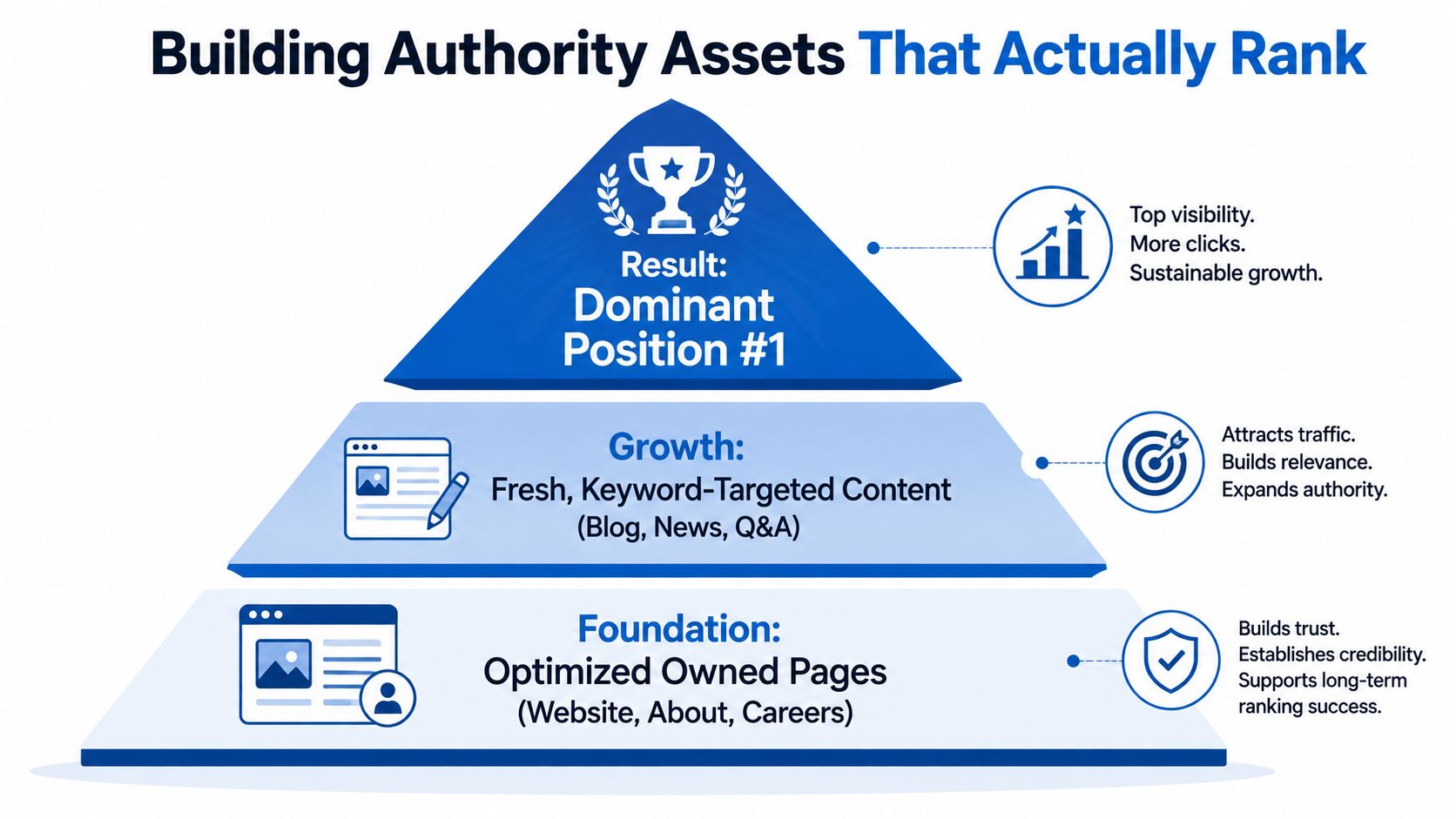
Once the SERP audit is mapped, the goal is no longer “publish something positive.” The goal is to build assets with enough authority to compete with what's already ranking. Thin pages almost never do that job well, especially when a negative article already has links, age, or search demand behind it.
Build a portfolio, not a single page
The strongest reputation campaigns use a mix of optimized owned pages, fresh content, executive profiles, video assets, and digital PR placements. That mix matters because branded SERPs are rarely single-format. A query can surface a website result, a LinkedIn profile, a news mention, a YouTube video, and a review page at the same time, so a single page rarely displaces every competing result by itself.
Asset diversification beats one-off suppression. Owned pages can anchor the brand story, earned media can add third-party credibility, and profile pages can occupy adjacent real estate that searchers see. If the result set includes multiple negative or neutral listings, you need multiple favorable assets to crowd them out.
A workable pattern looks like this:
- Owned pages: About, leadership bios, service pages, FAQ, and reputation-friendly landing pages.
- Earned placements: bylines, news mentions, interview coverage, and industry commentary.
- Profiles and video: LinkedIn, YouTube, podcast clips, and other properties that can rank for the brand.
- Backlink support: links that help favorable pages gain the authority needed to outrank entrenched results.
The trade-off is speed versus durability. Social profiles can move quickly, but they don't always hold rankings. Thin positive content can be easy to publish, but it often fails when the SERP gets competitive. The pages that stick usually have substance, internal support, and external links.
For some brands, that means using a service partner to coordinate content and reporting. TheBestReputation is one option that combines SEO audits, content work, media placements, and monitoring in one workflow, which fits campaigns that need coordinated page control rather than isolated blog publishing.
Scaling Local and Multi-Location Reputation Governance
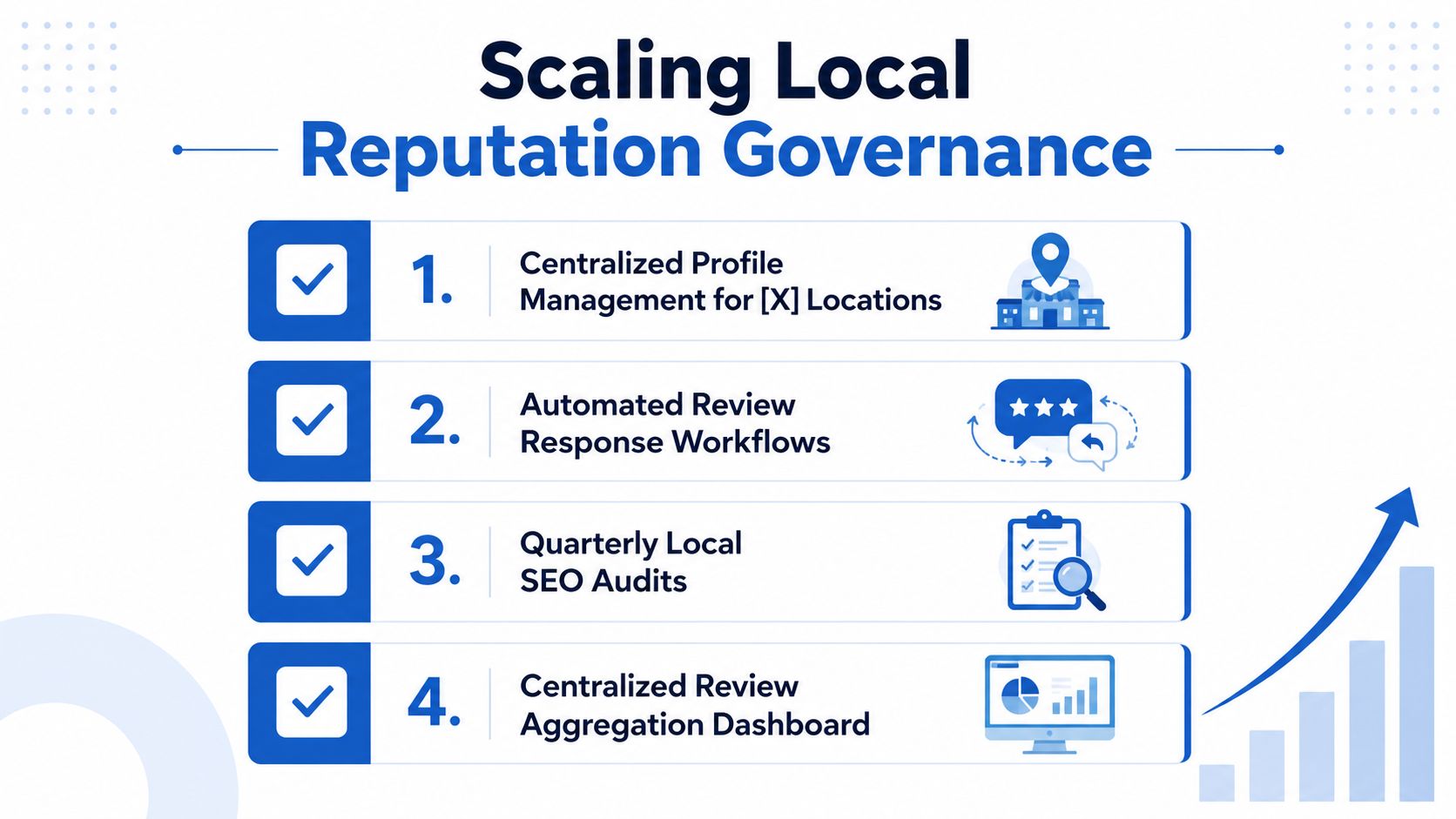
Local reputation work gets messy fast when one brand has dozens of locations and each location has its own reviews, citations, and listings history. The hard part isn't knowing that reviews matter, it's keeping the signal clean across every place a customer can verify the business. One bad profile or one stale directory listing can dominate a branded local query even when the main corporate site is strong.
NAP consistency is the baseline, not the finish line
NAP means Name, Address, and Phone, and it has to match across Google Business Profile, Maps, Apple Maps, Bing, and niche directories. That consistency matters because search systems use it as a trust signal, and users use it to decide whether a business is real, current, and reachable. If the same location appears under slightly different data across platforms, the local signal gets weaker.
The right operational model treats every location as part of a governed system. That includes review monitoring, response workflows, citation accuracy checks, and page updates for each branch or office. It also means someone has to own the process, because “ask the local manager to handle it” usually creates drift.
Review governance needs cadence
Strong local programs don't just collect reviews, they manage the response pattern. Negative feedback needs a consistent reply standard, because silence can hurt trust even if rankings stay flat. Review response quality also affects how a location looks when searchers compare options side by side.
Alchemer's guidance ties local reputation SEO to monitoring reviews, updating listings, publishing local content, responding to feedback, and investing in citation accuracy Alchemer guide. Surfer SEO's guidance is even more operational, emphasizing NAP consistency and review response as concrete mechanics for local visibility Surfer SEO guide. That's the right lens, local reputation is a governance problem with search implications.
The location page and the review profile have to tell the same story, or searchers notice the gap before the brand does.
For teams managing multiple branches, this local SEO reference from TheBestReputation is a practical reminder that the corporate brand can't outpace bad local signals if the underlying location data is fragmented.
Preparing for AI Search and Answer Engines
Traditional page-one management still matters, but it's no longer the full picture. Google AI Overviews, ChatGPT, and Perplexity are now discovery surfaces, and they can compress the first impression into a short answer that users read before they click anything. That changes the work from “rank a page” to “be a source the model trusts.”
Source authority now sits beside SERP visibility
The core risk is simple. A brand may rank acceptably in classic search while AI systems pull from a narrower, different set of sources. If the wrong article, profile, or summary is being cited, the first impression can be distorted even when traditional SEO looks stable.
That's why entity consistency and citation quality matter so much. Search teams need to know which sources AI systems mention, how they summarize the brand, and whether the same factual identity appears across the web. This is especially sensitive for legal, healthcare, finance, and executive-name queries, where a short answer can shape trust immediately.
A useful operational habit is to audit both the source set and the language used in AI summaries. If the same incorrect claim keeps surfacing, classic suppression alone won't solve it. The response has to include stronger source pages, cleaner entity data, and a tighter set of corroborating references.
For a practical way to pressure-test synthetic copy and summaries, AI Video Detector's guide to detect AI generated content is a helpful reference point. It's not a reputation playbook by itself, but it reinforces the broader issue, brands now have to understand how machine-generated material behaves before it gets treated like fact.
The monitoring model has changed
The old assumption breaks here. Ranking well in classic search may not be enough if the answer engine is summarizing a different source ecosystem. The next step for mature reputation teams is monitoring not just the SERP, but the citations and summaries that sit above or beside it.
This practical playbook for ranking in AI search fits that mindset well. It treats visibility as a source problem, not just a placement problem.
Measuring What Matters and Responding to Crises
Reputation SEO gets easier to manage once the metrics are tied to action. The wrong dashboard tracks impressions without telling you whether the brand is safer in search. The right one tracks whether favorable assets are taking space from negative results and whether the operating team can react fast enough when sentiment shifts.
Build a reporting rhythm, not a monthly ritual
Start with control density on page one, because that tells you how much of the visible result set you own. Add branded search impressions, click-through rate, review velocity, and sentiment trends, then review them on a weekly cadence for active campaigns. If the issue is local or executive reputation, weekly is usually the minimum pace that keeps you from reacting too late.
The key movement to watch is whether favorable assets climb from page two to page one, then into the top three. Those jumps matter because they change what most searchers see first. If an asset moves but still sits buried below the fold, it hasn't done the reputational job yet.
A simple crisis checklist helps teams stay calm under pressure:
- Detect early: watch branded queries, review patterns, and sudden sentiment swings.
- Align the response: decide who approves messaging before the first reply goes live.
- Stabilize the search set: reinforce favorable owned and earned assets while the issue is active.
- Escalate when needed: if removal or de-indexing is feasible, route it through the proper process.
For difficult scenarios, scenario planning can help teams avoid overreacting to one bad result or underreacting to a real escalation. PlotStudio AI's guide to choosing scenarios under uncertainty is useful for that kind of structured thinking.
The best crisis response is usually the one that already exists before the story breaks.
The operational shift is important. Reputation SEO isn't a quarterly content project, it's an ongoing monitoring and response function. Teams that treat it like operations, not marketing theater, recover faster and waste less time guessing.
Your Prioritized Action Plan for Reputation Control
Start with the fastest fixes, because the obvious gaps cause the most avoidable damage. Claim unowned profiles, repair NAP inconsistencies, and clean up any location or executive listings that are incomplete or outdated. Those changes won't solve everything, but they remove the easiest weak points.
Next, build the assets that can outrank what's hurting you. Strengthen owned pages, publish query-targeted content, support the pages with relevant links, and add earned media where the SERP needs third-party validation. If a negative result is holding position because it has authority, the response has to be stronger than a polite blog post.
Then put governance around the whole system. Set weekly monitoring, define response ownership, and keep a crisis path ready for sudden reputation spikes. If the brand is already stable, the job is mostly defensive. If the brand is damaged, the job is displacement and corroboration.
Search has become the place where credibility gets tested first, so the work has to be deliberate. If you want a team that handles SEO audits, content governance, media placement, and reputation workflows together, visit TheBestReputation and see how those pieces fit into a single reputation control program.

