
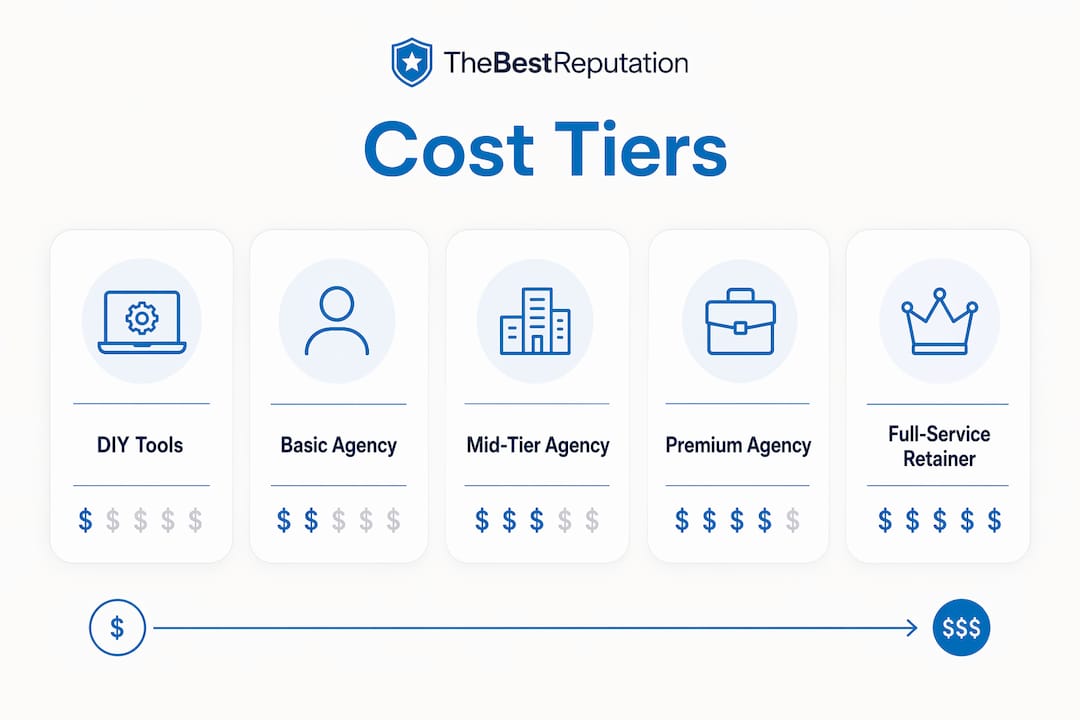
Reputation management in the U.S. typically costs between $500 and $10,000+ per month for managed agency services, with entry-level DIY tools running $0–$400/month. Your best immediate next step: request an itemized quote that separates platform licensing from professional service fees before committing to any contract.
What each band generally buys:
- $0–$400/month: Software monitoring, automated alerts, basic review aggregation. No strategic intervention.
- $500–$2,000/month: Managed review response, basic content monitoring, monthly reporting for small or local businesses.
- $2,500–$7,500/month: Full ORM with content creation, SEO suppression, PR outreach, and dedicated account management for mid-market clients.
- $10,000+/month (and up to $5–$10 million/year): Bespoke reputation programs for global brands, public figures, and executives facing high-stakes crises.
The gap between a $49/month SaaS tool and a $5,000/month agency retainer is not just price. It is the difference between visibility and resolution.
Table of Contents
- How do reputation management agencies charge?
- What does each price tier actually include?
- What actually drives your reputation management cost up?
- How to estimate your own reputation management budget
- Red flags and how to choose the right agency
- What timelines and contract terms should you expect?
- A real-world example: hybrid PR + SEO in practice
- Key Takeaways
- Why pricing transparency is the real differentiator
- Thebestreputation offers itemized ORM programs at every tier
- Useful sources
How do reputation management agencies charge?
Understanding billing mechanics protects you from misaligned proposals. The five most common models:
- Hourly rate: Billed per hour of professional time. Hourly rates range from $100–$135/hour for basic monitoring and review management to $400–$500/hour for crisis-level advisory by elite firms. Best for discrete, time-limited projects.
- Monthly retainer: A fixed recurring fee covering an agreed scope of work. Most agency relationships run on retainers, typically with a 6–12 month minimum. Best for ongoing ORM, content programs, and multi-location management.
- Project/one-time fee: A flat fee for a defined deliverable, such as suppressing a single negative search result. One-time suppression projects commonly run $1,500–$15,000 depending on difficulty and the authority of the target URL.
- SaaS subscription: A per-location or per-seat software fee covering monitoring, alerts, and automated review tools. No strategic human intervention included.
- Per-incident or outcome-based: Less common; fees tied to specific outcomes (e.g., de-indexing a page). Approach with caution — guarantees to remove content are a red flag.
Which model fits which situation:
- Monitoring only → SaaS subscription ($0–$400/month)
- Isolated negative result → one-time project fee ($1,500–$15,000)
- Ongoing brand protection → monthly retainer ($500–$7,500+/month)
- Crisis response → hourly advisory or emergency retainer ($400–$500/hour)
What does each price tier actually include?
| Pricing Model | Typical Services | Best For | Price Range | Contract Length |
|---|---|---|---|---|
| SaaS/DIY monitoring | Alerts, review aggregation, basic dashboards | Solo operators, budget-conscious SMBs | $0–$400/month | Month-to-month |
| Entry managed retainer | Review response, monitoring, monthly report | Local/single-location small businesses | $500–$2,000/month | 6–12 months |
| Standard ORM retainer | Content creation, SEO suppression, review generation | Multi-location SMBs, professionals | $1,500–$3,000/month | 12 months |
| Full-service ORM | PR outreach, suppression campaigns, crisis prep | Mid-market brands, executives | $2,500–$7,500/month | 12 months |
| Crisis/executive | 24/7 advisory, legal coordination, media relations | Public figures, national brands | $10,000+/month | Custom |
Common add-ons that appear outside the base retainer:
- Content suppression burst: $1,500–$15,000 per project
- Legal coordination or takedown support: Billed separately, often hourly at senior rates
- Rapid-response SLA upgrades: Premium on top of standard retainer
- Generative AI and search monitoring: Increasingly offered as a separate module
Agencies reserve high-end PR, original content creation, and aggressive SEO tactics for retainers above $1,500–$3,000/month. Below that threshold, most managed services cover responses and alerts, not suppression or earned media.
<

What actually drives your reputation management cost up?
Price differences between proposals often come down to six factors, not agency markup.
- Severity and visibility of the issue: A single negative Yelp review costs far less to address than a Forbes article ranking on page one for your name. Higher-authority URLs require more senior labor and longer timelines.
- Review volume and platform count: Managing 50 reviews/month across Google, Yelp, and Healthgrades costs more than monitoring one platform with 10 reviews.
- Multi-location scope: Each additional location adds monitoring, reporting, and response workload. Most platforms price per location.
- Legal or PR complexity: Content that requires a legal takedown, DMCA filing, or media relations outreach pulls in senior specialists at premium hourly rates.
- Speed and response SLAs: Crisis-level 24/7 availability commands a significant premium over standard business-hours coverage.
- Content production volume: Monthly article creation, press releases, and thought leadership pieces each add hours and cost.
Pro Tip: Ask every agency to provide a line-item breakdown separating platform licensing fees from professional service hours. Bundled quotes routinely obscure whether you are paying for a software seat or for a strategist’s time. The two are not interchangeable.
How to estimate your own reputation management budget
Work through these five steps before contacting any agency.
- Define your scope. Single location or multiple? Individual executive or corporate brand? A solo professional with one negative article has a narrower scope than a 10-location franchise with a 3.1-star average.
- Assess severity. Count the number of negative page-one results for your primary search terms. One result at position 8 is a monitoring issue. Three results in positions 1–4 is a suppression campaign.
- Choose a service tier. Match your severity assessment to the tier table above. If you have active page-one damage, budget for standard ORM at minimum ($1,500–$3,000/month).
- Add contingency for one-time work. If content removal or legal coordination is likely, add $3,000–$10,000 to your first-year budget as a contingency line.
- Calculate a 6–12 month total. Reputation repair rarely produces full results in under 90 days. Budget for at least six months of retainer plus any one-time project fees.
Inputs to prepare before requesting quotes:
- Current average star rating and monthly review volume by platform
- Number of page-one negative links for your primary branded keywords
- Any prior legal exposure or media coverage related to the issue
- Target keywords you want to own in search results
- Whether you need PR/media outreach or SEO suppression only
Example budgets:
Small local business (single location, 3.8-star average, one negative review site ranking page one): Standard ORM retainer at $1,500/month for 12 months = $18,000, plus a one-time suppression project at $3,000. Total first-year budget: approximately $21,000.
Executive (individual, two negative news articles in positions 1–3): Full-service retainer at $5,000/month for 12 months = $60,000, with PR outreach and content production included. Measuring the ROI against lost business development opportunities typically justifies this spend within the first two quarters.
Before committing, calculate what a damaged reputation is already costing you in lost conversions or client fees. The management fee often looks different once you quantify the baseline loss.
Red flags and how to choose the right agency
Not all proposals reflect equal value. Watch for these warning signs:
- ❌ Guaranteed content removal. No agency can guarantee de-indexing or removal from third-party platforms. Any firm that does is misrepresenting the process.
- ❌ Unusually low retainers for aggressive suppression. Suppression campaigns below $1,000/month rarely include the content production or PR outreach needed to move page-one results.
- ❌ Bundled pricing with no itemization. If a proposal cannot separate platform costs from professional fees, you cannot evaluate what you are actually buying.
- ❌ No measurable KPIs or deliverables. Vague promises about “improving your reputation” without defined metrics (ranking positions, review volume, sentiment scores) are not a contract.
Positive selection criteria:
- ✅ Itemized proposals with clear labor and platform line items
- ✅ Hybrid PR + SEO capability (not just one or the other)
- ✅ Defined SLAs for reporting cadence and crisis escalation
- ✅ References or verifiable case results
- ✅ Staged payment tied to milestones for larger projects
When comparing proposals, use the same dimensions: pricing model, services included, who the agency typically serves, price range, and contract length. A strong selection framework treats these as non-negotiable inputs, not afterthoughts.
What timelines and contract terms should you expect?
Reputation management is not a one-month fix. Realistic time-to-impact windows by service level:
- Monitoring and alert setup: Operational within days.
- Review generation and response programs: Measurable rating improvement typically visible within 60–90 days.
- Content ranking shifts (SEO suppression): New content begins ranking in 60–180 days; meaningful page-one displacement often takes 6–9 months.
- Full suppression campaigns: 3–12 months for sustained results, depending on the authority of the negative content.
- Crisis response: Immediate containment possible within 24–72 hours; full narrative recovery takes months.
Standard contract terms to expect:
- Minimum retainer length: 6–12 months for most managed programs
- Notice period: typically 30–60 days before cancellation
- Reporting cadence: monthly for standard programs, weekly for crisis engagements
- Escalation SLA: defined response time for crisis events (often 4–24 hours)
Multi-location clients should expect reporting to scale with location count. A 10-location brand will receive location-level dashboards and consolidated reporting, which adds to both the deliverable volume and the fee. For crisis-level situations, contract terms often include a dedicated escalation contact and a defined rapid-response protocol.
A real-world example: hybrid PR + SEO in practice
Client profile: A regional professional services firm with offices in three states. The firm had two negative news articles ranking in positions 2 and 4 for its primary branded search term, a 3.6-star Google average across locations, and no existing ORM program.
Scope and approach: Thebestreputation deployed a hybrid PR + SEO program covering original thought leadership content, media placements in industry publications, review generation across all three locations, and active monitoring of generative AI search results. The engagement ran on a full-service retainer.
Timeline and results: Within 90 days, the firm’s average star rating improved. By month six, one of the two negative articles had been displaced from page one by newly ranked owned and earned content. By month nine, both articles had moved off page one for the primary branded term.
Key takeaway from this engagement: The hybrid methodology — combining earned media (PR) with SEO-optimized content — produced faster displacement than content alone. Neither tactic in isolation would have achieved the same result in the same timeframe.
When you contact any agency, request an itemized scope that specifies which deliverables address which problem. Thebestreputation’s hybrid PR + SEO approach is built around exactly that kind of transparent, deliverable-specific engagement.
Key Takeaways
Reputation management cost in the U.S. ranges from $0/month for DIY monitoring tools to $10,000+/month for full-service agency programs, with most small businesses landing between $1,500 and $3,000/month for meaningful managed ORM.
| Point | Details |
|---|---|
| Core price bands | DIY tools: $0–$400/month; managed agency retainers: $500–$10,000+/month depending on scope and severity. |
| One-time project fees | Suppression of a single negative result typically costs $1,500–$15,000 as a standalone project fee. |
| Biggest cost driver | Search result authority and severity of the issue determine team seniority, hours, and timeline more than any other factor. |
| Must-ask before signing | Request an itemized proposal separating platform licensing from professional service fees to evaluate true cost. |
| Thebestreputation | Offers hybrid PR + SEO programs across monitoring, standard ORM, and crisis tiers with itemized, deliverable-specific proposals. |
Why pricing transparency is the real differentiator
Most business owners come to reputation management after something has already gone wrong. By then, the pressure to act quickly can push them toward the first proposal that sounds credible, regardless of whether it is itemized or measurable. That is where the real cost risk lives.
What I find consistently underestimated is the value of a hybrid methodology. Agencies that operate in either PR or SEO alone tend to hit a ceiling. PR without SEO produces coverage that does not rank. SEO without PR produces content that lacks the authority signals needed to displace established negative results. The firms that move page-one results fastest are the ones that run both tracks simultaneously.
Thebestreputation’s ranking at No. 201 on the 2025 Inc. 5000 is not a vanity metric. It reflects the kind of sustained client results that generate referrals and compound growth. When evaluating any agency, compare itemized proposals and measurable KPIs first. Price is the last variable to weigh, not the first.
Thebestreputation offers itemized ORM programs at every tier
If the price bands in this guide describe your situation, Thebestreputation can scope a program that fits it precisely. From monitoring-only engagements to full suppression and crisis management, every proposal is itemized by deliverable so you know exactly what professional work you are paying for.
Thebestreputation’s managed reputation services cover the full spectrum: review generation and response, SEO suppression, PR and media outreach, and executive digital branding. The firm’s hybrid PR + SEO methodology is what separates a program that produces measurable page-one results from one that only monitors them. Request an itemized quote or a quick reputation audit directly at thebestreputation.com and get a clear scope before you commit to any contract.
Useful sources
- DesignRush: Reputation Management Cost Trends — Hourly rate tiers and service-type pricing ranges for U.S. agencies.
- Avita Group: Reputation Management Pricing — Market table with tiered monthly ranges and one-time project fee benchmarks.
- Onewrk: Reputation Management Agency Cost Guide — Guidance on itemized proposals and separating platform from professional fees.
- Scorixa: Online Reputation Management Cost — ROI framing and the case for calculating baseline reputation loss before budgeting.
- Everything-PR: What Reputation Management Costs — Full market spectrum from DIY tools to bespoke $10M/year programs.
- Thebestreputation: What Drives Reputation Management Pricing — Deep dive into the billing factors and cost drivers covered in this guide.

