Corporate Reputation Management Services in 2026
You’re preparing for a sales meeting when the prospect asks about an old lawsuit. Your team considers the matter closed, but a company-name search still puts the article ahead of your current work. A review profile tells another incomplete story, and an AI-generated summary blends yesterday’s allegation with today’s leadership. Corporate reputation management services address that information environment, not just the next press release.
The practical job is to identify what’s accurate, repair what’s wrong, resolve the conduct behind legitimate complaints, and make credible evidence easier to find. You can influence visibility and correct sources. You can’t buy control over independent publishers, search engines, or AI answers.
Table of Contents
- What Corporate Reputation Management Services Cover and When You Need Each
- Outcomes Worth Paying for and the Numbers Behind Them
- How a Program Runs from Audit to Monthly Proof
- Who Hires This Work and What Each Buyer Needs
- How to Choose a Firm and Which Promises to Reject
- Sample Engagements for the First Two Quarters
- Commission the Audit Before You Sign a Retainer
What Corporate Reputation Management Services Cover and When You Need Each
A company-name search can shape the meeting before anyone speaks. If prospects find an unexplained dispute, conflicting executive biographies, and unanswered complaints, your sales team starts by defending the business rather than discussing the buyer’s needs.
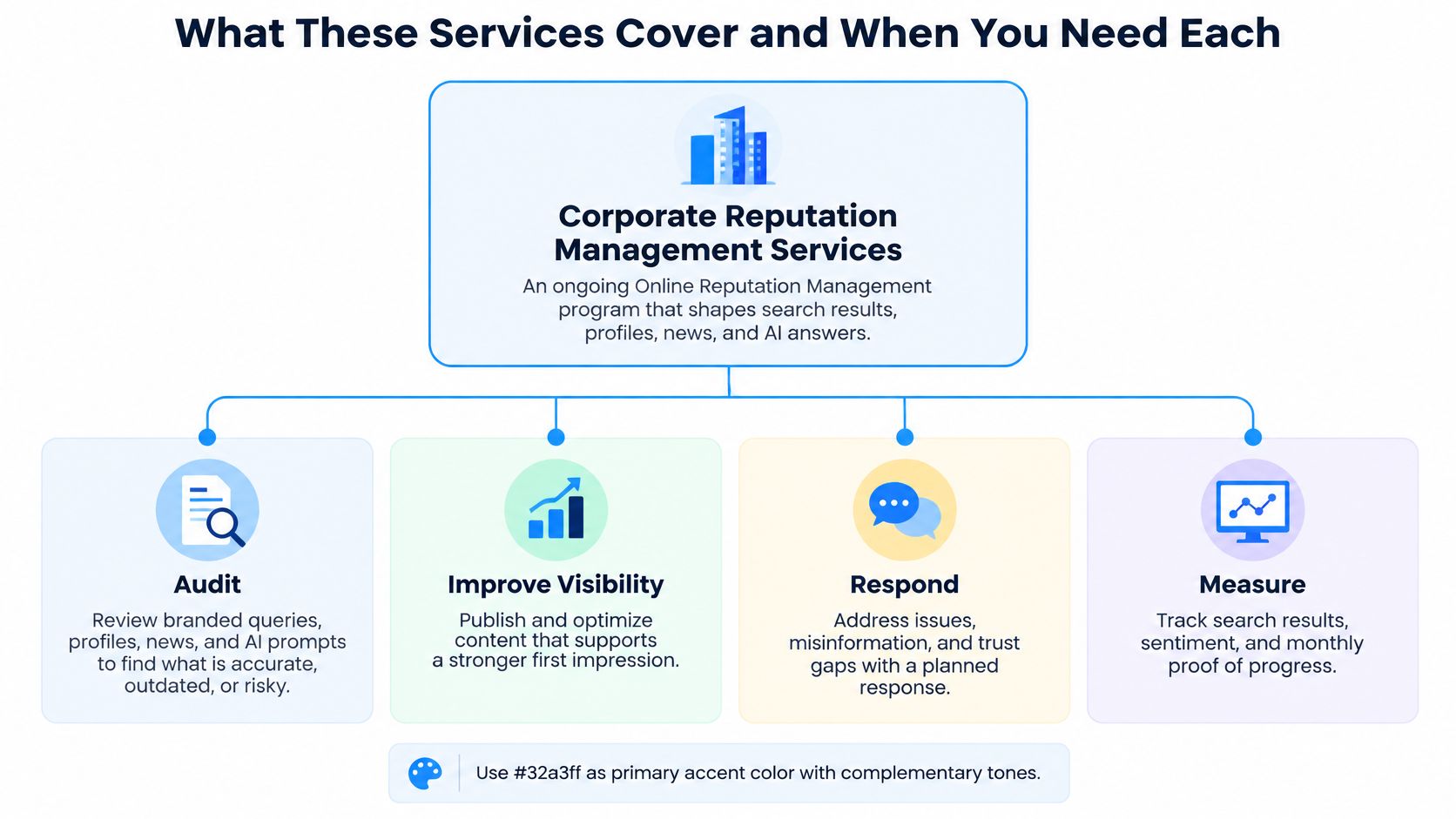
An ongoing Online Reputation Management program connects those problems instead of treating each channel as a separate campaign. Corporate reputation also depends on employee experiences, governance, and operational decisions. The digital program should represent those realities accurately, not manufacture a more convenient version.
Match the Service to the Actual Problem
Corporate reputation service lines, metrics, and triggers
| Service line | What the work covers | Primary metric | Start it when |
|---|---|---|---|
| SEO and SERP audit | Branded-query inventory, harmful URLs, content gaps, entity consistency | Share of favorable results on priority queries | Page one misrepresents the company or leadership |
| PR and thought leadership | Relevant media, bylines, executive profiles, third-party corroboration | Credible pickups and citations, not mention volume | Owned pages exist but independent sources don’t back them |
| Content governance | Owned explainers, corrections, profiles, and publishing standards | Accuracy, freshness, and usefulness of priority pages | Facts conflict across the site, bios, and filings |
| Review remediation | Policy-based disputes, responses, and authentic review velocity | Rating trend, response-time percentile, unresolved cases | A location or product rating is volatile or unfair under platform rules |
| Crisis response | Monitoring, holding statements, stakeholder messages, incident log | Time to first accurate statement and narrative drift | A safety, legal, labor, or viral event is live or likely |
| Reporting | Rankings, sentiment, media, reviews, and lead or location outcomes | Movement by dimension versus the audit baseline | Leadership needs proof beyond screenshots |
| Generative-AI monitoring | Prompt tests across models, citation sources, factual errors | Citation presence, accuracy, sentiment, geographic consistency | Assistants summarize the brand for buyers or journalists |
Start with the SEO and SERP audit. Record the exact query, search location, result URL, position, and assessment. Define favorable as accurate and relevant, not merely flattering, and preserve the baseline so later reports can’t cherry-pick improvements.
PR and thought leadership supply independent context that a company website can’t provide by itself. Pitch a genuine industry question and a qualified spokesperson. A relevant trade publication’s analysis is more useful than a syndicated announcement nobody in your buying audience reads.
Content governance keeps those claims consistent. Assign owners to executive profiles, company facts, product explanations, and dispute updates. RedactAI’s guide to strengthen your online reputation in 2025 offers a useful starting checklist for organizing this maintenance work, rather than treating reputation as an occasional cleanup.
Review remediation combines customer recovery with evidence-based platform disputes. A harsh account of a real experience calls for investigation and response, not an automatic removal request.
Connect Response With Accountability
Crisis response needs named decision-makers, approval routes, and a holding statement that distinguishes confirmed facts from unanswered questions. Message control means controlling your own accuracy and coordination, not preventing legitimate scrutiny.
Reporting should connect each workstream to its intended change. Publishing activity isn’t proof of improved reputation; neither is a screenshot showing an isolated ranking gain.
Generative-AI monitoring checks whether assistants identify the right company, distinguish allegations from findings, and cite current sources. Keep the underlying answer and citations, not just a sentiment label.
Practical rule: Start with the audit unless an active incident requires immediate crisis coordination.
Outcomes Worth Paying for and the Numbers Behind Them
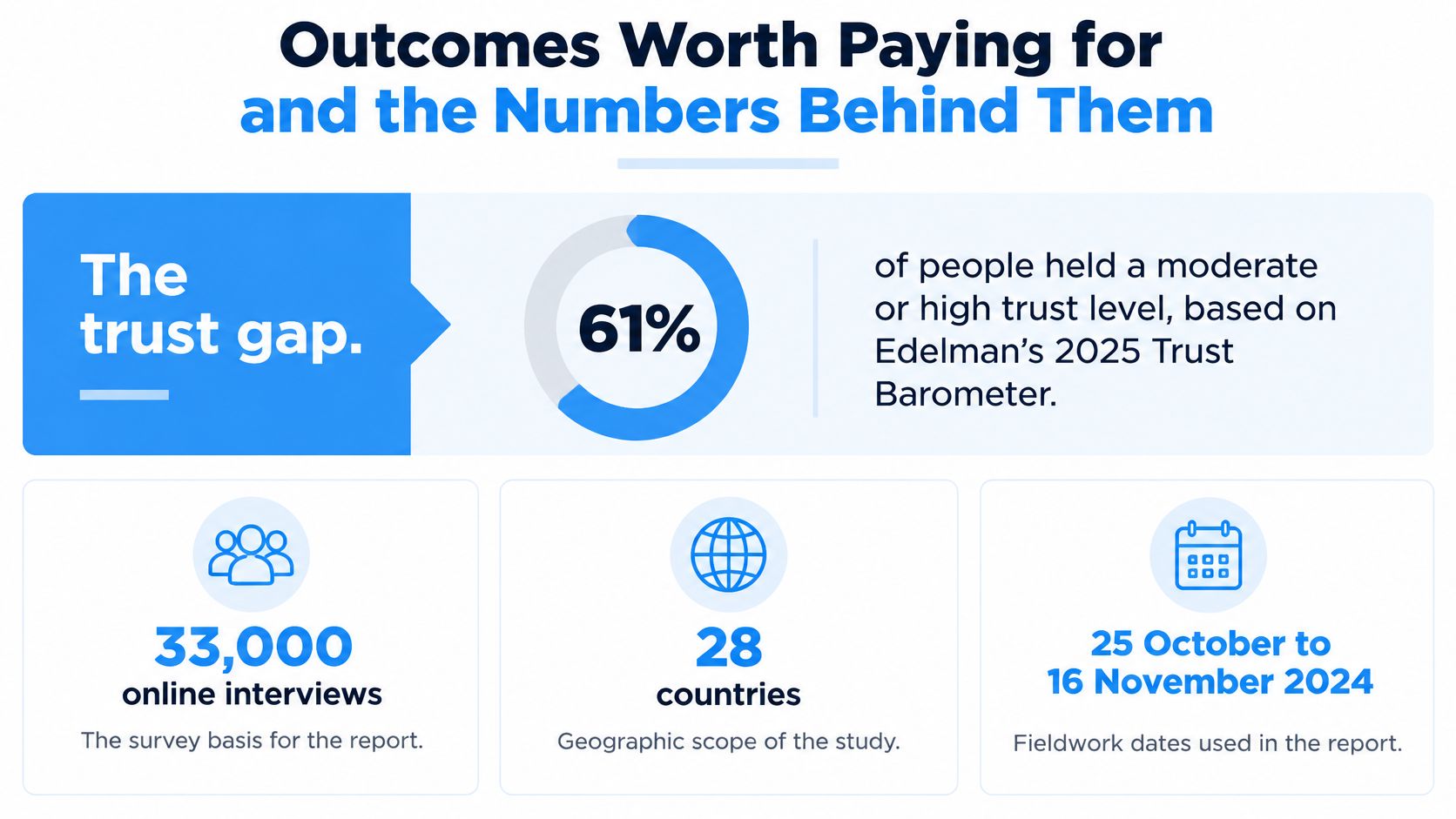
A company can rank well and still face a trust problem. Edelman’s 2025 Trust Barometer, based on 33,000 online interviews across 28 countries conducted October 25 to November 16, 2024, found that 61% of people globally had a moderate or high sense of grievance. Business was the most trusted institution in 15 of those 28 countries. Among respondents with high grievance, business scored 81 points lower on ethics and 37 points lower on competence than among those with low grievance.
These findings point to a practical limit: favorable copy cannot resolve the conduct behind a grievance. If customers struggle to obtain refunds while a company publishes claims about accountability, the mismatch gives skeptical audiences a reason to question those claims.
Reviews Connect Perception With Buying Intent
In a quantitative study of 180 respondents, positive reviews increased trust (β = 0.52), negative reviews reduced purchase intention (β = -0.48), and ratings correlated with trust (r = 0.65). Reviews and ratings explained 62% of the variance in purchase decisions in that study. Those relationships describe the study’s respondents, not a guaranteed revenue lift for a company.
An experiment involving 470 participants published in the Journal of Computer-Mediated Communication found that positive and negative review valence moved purchase intention in the same direction, with audience expertise moderating the effect. The practical implication is to match proof to the audience: procurement specialists need evidence about implementation and risk; consumers need clear service expectations and credible customer experiences.
Define the Conditions for Pausing Promotion
Dashboard fields and the signal to pause promotion
| Dashboard field | What it measures | Pause promotion and fix operations when |
|---|---|---|
| Favorable-result share | Share of priority branded queries with accurate, favorable page-one results | Share falls across two reporting cycles |
| Sentiment by position | Sentiment of results ranked first through tenth on priority queries | Negative results rise into the top three positions |
| Media quality | Independent, relevant pickups compared with raw mention volume | Coverage comes only from low-relevance outlets |
| Response-time percentiles | Distribution of time from complaint receipt to substantive response | Slower cases breach the agreed response commitment |
| Unresolved complaints | Open complaints by location and age | Backlog grows month over month |
| Repeat incidents | Same issue recurring after a documented fix | Any recurrence after a fix is logged as complete |
| Leads or bookings by location | Customer outcomes tied to reputation work at each site | Outcomes decline while rankings improve |
These are proposed operating triggers, not industry benchmarks. A falling visibility measure calls for diagnosis. A recurring service failure calls for pausing promotion until the responsible team addresses it.
Use client success metrics for reputation programs to connect visibility with business outcomes without attributing every booking to reputation work. For executive publishing, a comparison of LinkedIn analytics tools can help identify supporting measurements. Engagement counts alone do not establish qualified inquiries or independent corroboration.
How a Program Runs from Audit to Monthly Proof
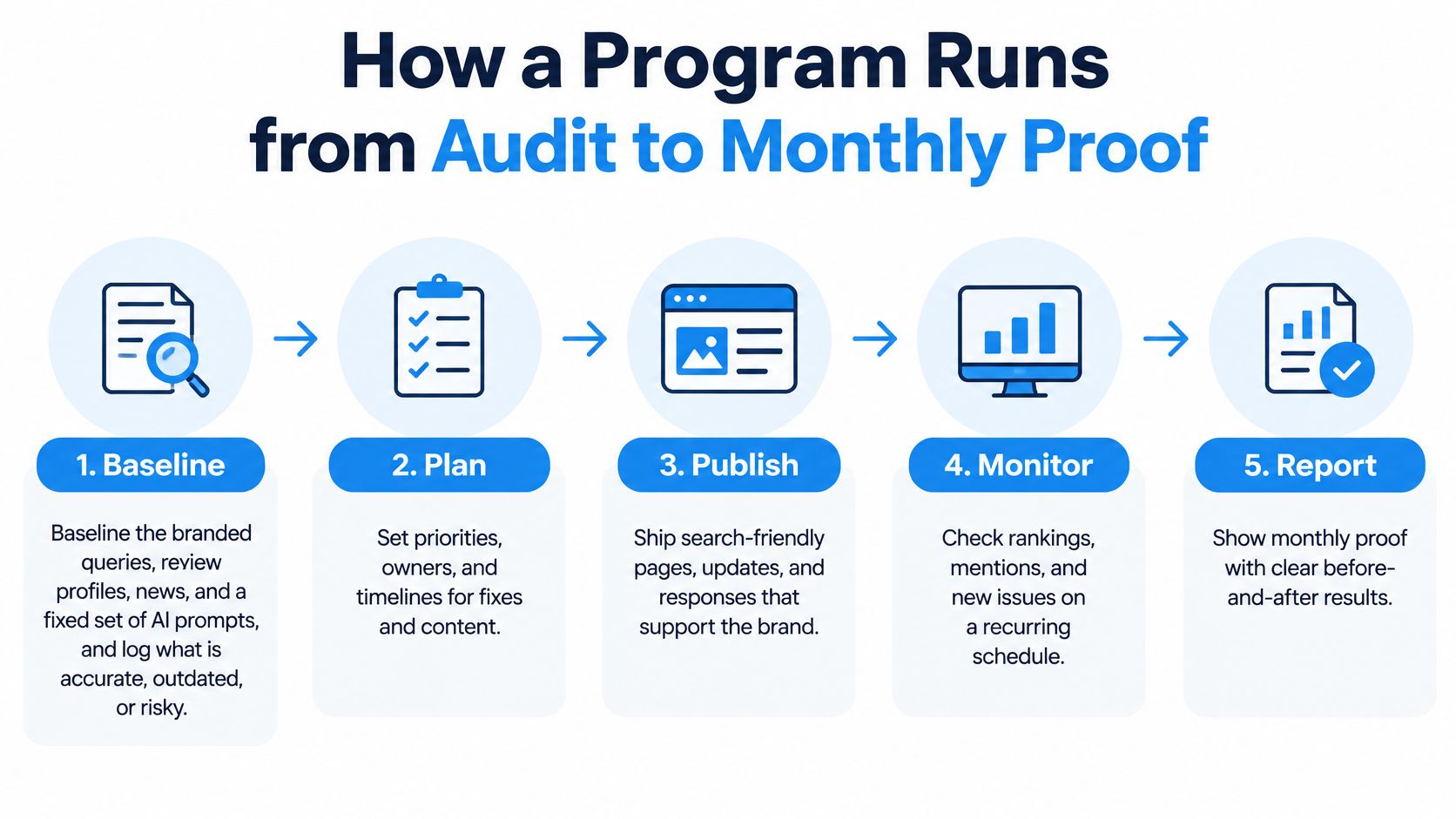
A workable program needs an issue register, accountable owners, and repeatable tests. A shared spreadsheet can establish the process before you invest in a more elaborate dashboard.
Establish Evidence Before Publishing
-
Baseline the discovery environment. Inventory branded queries, review profiles, news, and a fixed AI prompt set. Edelman’s 2025 brand-trust findings report that 55% of people use generative-AI platforms, and 91% of those users use them for shopping-related activities. Save answers, citations, dates, and test settings so factual accuracy and favorable-result share have a defensible starting point.
-
Segment the issues. Tag each item by brand, location, product, executive, and topic. A billing complaint belongs with the team that can resolve the account; an allegation about governance needs legal and communications review. Measure unresolved complaints and repeat incidents at the level where someone can act.
-
Assign a remedy and an owner. Choose between operational correction, a sourced explanation, earned coverage, a documented platform request, or no intervention. Keep unfavorable but accurate criticism in the register rather than relabeling it misinformation. Track whether the agreed remedy resolves the issue, not merely whether someone completed a task.
Publish, Respond, and Retest
-
Build pages that answer the query. Publish clear explanations, dated updates, relevant evidence, and identifiable authors. Google’s page-experience guidance supports a helpful, reliable, people-first approach and clarifies that search-quality raters don’t directly control rankings. Judge priority pages on usefulness and accuracy alongside search visibility, rather than producing thin pages to occupy result slots.
-
Route review responses by severity and reach. Escalate safety allegations, privacy concerns, and unresolved cases before routine comments. Give frontline staff approved boundaries, not scripts that promise outcomes they can’t authorize. Record the policy basis for every removal request and measure response-time percentiles alongside complaint closure.
-
Retest under documented conditions. Repeat search checks and AI prompts on a fixed schedule. Record model, date, location, language, prompt wording, and available browsing settings because outputs can differ across those conditions. Score citation presence, factual accuracy, source quality, sentiment, uncertainty, and geographic consistency, then report changes against the baseline.
A citation isn’t proof that an assistant interpreted a source correctly. Review the passage behind the citation and distinguish a factual error from a reasonable, unfavorable summary.
Durable AI visibility comes from current, consistent, independently corroborated sources. A service provider can improve that evidence environment, but it can’t force an assistant to follow a script.
Who Hires This Work and What Each Buyer Needs
A small or midsize owner often arrives after a harsh article or cluster of complaints becomes a recurring sales objection. The useful assignment is narrow: identify the queries prospects search, correct the highest-risk gaps, and give staff a reliable way to handle feedback. A broad executive thought-leadership campaign may be premature.
An enterprise communications team may already have strong media relationships but no shared ownership of search results, executive profiles, and review escalation. Its job is coordination: connect legal, customer experience, investor relations, and publishing approvals around the same factual record.
Different Buyers Need Different Evidence
- Founders and public figures: A prospective partner searches the founder’s name and finds material about a former business. Separate the personal-name inventory from company queries, clarify dates and affiliations, and use CEO reputation management planning for leadership-specific risks.
- Multi-location operators: A regional manager sees healthy averages while an individual branch struggles. Report listing accuracy, feedback patterns, and unresolved cases by site. BrightLocal’s 2025 Local Consumer Review Survey concerns U.S. local-business review behavior, so don’t treat its audience as a universal proxy for every market.
- Legal, healthcare, and finance teams: A complaint may involve confidential information or a public regulatory record. Use compliance-aware copy and private case handling without confirming protected details in a public response. Accurate public records require context, not a promise of suppression.
Crisis readiness is another purchasing reason. In Cision’s survey of PR agencies and in-house teams, only 29% of public-relations and communications professionals in 2024 felt strongly about their ability to respond to a crisis.
Before an incident: Put approval authority, backup contacts, and a holding-statement process in the engagement, not on a future wish list.
A page-one news problem needs an evidence and visibility plan that addresses the story’s actual substance. A sliding location rating needs branch-level investigation and customer recovery. A leadership transition needs accurate biographies and clear organizational facts before stakeholders start searching.
How to Choose a Firm and Which Promises to Reject
Take the sales conversation beyond deliverable counts. Ask the firm to explain which query matters, which source currently influences it, what intervention is justified, and what evidence would show progress.
A coordinated provider should put SEO and media relations on the same brief. Otherwise, the PR team may secure coverage unrelated to the search problem while the SEO team publishes pages that lack independent support.
Use These Tests During the Sales Call
Vendor tests and disqualifying promises
| Test | What good looks like | Red flag |
|---|---|---|
| Scope | SEO, PR, content, reviews, and crisis on one brief | Unrelated retainers that never share targets |
| Audit | Written baseline of queries, sources, reviews, and AI answers before a retainer | A price with no inventory of the problem |
| Removals | Documented, policy-based requests and willingness to leave accurate criticism | Guaranteed deletion of lawful news or reviews |
| Reviews | Responses, operational fixes, authentic feedback, and compliance with the FTC rule described below | Paid or fake sentiment, sentiment-conditioned incentives, or threats to reviewers |
| Reporting | Favorable-result share, source quality, response time, unresolved cases | Rank screenshots and mention counts only |
| AI answers | Prompt log, citations, and corrections to source facts | A claim to control assistants |
| Crisis | Named roles, holding statements, and a response-time commitment | An undefined promise to post if something happens |
| Price | Itemized quote tied to query count, locations, and monitoring frequency | A flat guarantee of results regardless of scope |
The FTC’s Consumer Reviews and Testimonials Rule, effective October 21, 2024, prohibits fake reviews, incentives conditioned on positive or negative sentiment, and specified coercive review-suppression tactics, including unfounded legal threats and intimidation. Courts can impose civil penalties for knowing violations, so the review row is a compliance test, not merely a preference about tone.
Removal eligibility also needs careful wording. Being old or unfavorable doesn’t automatically make an item removable. Ask the provider to identify the specific publisher process, platform policy, or legal basis and explain the difference between removing a source page and de-indexing a search result.
Reject Activity That Masquerades as Evidence
Google’s Reviews System rewards insightful first-party review analysis and doesn’t evaluate third-party user reviews in a product or service page’s review section. Publishing short promotional summaries is therefore not the same mechanism as improving customer-review profiles.
For a U.S. integrated option, assess this reputation management agency against the same criteria as a specialist SEO consultancy or PR firm. Its coordinated search, media, and content model should still come with clear ownership, boundaries, and reporting.
Ask for an itemized quote showing research, publishing, outreach, monitoring, and escalation responsibilities. Confirm who owns the resulting assets and what happens when the engagement ends.
Signing condition: Require a sample monthly report and a written refusal policy for deceptive work or unjustified suppression.
Sample Engagements for the First Two Quarters
The following are hypothetical planning scenarios, not client results or promised timelines. Each starts with a different trigger and produces evidence a buyer could inspect.
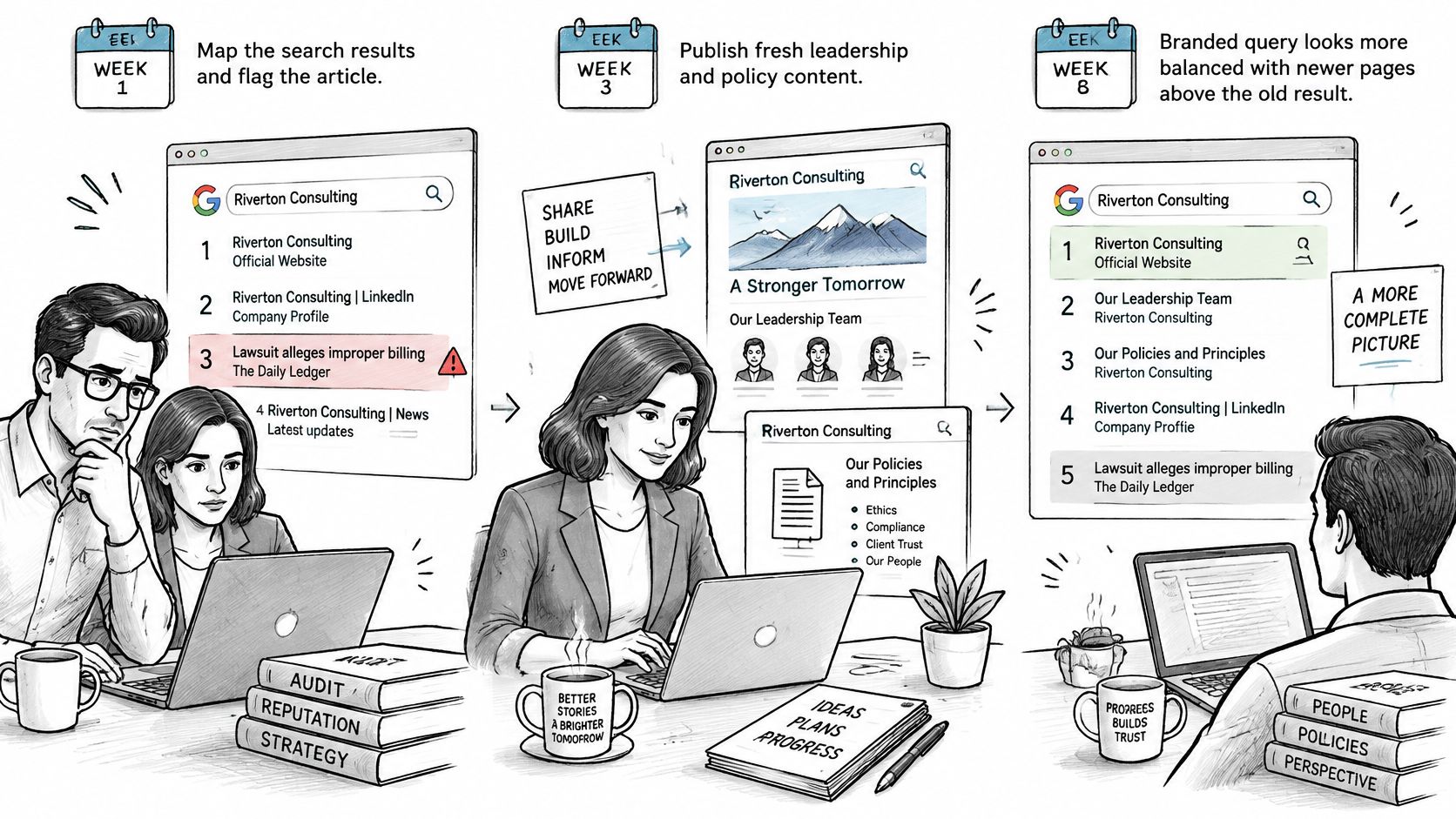
A Midsize Firm With an Old Lawsuit Article
Say a two-year-old lawsuit article ranks for the company name. During weeks 1 to 2, the audit establishes that the article is accurate, so the team leaves it in place and separately evaluates outdated forum allegations against the forum’s rules.
During weeks 3 to 8, the firm publishes a sourced explanation of the matter’s current status and aims to secure one relevant trade placement about its present operations. Legal reviews the explanation for accuracy without turning it into an unreadable denial.
By week 12, the proposed measure is a higher share of accurate, favorable search results, not a vanished court record. During the second quarter, the team checks whether the new material answers buyer questions and earns visibility without creating contradictory accounts.
A Service Brand With Uneven Location Reviews
Consider a 40-location operator whose corporate average hides branch-level problems. The first month reconciles listing mismatches, assigns profile owners, and introduces a response service-level agreement that staff can meet.
Recent customers receive neutral requests for honest feedback, without conditioning the invitation on a star rating. During the rest of the hypothetical 90-day period, managers investigate recurring complaint categories and document closures.
- Inspect the output: Look for a location-level issue register, response logs, and evidence of operational changes.
- Verify the result: Assess rating distribution and unresolved complaints by branch, rather than celebrating a company-wide average.
- Extend into the second quarter: Investigate locations that remain unstable instead of increasing review requests indiscriminately.
An Executive Misidentified in AI Summaries
An assistant merges an executive with a similarly named person and repeats an outdated claim. The engagement starts with a source audit that traces the mistaken identity and documents conflicting affiliations.
The team corrects owned biographies, requests factual corrections from relevant publishers, and maintains a monthly prompt log scoring accuracy and citations. The verifiable output is a cleaner source record and documented answer tests, not a selected screenshot that hides contradictory responses.
Ninety days can’t erase newsworthy facts or guarantee model behavior. Choose the scenario closest to your trigger and reuse its milestone list in a proposal, with deliverables separated from outcomes the provider doesn’t control.
Commission the Audit Before You Sign a Retainer
Don’t buy a broad campaign before someone has classified the problem. A sales proposal should distinguish operational failures, factual errors, policy violations, and lawful criticism because each requires a different decision.
Prepare a compact evidence pack. It gives competing firms the same starting material and makes vague promises easier to challenge.
Build and Send the Query Stack
-
Choose five priority queries. Include the company name, CEO name, main product, company plus reviews, and company plus the most important city. Adapt the wording to what a customer, recruit, investor, or journalist would type.
-
Capture the discovery experience. For each query, save page-one screenshots, the relevant review profile, and an AI answer where applicable. Record the date, search location, prompt, and cited sources so the reviewer understands the conditions.
-
Classify the evidence. Mark items accurate, outdated, unfair under a stated policy, or unfavorable but true. Add the supporting document or policy language rather than relying on a stakeholder’s dislike of the result.
-
Request comparable audits. Send the stack to two or three firms. Require a written assessment, a refusal policy for lawful criticism, and a sample report showing favorable-result share, review response time, and AI accuracy. A free online reputation audit is one available starting point.
-
Reject deletion guarantees. Ask who controls each proposed action and what happens if a publisher, platform, or search engine declines the request. Don’t accept a promise to bury the past as a substitute for a documented plan.
-
Authorize operational fixes first when necessary. If repeat incidents or complaint backlogs drive the problem, assign internal owners before commissioning additional coverage.
Your action this week is to send the query stack and request the audit. Buy a defensible diagnosis before you buy recurring execution.
TheBestReputation offers corporate reputation management services that combine search audits, media relations, content governance, and review and crisis workflows. Bring your query stack and ask for a written assessment of what can be corrected, what needs operational repair, and how progress will be measured.
