Reputation Management for Celebrities: 2026 Crisis Guide

You can tell when a celebrity's reputation is slipping before the public headline lands. The team starts seeing it in search results, in fan chatter, in screenshots that keep reappearing, and in AI answers that repeat an old problem as if it's current. By the time the phone rings, the narrative is often already moving. That is why reputation management for celebrities is no longer just crisis PR.
It is a working system for controlling a permanent digital record, where search, social, press, and AI summaries all shape what people believe first.
| Tactic | Speed to Impact | Durability | Primary Use Case |
|---|---|---|---|
| Media relations | Fast | Moderate | Rapid narrative reset, authoritative placements |
| SEO | Slower | High | Long-term page-one control and suppression |
| Crisis monitoring | Immediate defensive value | Ongoing | Early warning, escalation control, issue containment |
Table of Contents
- The New Reality of Celebrity Digital Footprints
- Conducting a Professional Digital Footprint Audit
- Comparing ORM Tactics for Speed and Durability
- Strategies for Content Suppression and Narrative Shift
- Crisis Response and Image Repair Frameworks
- Managing Reputation in the Era of AI Search
- Measuring Success Through Search Visibility KPIs
The New Reality of Celebrity Digital Footprints
A celebrity's public image used to be driven by interviews, premieres, and a few major outlets. Now it lives in a searchable system that keeps old stories, images, and commentary in circulation long after the original event. Scholars trace the modern celebrity phenomenon to the mid-19th century, and today's media environment turns that history into a persistent public record where reputational effects can outlast the event itself by years. That is why narrative control has become a long-tail discipline, not a one-time cleanup as documented in this historical overview.

Search and AI now define the first impression
The practical problem is that audiences often meet the search result before they meet the person. Search pages, news results, social profiles, and AI summaries all contribute to a stitched-together identity that may be incomplete, outdated, or unfair. That means the public face of a celebrity isn't only what the person says; it's what the digital ecosystem repeats.
Practical rule: if page one tells a one-note story, the audience usually assumes that story is the whole truth.
This is why reputation management for celebrities has merged PR, content strategy, and search visibility work. A press statement can help, but it rarely solves the underlying visibility problem by itself. The more durable task is to shape the set of assets that search engines and AI systems can easily trust, cite, and surface.
TheBestReputation's celebrity reputation management service is one example of how this work is packaged in practice, but the core principle is broader than any single vendor. The digital footprint has become an asset class. If the footprint is unmanaged, it becomes a liability that keeps renewing itself every time someone searches the name.
Conducting a Professional Digital Footprint Audit
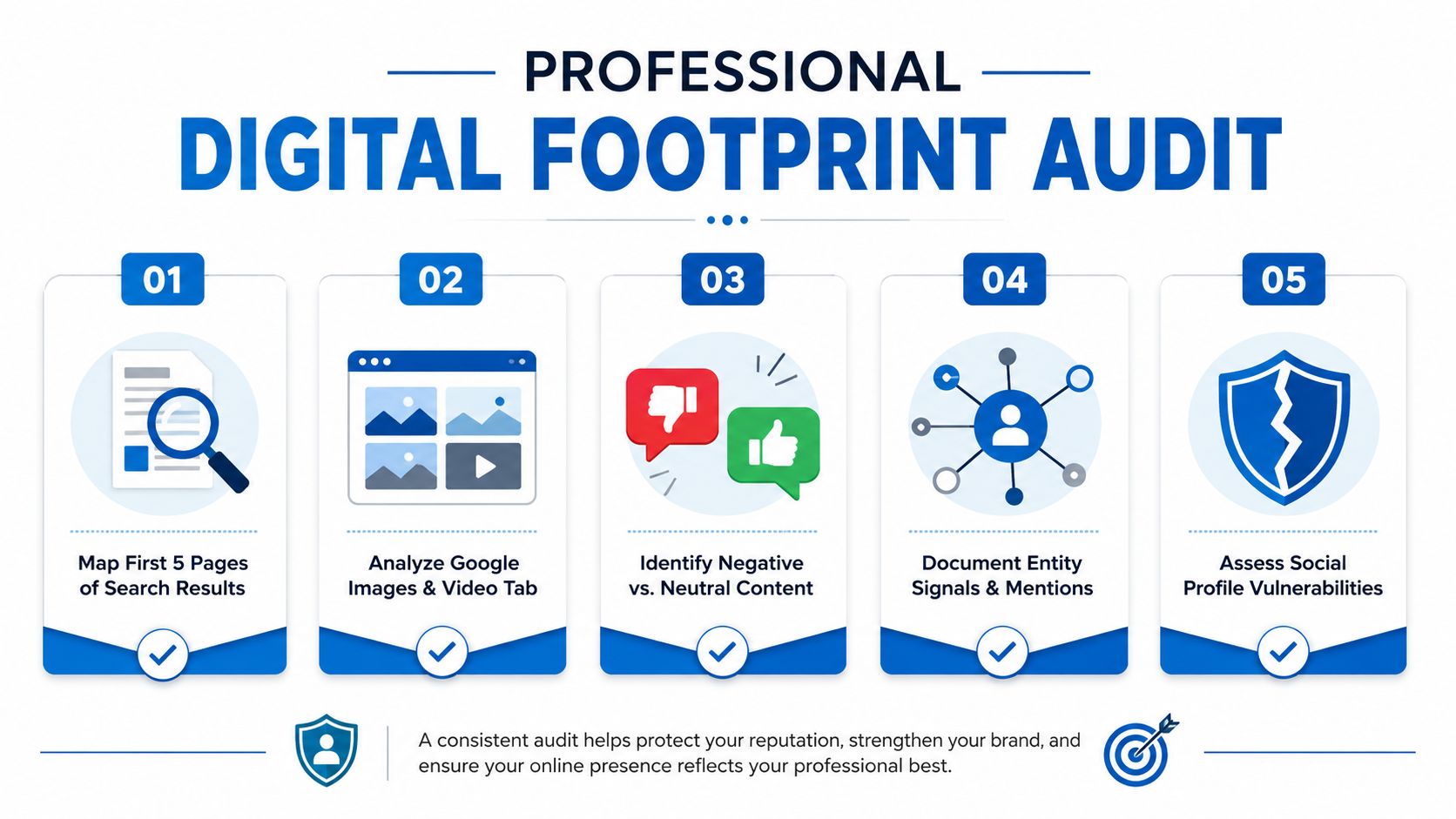
The first serious move is a full digital footprint and search visibility audit. Not a vanity search, not a quick scan of the homepage, and not a glance at one social profile. A professional audit maps the first several pages of search results, Google Images, News, social platforms, fan sites, forums, Reddit, YouTube, review-style sites, public records, and what AI platforms are saying about the person.
What the audit has to answer
The audit is really a sorting exercise. You're trying to identify what's ranking, what's vulnerable, and what's missing. Ranking means the pages and profiles that already dominate the search results. Vulnerable means old controversies, misleading headlines, unwanted images, impersonation accounts, thin bios, and anything likely to spike if another outlet picks it up. Missing means the authority signals that should exist but don't, such as stronger bios, cleaner profiles, or more credible third-party coverage.
That's where the structure matters. Owned assets include the celebrity's website, official social profiles, and verified bios. Earned assets include interviews, editorial coverage, and third-party profiles. Hostile assets include forum threads, negative stories, and pages that gain traction because they fill a gap the public never should've seen.
Google's own Search documentation confirms structured-data support for discussion forum and profile page markup, which makes those community sources directly relevant to footprint audits and search visibility through Google's Search documentation. That matters because a footprint audit isn't just about damage detection. It's about understanding which sources search systems may treat as first-person or identity-relevant signals.
The most useful audit question is simple. If someone searches this person today, what story does page one tell, and is that the story the team wants reinforced?
TheBestReputation's website audit guide fits naturally into this workflow because the website is usually the first owned property that can be strengthened, corrected, and made more searchable. A good audit ends with a priority map, not a pile of screenshots. That map becomes the basis for suppression, media placement, profile optimization, and crisis planning.
Comparing ORM Tactics for Speed and Durability
A celebrity team dealing with a fast-moving scandal usually needs media relations first. A strong placement in an authoritative publication can shift the conversation quickly, and it gives search engines and AI systems fresh material to surface. That matters when the immediate job is to replace a hostile story with a source that looks credible and current.
Where each tactic fits
SEO is slower, but it carries the work after the first wave of attention fades. It helps positive assets keep ranking once the initial spike passes. Monitoring works differently. It does not create visibility by itself, but it protects the rest of the program by catching new problems before they spread.
The strongest teams use these tactics in sequence. Media relations sets the new narrative, SEO helps that narrative hold, and monitoring keeps the campaign from being surprised by the next post, clip, or article.
| Tactic | Speed to Impact | Durability | Primary Use Case |
|---|---|---|---|
| SEO | Moderate to slow | High | Page-one replacement, long-term control |
| Media relations | Fast | Moderate | Immediate narrative shift, authority building |
| Crisis monitoring | Immediate defensive value | Ongoing | Early detection, escalation control |
That order matters because reputation work rarely comes from one clean move. Search results may already be crowded with negatives, and media relations can change the conversation faster than SEO alone. If the goal is to keep the win in place, search work has to follow.
The trade-off is simple: budget and patience. Media buys attention. SEO buys persistence. Monitoring buys time, and time often keeps a small issue from becoming an identity problem. A celebrity team that understands those differences allocates resources differently from one that assumes every problem needs the same response.
Strategies for Content Suppression and Narrative Shift
I've seen campaigns fail because the team obsessed over one bad URL and ignored the wider search environment. That usually leads to wasted energy, uneven results, and a narrative that snaps back the moment attention returns. The smarter approach is to build enough credible positive material that the negative result loses its gravitational pull.
Build the surrounding assets, not just the rebuttal
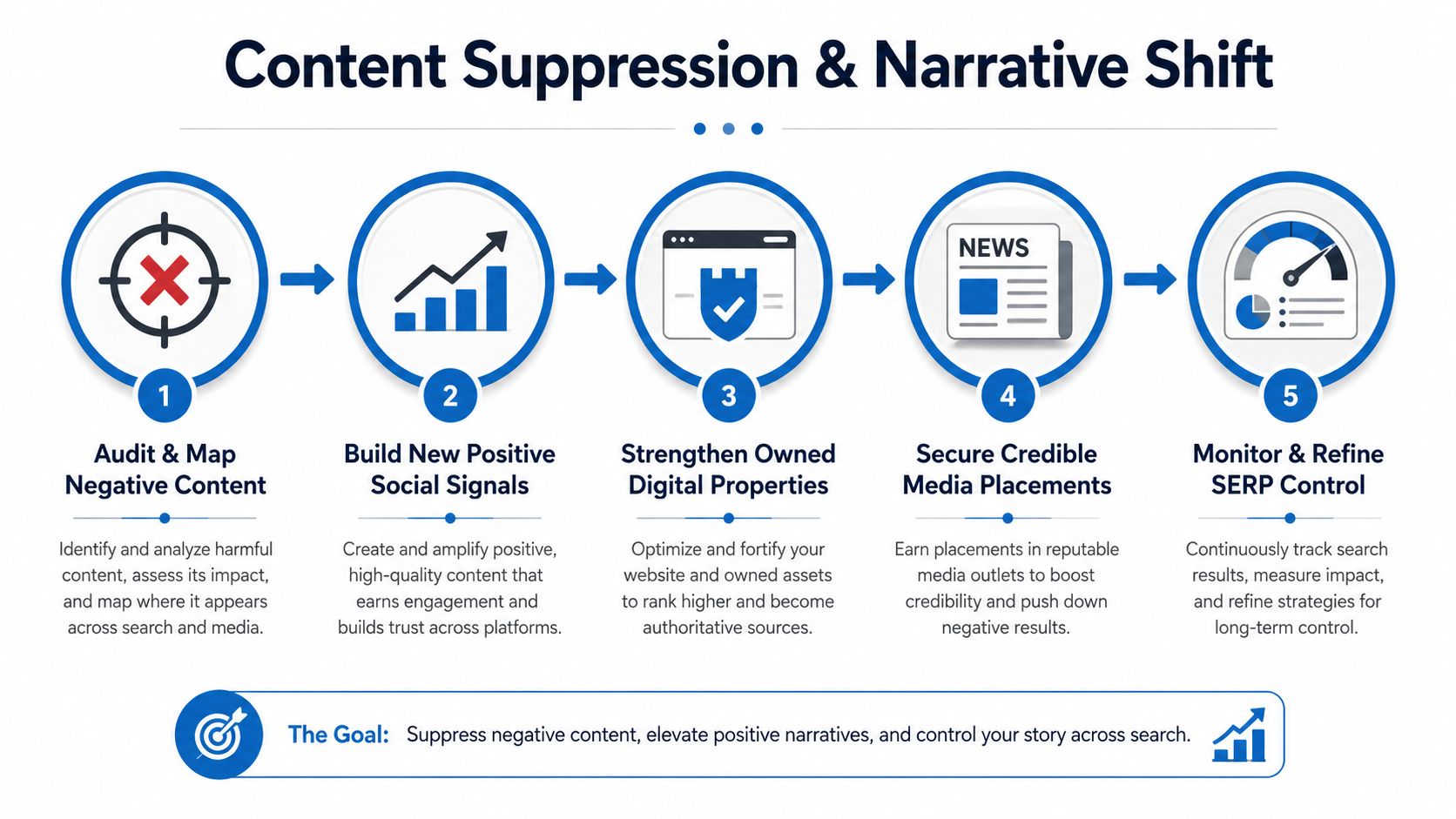
The core tactic is to strengthen the celebrity's owned digital properties and then create enough related signals that search engines have better material to rank. That includes official bios, controlled social profiles, fresh articles about current work, and credible editorial coverage that reinforces the same story from different angles. When those assets point to each other through consistent messaging and backlinks, they become easier for search systems to trust.
A useful reference point is TheBestReputation's comprehensive website audit guide, because a weak website can slow down every other suppression effort. If the official domain is thin, outdated, or disconnected from the rest of the footprint, it won't support the rest of the campaign well.
The strongest suppression campaigns don't chase every negative page individually. They change the ratio of visible content. That means improving the official site, publishing new third-party coverage, refreshing bios, and making sure the message holds together across platforms. The negative result may still exist, but it stops being the dominant answer to the search query.
The video below is useful for teams that need a practical example of how a search-first reputation campaign gets organized across content and placement work.
Search suppression works best when it's treated as narrative engineering. You're not just pushing content down; you're building a more believable replacement. That replacement has to look current, relevant, and authoritative enough that it earns its place.
Crisis Response and Image Repair Frameworks
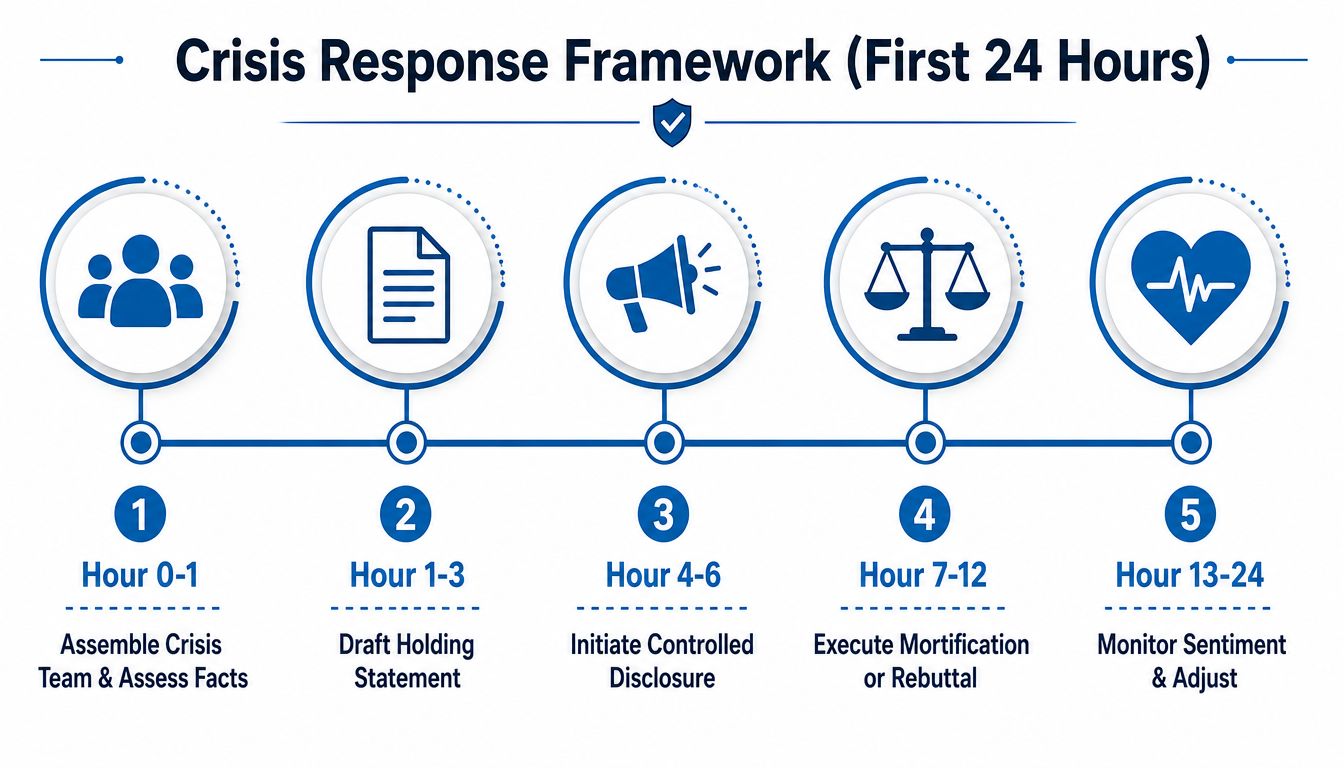
When a scandal breaks, silence is usually the most expensive mistake. A 2026 analysis of 127 celebrity crises reported that delayed or absent responses accounted for 73% of high-profile scandals, and that statements issued within 12 hours were associated with 54% less reputation damage than responses made after 24 hours according to that analysis. That doesn't mean every statement should be rushed. It means the team needs a disciplined first-day process.
Speed matters, but so does tone
In public-figure crisis cases, any response strategy beat no response strategy in an experimental study of scandal response, which is a blunt reminder that some form of message discipline usually helps once the issue is already public as shown in the study from USF. The more recent Instagram research adds an important nuance. Mortification, meaning direct apology and acceptance of responsibility, drew the strongest audience support, while denial drew the most negative reactions in the 2025 study and in later Instagram apology research published in 2026.
That means a crisis plan can't be generic. The team has to decide whether the facts support an apology, a rebuttal, or a more limited holding statement, and then move quickly enough that the story doesn't harden without them. Sincerity, transparency, and pre-crisis reputation all matter because audiences are not only judging the statement, they're judging whether the statement feels earned.
For teams building the process itself, identify risks in social media before the issue spreads beyond the original post or clip. That kind of monitoring discipline supports the first 24 hours, which is where most of the damage control happens.
TheBestReputation's crisis communication plan template fits here because the statement chain, approval chain, and monitoring chain all need to be clear before pressure hits. The first day is about facts, tone, and channel coordination. If those three things are stable, the team has a chance to keep the crisis from turning into a lasting identity stain.
Managing Reputation in the Era of AI Search
A lot of celebrity teams still audit only blue links, and that's no longer enough. Google's AI Overviews can occupy from about 40% of the visible above-the-fold space to the full page above the fold, and one industry study says they can appear for almost half of all queries in the AI Overviews report. Google also said in May 2024 that AI Overviews were rolling out to everyone in the U.S. and would reach over a billion users by the end of the year in Google's update.
The AI layer rewards page-one control
The key strategic point is that the AI layer isn't separate from search. seoClarity reported that more than 99% of AI Overview instances were sourced from the top 10 web results, which means the pages already ranking on page one strongly influence what the AI layer summarizes and surfaces in seoClarity's research. If the page-one set is polluted, the AI answer often inherits that problem.
That's why reputation management for celebrities now has to include AI search testing. Teams should compare what Google, Gemini, Perplexity, and ChatGPT say about the client, then trace which source pages those systems lean on. A useful operational framework for that work is the Stimulead revenue-focused framework, especially for teams that need to translate AI visibility into a repeatable process instead of treating it as a mystery.
Rule of thumb: if the source pages are weak, the AI answer usually is too.
This is also where misinformation risk rises. Neutral industry analysis says public figures should monitor social platforms, fringe sites, and even the dark web in real time, and prepare for deepfakes and synthetic text, because celebrity-induced crises can spread across social media within hours in that analysis. AI search doesn't replace traditional ORM; it raises the stakes on source quality, monitoring speed, and narrative consistency.
Measuring Success Through Search Visibility KPIs
The first report a celebrity team should see is a search visibility and sentiment snapshot. It should show what dominates when someone searches the name, which results are positive, neutral, or negative, and how that mix is shifting over time. That snapshot is the cleanest way to show whether the footprint is becoming more controlled.
The main KPI is positive search dominance. Track which credible positive pages are beginning to occupy more of page one, which negative URLs are moving down, and whether the tone of AI answers is changing in the same direction. A before-and-after view works best because it shows not only whether a campaign is active, but whether the public-facing story is changing.
The reporting should also include Google News visibility, movement in negative-result position, and a comparison of AI answers week over week. For a practical reporting structure, TheBestReputation's client success metrics guide is a useful model for how to present progress without burying the team in noise.
If the metrics don't show a shift in the first-page mix, the strategy isn't done yet. If they do, the job becomes maintaining that dominance and protecting it from the next rumor, post, or headline.
If your team needs a practical plan for reputation management for celebrities, TheBestReputation builds search audits, crisis response workflows, media placement strategies, and AI-era visibility programs around the actual footprint a public figure has today. Visit TheBestReputation to discuss a focused audit and a campaign built around your search results, press coverage, and AI presence.
