Smart Background Search: How It Works, Rules and Workflow

You're two weeks from signing a three-year vendor contract, or one interview away from an offer, and the last thing you do before either is type a name into a search box. What a quick smart background search returns is a stack: an old filing with a matching surname, a review from someone claiming to be a former employee, a people-search profile listing an address in a state nobody mentioned, and an AI assistant's tidy paragraph that summarizes all three as if they were settled facts.
None of it tells you which items belong to the person you're considering. None of it tells you which items you're allowed to use, or what you'd have to do first.
That gap between finding information and being permitted to act on it is where careers, deals and reputations get damaged. Smart background search isn't a faster search box. It's a purpose-driven information system: the purpose you name decides the legal path, the confidence labels the pipeline attaches decide what's safe to touch, and every finding needs a verification route and a dispute route before it can affect someone's opportunities.
Table of Contents
- How Smart Background Search Differs From Traditional Checks
- How a Smart Background Search Pipeline Works and How to Trust Its Output
- Reputation and Due Diligence Uses Worth Searching For
- Privacy and Legal Rules That Shape Every Search
- A Step-by-Step Smart Background Search Workflow
- Decide Whether to Run a Smart Background Search
How Smart Background Search Differs From Traditional Checks
Smart background search is the automated collection and synthesis of identity, employment, education, criminal-record, licensing, and other public-record information into one searchable view. The value isn't volume. It's that the pieces get cross-referenced, so a name, an employer, a license number and a filing date can be checked for agreement instead of stacked in a folder and handed over.
Think of two people behind a desk. A traditional check is a filing clerk: you hand over a name and a purpose, the clerk pulls the fixed folder that purpose calls for, and hands it back once. Smart background search is a research librarian: it reads across the whole archive, notices that a 2016 address contradicts a 2025 filing, and flags the conflict instead of filing it away.
That difference shows up across six criteria.
| Aspect | Traditional background check | Smart background search |
|---|---|---|
| Core question | Is this person's formal record clean? | What is publicly findable about this person or company, and does it match the identity? |
| Sources | Court, criminal, employment, education and licensing records | Public records plus news, reviews, social profiles, people-search listings and AI-generated summaries |
| Output | A fixed report delivered once for a decision | Searchable findings with source links, dates and change alerts over time |
| Typical trigger | Hiring, tenancy, licensing or credit decision | Reputation monitoring, partner or vendor vetting, executive due diligence |
| Legal status | FCRA applies when the report is used for employment, housing, credit or insurance | FCRA applies when the output informs those decisions; otherwise privacy and defamation law govern |
| Main risk | Outdated or inaccurate records | Name matches mistaken for identity matches, and unverified summaries presented as fact |
The table stops short of the point that matters most in practice. Legal status follows the use, not the collection method. The Federal Trade Commission's 40-year review of the Fair Credit Reporting Act explains that a report can qualify as a "consumer report" when it contains information about a person's character, general reputation, personal characteristics, or mode of living and is used for employment, housing, credit, insurance, or similar eligibility decisions.
The statute dates to 1970, and it reaches further than a hiring decision: the FTC names employment, promotion, reassignment and retention as covered employment purposes. A search assembled entirely from public pages and cached snippets doesn't escape regulation because it was free to collect.
The test to apply: if the output will shape someone else's opportunities, treat the search as regulated from the first query, not from the moment you're about to decide.
How a Smart Background Search Pipeline Works and How to Trust Its Output
A search returns a lawsuit naming someone who shares an executive's name. Before that result reaches a decision-maker, the system needs to establish identity, preserve the record and explain what remains uncertain. Fast retrieval alone cannot do that.
The technical half of trust starts with architecture. A good system separates ongoing collection from the search someone runs when they need an answer. A published design for an ingestion, indexing, retrieval, reranking and explanation pipeline separates those layers into stateless services behind an API gateway. That separation lets searches use indexed material rather than collect every page again.
Collection works like a delivery route. Scheduled jobs revisit defined targets, such as a company's registered name, an executive's license number or a brand plus “lawsuit.” The search purpose determines which targets belong on that route and which findings need closer review.
Here are the stages that run before the trust layer sits on top. The diagram illustrates collection through retrieval; reranking and explanation follow.
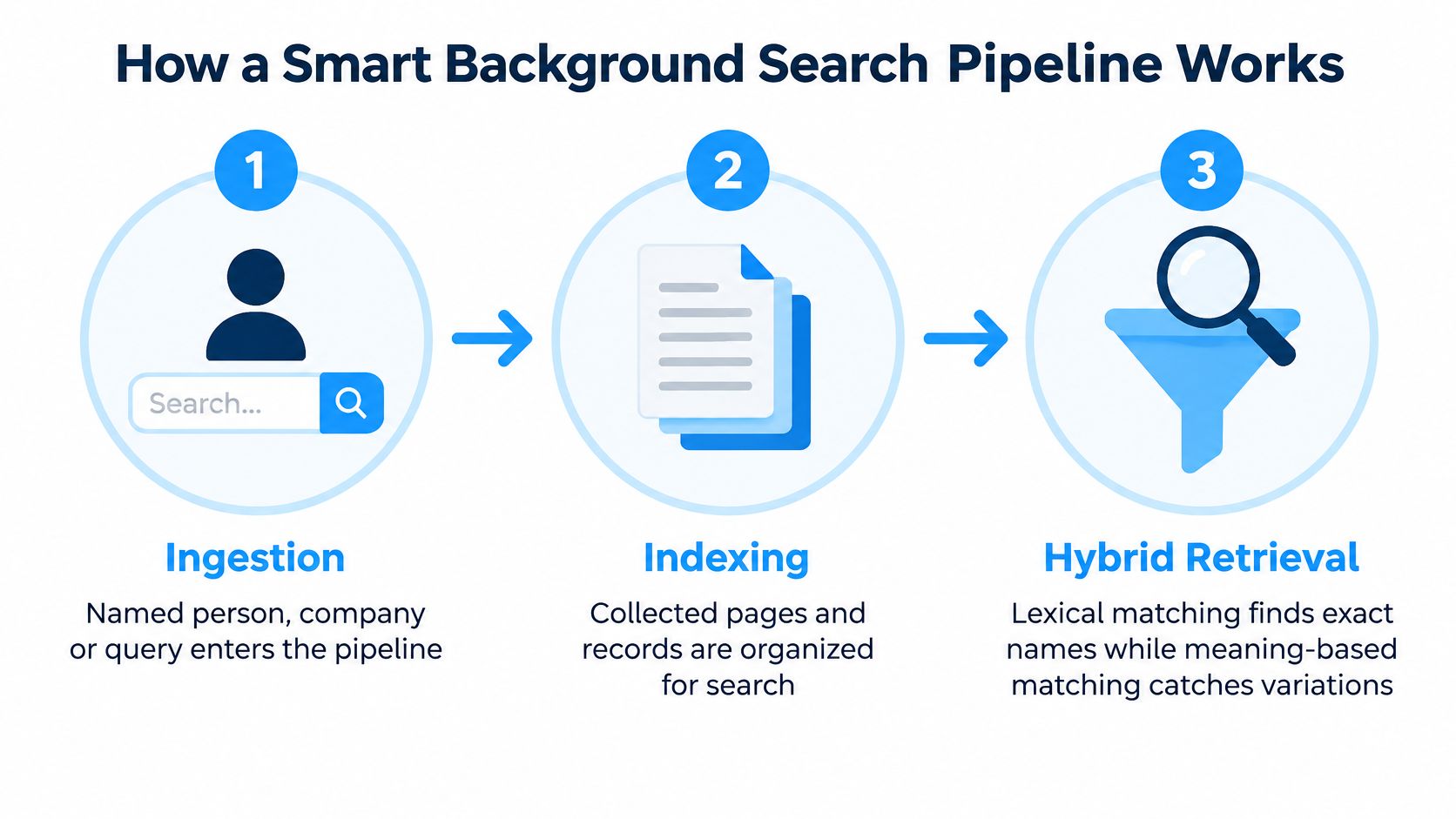
- Ingestion. The job takes a person, company or free-text query, together with identifying details. Without those details, later stages may retrieve material about namesakes.
- Indexing. Pages and records are stored with their source, retrieval time and relevant passages. A summary alone loses the evidence needed to check or dispute a finding.
- Hybrid retrieval. Lexical matching preserves exact names, URLs and legal terms. Meaning-based matching catches varied wording in reviews and forum threads. Use both without allowing semantic similarity to substitute for an identity match.
- Reranking. A relevance pass prioritizes passages that answer the question. A diversity filter reduces near-duplicates so syndicated coverage does not crowd out an original filing or create the appearance of independent corroboration.
- Explanation. Each result carries its source, date and confidence level. The explanation should make clear what the record supports and what still needs investigation.
Background jobs should expose their status without requiring an open browser session. Monitoring should also distinguish a material change from an unchanged page. Content fingerprints help keep repeated discoveries from filling an alert inbox.
Why a Citation Isn't a Confirmation
A citation gives you something to inspect, not permission to trust the summary. In a 2025 study of eight AI search systems involving 1,600 news-source identification tests, systems returned incorrect information in more than 60% of queries, according to Columbia Journalism Review's Tow Center comparison.
That finding concerns news-source identification, rather than background-screening accuracy. The practical lesson is still relevant: open the cited material and check whether it supports the statement.
Verify before acting:
- Confirm identity with independent identifiers. Check details such as date of birth, employer, city, license number or a verified profile. A shared name is insufficient.
- Separate primary records from summaries. Read the docket rather than relying solely on coverage describing it.
- Check dates and jurisdiction. Establish whether the record reflects the current status, including any settlement or expungement.
- Capture the original. Preserve the page, URL and timestamp so later edits do not erase the basis for review.
- Separate what was reported from what was proven. A complaint records allegations; it does not establish liability.
- Record what you didn't find. Describe the limits of the search so missing results are not presented as proof that no issue exists.
- Require human review before any adverse finding. Automation can prioritize investigation. A person must assess the underlying evidence before it affects someone's opportunities.
For a confirmed court record that keeps resurfacing, consider the documented route for removing court records from Google search results, recording the grounds for any request. Removing a search result and changing the underlying court record are separate outcomes. Neither replaces checking the record's accuracy.
Label Confidence Before Anyone Acts
Confidence labels should describe evidence, not how persuasive a summary sounds. Use them to control the next permitted action.
| Label | What it takes | What it permits |
|---|---|---|
| Confirmed | Two or more independent identifiers plus a primary record, read by a person | May inform a decision only through the applicable legal process, with the source attached and a dispute route |
| Probable | Identifiers mostly align but one gap remains | Further investigation, not a decision on its own |
| Unverified | A name match or summary without a primary record | Internal lead only, not an adverse conclusion |
| Conflicting | Sources describe different people or incompatible versions of events | Exclusion from decisions until a person resolves the conflict |
These labels are workflow controls, not legal clearance.
A CIDR 2024 paper on task-based dataset search discusses latency, privacy and data-quality concerns in search adoption. Applied here, those concerns favor an adaptive schedule: revisit fast-changing sources more often, use conditional requests and fingerprints for stable pages, and reserve expensive reranking for meaningful changes. Minimize collection, encrypt task state, isolate tenants and set retention periods. Keep raw evidence separate from derived indicators so reviewers can distinguish the source from the system's interpretation.
Working rule: a finding enters a decision only after two independent identifiers agree, someone has read the primary record, and the person it describes has a way to dispute it.
Reputation and Due Diligence Uses Worth Searching For
A hiring manager types a candidate's name into a search bar the night before the final interview and finds an old forum argument, a wrong-address people-search listing, and a namesake's court record. Which of those may shape the decision, and which must be ignored? The answer depends on the purpose behind the search, and that same logic governs every legitimate use of this kind of pipeline.
The provider matters as much as the query. Consumer reporting agencies handle regulated employment screening. People-search and data-broker sites serve personal footprint checks. Reputation-monitoring firms watch names, reviews and AI answers over time. The first carries explicit FCRA duties, the second lives under privacy law, and the third sits mostly in defamation and platform-policy territory. Mixing them up is how well-meaning teams buy a screening report from a site that never agreed to screening obligations.
Three families of use cases sit behind most searches.
- Online reputation management. The question is what page one and the AI answer say about this person or brand today, and whether that picture is accurate. Sources worth checking are the name and its variants in search, review profiles, news archives, forum threads, image results, and the summaries ChatGPT, Gemini and Perplexity return. A person takes over at the point where a finding needs a judgment: remove it, correct it, or answer it with better content. Removal belongs at the source where feasible, and what cannot come down can often be pushed out of sight by accurate, stronger material.
- Due diligence on a counterparty. The question is whether this hire, investor, landlord, vendor, partner or board candidate checks out. Sources are corporate registries, litigation, licensing records, news coverage, and a regulated screening report where the purpose is a hiring decision. A 2025 global benchmark survey from HireRight reported that more than three-quarters of businesses found candidate discrepancies during screening in the prior 12 months, and 13% found an average of at least one discrepancy per five candidates. Interest in social-media sources as part of that screening has been rising, which makes the purpose question sharper, because reading public posts for curiosity and scoring them for a hiring decision sit under very different obligations. A recruiter takes over the moment a discrepancy could disqualify someone, because that person gets to explain it first.
- Personal privacy checks. The question is what brokers and outdated profiles expose about you: your address, phone number or relatives. Pew Research Center's reputation management study found that 57% of adult internet users had searched for information about themselves online, up from 47% in 2006. The human decision point is whether to remove a listing at the source or correct it in place, and that choice belongs to the person named.

Some matters need a person on the ground rather than a screen: confirming that a company operates from the address it claims, or that a witness exists. For those, private detective London is a useful escalation, with the same documentation standards applied to what comes back.
One rule holds across all three families. The closer a use case moves toward a hiring, tenancy or credit decision, the more it falls under the regulated path, with consent and dispute duties attached. The guide to how often online information affects hiring is worth reading before a reputation finding gets folded into a personnel decision, because the search itself may be lawful while the use of it is not.
Privacy and Legal Rules That Shape Every Search
Five searches can look identical on a screen and sit under five different rulebooks, because the purpose sets the obligations, not the technology. Purpose is the system's first input, and everything downstream (consent, notice, dispute routes) inherits from it.
| Purpose | Legal trigger | Required steps |
|---|---|---|
| Hiring or promotion | Report used for an employment decision under FCRA | Obtain written consent before ordering; give a copy of the report and rights summary before any adverse action; explain and offer a dispute route afterward |
| Tenancy, credit or insurance | Report used for housing, credit or insurance eligibility | Document the permissible purpose before ordering; apply the FCRA notice and accuracy rules |
| Personal or reputation monitoring | No eligibility decision; only public information is read | Limit the search to the person's public footprint; respect privacy and defamation law; log removal requests with reasons |
| Namesakes, translated or foreign records | Ambiguous identity or records from another jurisdiction | Confirm identity with two or more independent identifiers; check local data-protection rules; record the correction route |
| Removal requests to websites | Request to remove inaccurate or sensitive personal information | Document each case; avoid bulk or paid suppression tactics that risk domain-wide demotion |
For employment, the sequence is fixed and the order matters. The FTC's guidance for employers on background checks states that an employer must obtain the applicant's written permission before ordering a report compiled by a screening company. If the employer may reject, terminate or otherwise take adverse action, it must first supply a copy of the report and a summary of FCRA rights. Only then does the decision happen, and afterward the employer must explain that the report drove it, tell the person how to dispute inaccurate or incomplete information, and point them to an additional free report within 60 days. Each step exists to give the person a chance to correct errors before those errors cost them a job.
Enforcement tells you how seriously these lines get policed. The FTC's 2023 privacy and data-security update reported 117 Fair Credit Reporting Act cases and more than $137 million in civil penalties against companies violating FCRA requirements. That update also cited enforcement against TruthFinder, Instant Checkmate and affiliates over marketing reports for employee and tenant screening without adequate accuracy procedures. Accuracy procedures carry this much weight because criminal and civil records often attach to common names, and a mismatch can follow the wrong person for years.
States are moving in parallel. A 2025 analysis of automated employment decision rules describes expanding obligations around disclosure, recordkeeping and bias controls, with Illinois restricting AI outcomes that discriminate on protected characteristics, including through proxies such as ZIP codes, and California emphasizing that employers stay responsible for discriminatory effects even when a vendor supplies the tool.
Practical rule: decide the purpose, write it down, and let it choose the paperwork. A monitoring search doesn't need consent forms; a hiring search needs them before the first query, not before the offer.
On the removal side, a legitimate request is documented case by case, with the reason, the date and the evidence attached. Google's spam policies for search state that when it processes a significant volume of personal-information removals involving a site with exploitative removal practices, it demotes other content from that site in results. Bulk suppression campaigns can therefore cost a whole domain its visibility, which is why the dispute route matters as much as the finding itself.
Namesakes, translated sources and foreign records sit outside every simple rulebook, and they need identity and jurisdiction checks before any finding travels into a decision. A pipeline can label a match as low-confidence, but only a human comparing identifiers decides whether it is safe to act on. Where wrongful exposure is the problem, a documented data broker removal process beats scattered opt-out forms, because the trail shows what was asked, of whom, and when.
A Step-by-Step Smart Background Search Workflow
Run the work in a fixed order and most compliance mistakes disappear before they're made.

- Define the purpose. Name the decision the finding could inform, because a hiring check needs consent before the search starts and a reputation audit doesn't. The common slip is starting the query first and retrofitting a purpose.
- Get written consent where the regulated path applies. Collect the signature before the order goes out, since consent gathered after the search looks like an afterthought to a regulator. Skipping this step is the single most expensive shortcut in employment screening.
- Set the target entity with identifiers. Attach date of birth, employer, location or license number to the name, because a bare name returns name matches by design. Teams that skip identifiers spend their review time untangling strangers.
- Choose sources and a schedule. Poll high-risk entities and volatile sources often, and hit stable pages with conditional requests, which keeps cost and alert noise down. Crawling everything daily is how budgets die without improving coverage.
- Store only what you need. Keep normalized entities, source IDs, timestamps and short evidence snippets, because query logs about executives or health matters are themselves a privacy exposure. Storing full pages indefinitely invites a breach you'd have to disclose.
- Triage every hit as identity match, name match or unrelated. Sorting first stops a same-surname filing from reaching a decision-maker. The slip here is reading the most dramatic item before checking whether it's the right person.
- Verify and label. Apply the identifier checks and assign Confirmed, Probable, Unverified or Conflicting, because the label decides who may act next. Skipping verification turns a pipeline into a rumor mill with citations.
- Route adverse findings to a human reviewer. Someone must own the required notices, the copy of the report and the dispute channel, since a finding can't be delivered by a dashboard. Automating this step is the fastest route to a legal complaint.
- Log corrections and re-run on schedule. Record what was disputed, corrected or removed, then repeat the search at the agreed interval, because yesterday's clean result ages badly. The common slip is treating one pass as a permanent answer.
A finished output reads like a dated inventory, not a narrative: confirmed items with attached records, probable items flagged for follow-up, unverified items parked, conflicts unresolved and visibly marked, each linked to its source, with the reviewer's decision and date recorded next to it. Anyone opening that file six months later can see what was known, when, and who acted. If the subject is a person's own name rather than someone else's, the practical walkthrough for how to Google yourself covers the audit from that side of the desk.
Decide Whether to Run a Smart Background Search
Answer three questions before any query runs.
Will this output shape a decision about another person's job, home, credit or insurance? If yes, you're on the regulated path: consent, disclosure, accuracy review and a dispute route come first, and the vendor you pick has to accept those duties in writing.
Is the subject a person's or a company's own public footprint? If yes, start with a monitoring audit of what ranks for the name, the review profiles and the AI summaries, then decide what gets corrected, removed or answered.
Is the name common or ambiguous? If yes, collect identifiers before the search begins, or you'll spend the review budget proving that three different people exist.
For reputation work, TheBestReputation runs a free confidential analysis on Days 1 to 3 that audits everything tied to a person's name across Google, people-search sites and AI platforms, with the full report delivered in under 24 hours and covering 100+ data points. The firm protects companies, executives, public figures, brands and individuals across search engines and AI systems. Whoever does the work, ask for written scope, the legal basis for every source in it, and how each result gets verified before anyone acts.
Today's action is short: write the purpose on one line, list the identifiers you have, and choose the path that purpose requires. Everything else follows from those three lines.
A search result only becomes a decision when someone decides to treat it as one, and that's the moment TheBestReputation exists to make safer. Whether you're protecting your own name, an executive team or a company facing a fresh wave of negative coverage, TheBestReputation starts with a free confidential analysis that maps what Google, people-search sites and AI platforms say about a name, so the next move is based on evidence rather than alarm. Visit the site to see how the audit works and what it covers before you commit to anything.
