What Is Content Governance and Why It Matters
Content governance is the operating framework that decides who can publish, what standards content must meet, how it's reviewed and approved, and what happens to it after launch, including updates and retirement. In practical terms, it turns content from a collection of pages into a managed system with clear ownership, controls, and lifecycle rules.
You may already have a governance problem without calling it one. A product page contains an outdated claim, a press article still ranks for your company name, or an AI-generated draft reaches publication without anyone recording who checked its sources. Search engines, AI summaries, customers, journalists, and regulators can all encounter that content, while your team assumes someone else owns the fix.
For a reputation-focused organization, governance determines which version of the brand remains visible. It connects editorial judgment with search visibility, public trust, legal review, and the decision to update, redirect, de-index, or retire content.
Table of Contents
- What Content Governance Really Means
- The Four Building Blocks Every Framework Needs
- Why Governance Shapes SEO and Reputation
- How Content Moves Through a Governance Workflow
- Traditional Governance Versus AI Content Governance
- A Practical Framework You Can Start With
- Measuring Governance and Getting Started
What Content Governance Really Means
A brand publishes a product page, updates its pricing, and changes a feature. Months later, an outdated comparison page still appears in search results. A customer trusts the old information, an AI summary repeats it, and a journalist cites it in an article. Nobody intended to mislead anyone, yet the brand's public record now tells an inaccurate story.
Content governance is the system that determines how a brand's information is created, checked, published, maintained, and retired. It gives teams a way to manage content after publication, when facts change, risks emerge, and audiences encounter pages in unexpected places. The lifecycle-based approach described in Content governance guidance from WebinOne connects publishing decisions with quality control, compliance, and long-term ownership.
For reputation-focused organizations, this system works like a chain of custody for public information. Each important claim should have a source, each content asset should have an accountable owner, and each change should leave a clear record. If a product statement changes, the team needs to know which pages, documents, social posts, and media assets may also require review.
Governance therefore controls more than what appears on a website. It influences the evidence available to search engines, AI systems, customers, journalists, and regulators. A page with clear authorship, current information, and reliable sources gives those audiences stronger material to interpret. An abandoned page filled with outdated claims can reinforce an unfavorable or misleading view of the brand.
Governance is a control system
A content calendar records publishing intentions. Governance sets the conditions for publication and defines the response when content becomes inaccurate, risky, or irrelevant.
That distinction matters because polished writing can still create reputational problems. A page may use the right tone while making an unsupported claim, exposing private information, missing an accessibility requirement, or presenting an old policy as current. Governance places review decisions around those risks before and after publication.
Practical rule: Assign an owner to every important content item before scheduling its publication.
A useful governance model should make several decisions visible:
- Who is accountable? Identify the person or team responsible for accuracy, updates, and escalation.
- Which standard applies? Record the requirements for sourcing, accessibility, privacy, legal review, brand language, and factual claims.
- What level of review is required? Match approval to the content's risk. A technical product guide may need subject-matter review, while a regulated claim may also require legal approval.
- What happens when conditions change? Define when to update, redirect, restrict, de-index, archive, or remove the content.
These decisions affect reputation because every published asset can become part of the brand's searchable history. Search engines may rank an old page above a newer one. AI-generated summaries may draw from content the marketing team has forgotten. Audiences rarely see the internal debate behind a page. They see the claim, the date, and the organization attached to it.
A style guide governs how content sounds. Content governance governs whether the organization can stand behind what it says, where it appears, and how long it remains public.
The Four Building Blocks Every Framework Needs
A workable framework needs four connected parts: policies, roles, workflows, and lifecycle rules. The infographic below also highlights taxonomy and metrics, which help teams organize content and determine whether the framework is functioning in practice.
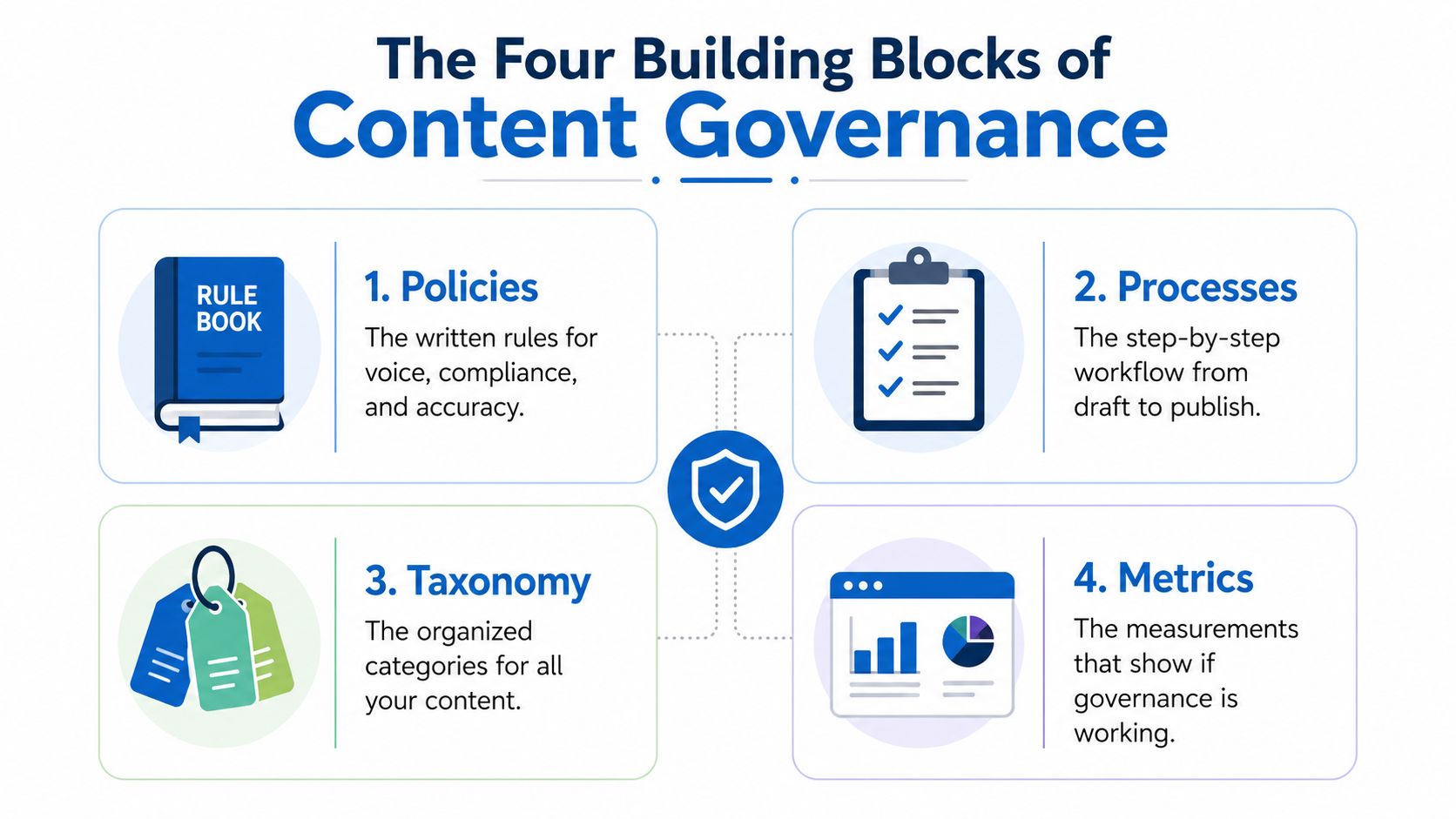
Policies create the rulebook
Policies turn assumptions into written standards. They can cover brand voice, factual accuracy, source quality, accessibility, privacy, legal review, localization, and approved terminology.
A brand voice policy might tell writers to use direct language, avoid unsupported superlatives, and explain technical terms for non-specialist readers. An accuracy policy might require a source for every material product claim. Without these rules, two writers can make reasonable but conflicting decisions, and the audience sees inconsistency.
Roles assign responsibility
Roles prevent the familiar “I thought someone else checked it” failure. A writer creates the draft, an editor checks structure and clarity, a legal reviewer handles defined risk areas, and a page owner remains accountable after publication.
The roles don't need to be complicated. A small organization may assign several responsibilities to one person, but it should still document the lanes. Permission tiers in a CMS or DXP can restrict who may draft, edit, approve, or publish, as explained in CoreMedia's enterprise content governance guide.
Workflows create repeatable gates
A workflow is the route content follows from idea to live publication. For example, a three-step review queue might move a draft from editorial review to legal review, then to final approval.
The value lies in repeatability. A high-risk claim should trigger the same checks whether it appears on a product page, a blog article, a social post, or an executive profile. Encoding approval routing and workflow triggers in the CMS or DXP reduces dependence on memory and informal messages.
Lifecycle rules prevent content decay
Lifecycle rules govern what happens after launch. They define when a page receives an accuracy review, who receives the task, and which conditions justify an update, merge, redirect, noindex directive, archive, or removal.
An 18-month refresh rule can be appropriate for a lower-risk evergreen page if the owner also checks it sooner after a product change, regulation change, or factual correction. The exact interval should follow the content's risk, not a universal schedule.
These blocks interlock. A policy without a role is a memo. A workflow without lifecycle rules is a launch checklist with no follow-through. Roles without standards create accountability without direction, while lifecycle rules without metadata make it difficult to find the pages that need attention.
Why Governance Shapes SEO and Reputation
Search engines and AI systems can only evaluate the content that remains available, structured, and discoverable. Governance decisions therefore influence the evidence audiences encounter when they search a brand, read a result snippet, or receive an AI-generated summary.
An accuracy policy determines which claims are allowed onto a page. An editorial workflow determines whether a faulty statistic or unsupported product statement is caught before publication. A lifecycle rule determines whether an aging page is refreshed, redirected, merged, or left online to compete with newer information.
That relationship is especially important for reputation management. A page that once represented the brand accurately can become a liability when its claims, terminology, pricing, leadership information, or product details change. Search visibility gives the page continued influence, while an AI system may treat the page as one source among others when forming an answer.
| Governance Rule | Reputation and SEO Outcome |
|---|---|
| Accuracy and sourcing standards | Reduces the chance that unsupported claims appear in visible search content or brand materials. |
| Named page ownership | Gives someone responsibility for correcting inaccurate or outdated information. |
| Approval routing | Sends higher-risk claims to the right editorial, legal, or communications reviewer. |
| Metadata and taxonomy controls | Help teams identify content by type, audience, risk, owner, and review status. |
| Retirement rules | Limit the period during which obsolete pages can shape search results and audience decisions. |
How Google ranks content and what it means for your site is useful context for teams connecting content quality with search performance. Governance doesn't guarantee rankings, but it determines whether the content supporting those rankings is accurate, current, and aligned with the brand's approved message.
Reputation teams also need to verify how visual and social content appears across public channels. A resource such as find where Instagram images appear can help an investigator locate publicly visible images associated with an account or identity during a broader digital presence review. That kind of discovery should feed into ownership, approval, and removal decisions rather than sit outside the content system.
The key point is simple: reputation and SEO increasingly meet on the same public surface. Governance choices affect which version of the brand audiences can find, which claims remain indexable, and which corrections happen before outdated information becomes part of the brand narrative.
How Content Moves Through a Governance Workflow
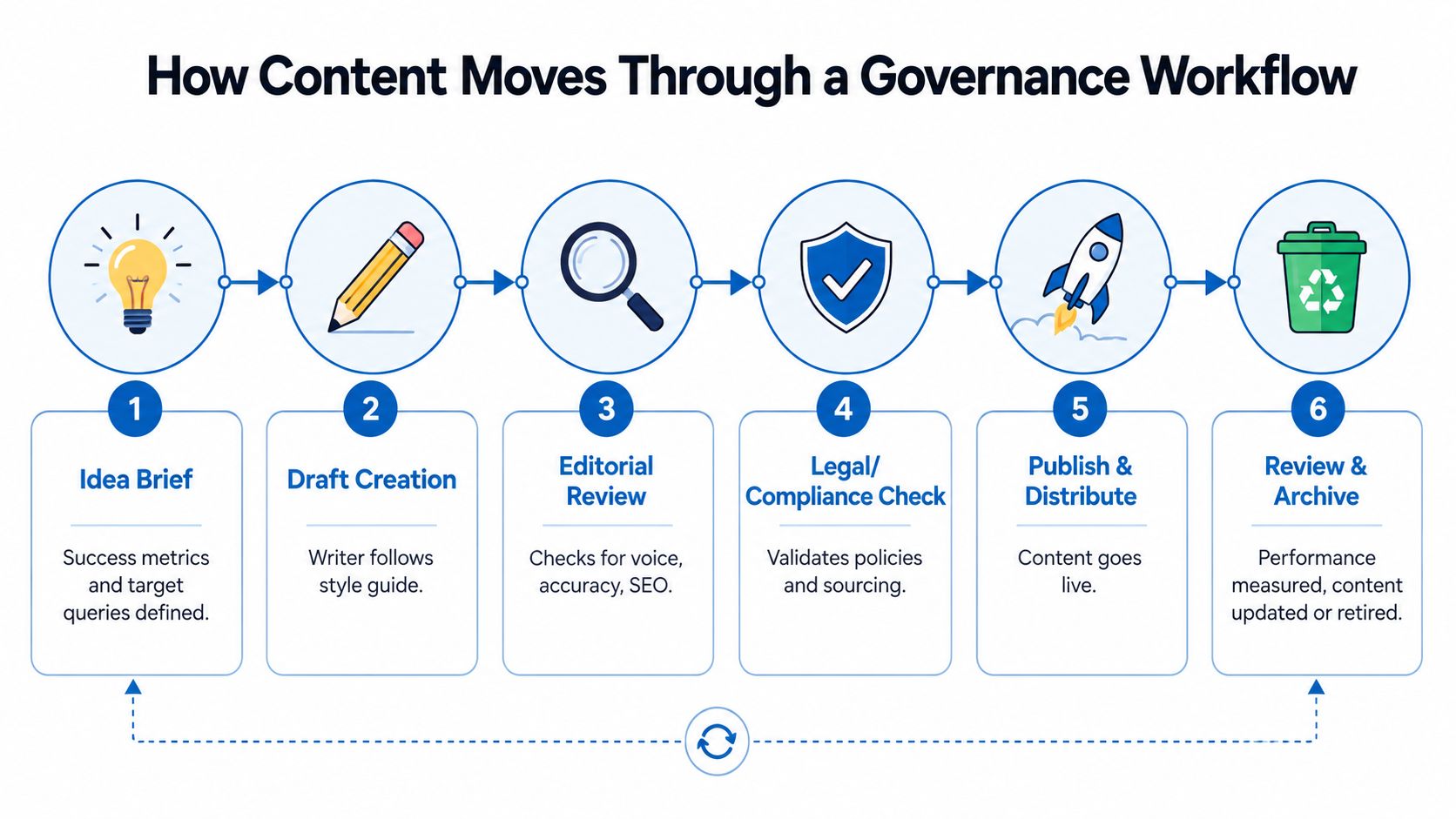
A governed workflow should be easy to follow on a shared board or inside a CMS. Each stage answers a different risk question, and each approval creates a record of who made the decision.
From brief to approved draft
The process starts with an idea brief. The team records the audience, target queries, business purpose, success measures, content type, and reputation category. A product page needs different controls from an Online Reputation Management article, even if both appear on the same domain.
The writer then creates the draft using the applicable style, sourcing, and accessibility rules. Editorial review checks clarity, tone, factual support, links, headings, and the intended audience. A legal or compliance review is triggered when the content includes regulated claims, sensitive allegations, contractual language, personal data, or other defined risk terms.
SEO review checks titles, descriptions, internal links, canonical decisions, structured data where relevant, and whether the page belongs in the intended information architecture. It shouldn't rewrite the governance rules. It confirms that the approved content is technically prepared for discovery.
Approval depends on risk
A useful matrix might classify hero pages and high-risk reputation assets as Tier 1, requiring a senior communications, legal, or subject-matter approver. Lower-risk evergreen posts might sit in Tier 3, allowing self-service publishing with documented spot checks.
The tier should determine who may approve, not whether quality matters. Every tier still needs an owner, a source record, and a maintenance status.
Audit trail: Record the draft version, reviewers, approval decision, date, and material changes so leadership can explain what happened later.
After launch, monitoring checks whether the page remains accurate and useful. Teams can establish review checkpoints at 30, 90, and 180 days, then adjust the cadence based on risk and observed change. A traffic decline, regulation change, product update, or factual correction can trigger an earlier review.
The final stage is retirement. The owner decides whether to update the page, merge it into a stronger resource, redirect it, apply a noindex directive, or archive it. The choice should reflect search intent, legal requirements, user value, and whether the page still represents the brand accurately.
The content approval process guide offers a practical reference for documenting these checks. For teams that want a visual reminder of the complete flow, the embedded video below can support an internal training session.
A mature workflow leaves evidence at every gate. When a negative search result, inaccurate claim, or outdated page becomes an issue, the organization can identify the owner, see the approval history, and act without reconstructing decisions from scattered inboxes.
Traditional Governance Versus AI Content Governance
Traditional governance assumes that a human writer produced the words. Its controls usually focus on the byline, the writer's expertise, manual fact-checking, editorial review, and the final approver.
AI content governance keeps those controls but adds another evidence layer. Teams must know whether AI drafted, summarized, translated, personalized, or substantially edited the material. They must also preserve enough information to verify the output and explain the human decisions that led to publication.
| Checkpoint | Traditional Governance | AI Content Governance |
|---|---|---|
| Author responsibility | Assigns a human writer and accountable editor. | Identifies the human owner and records the AI system's role in production. |
| Source verification | Checks claims against the writer's cited sources. | Independently verifies claims and confirms that AI hasn't introduced unsupported material. |
| Version control | Stores drafts and editorial changes. | Also records relevant prompts, source documents, model outputs, and material edits where policy requires. |
| Human review | Uses an editor or subject-matter reviewer. | Requires human review with specific attention to hallucination, bias, omissions, and misleading certainty. |
| Disclosure | Applies the organization's normal authorship policy. | Adds rules for when and how AI assistance is disclosed. |
| Recordkeeping | Retains approval evidence. | Retains evidence that AI use, review, source checking, and approval occurred. |
This distinction matters because accountability can become unclear when several people edit an AI draft before publication. Who approved the claim? Which source supported it? Did the translator introduce a new meaning? Was the summary checked against the original document?
Future-proof AI content strategy can help teams think about AI use as an operating practice rather than a writing shortcut. The practical governance question is not whether a machine touched the draft. It's whether the organization can show who verified the result and whether the output met the same quality and reputation standards as human-written material.
For teams evaluating visibility in generative search, SEO for AI search provides related context. AI governance doesn't replace editorial judgment. It expands the checkpoints around prompts, source documents, model use, human review, approval logs, and recordkeeping.
The standard stays constant: accurate, useful, compliant, on-brand content. Only the path to reliable evidence becomes more demanding.
A Practical Framework You Can Start With
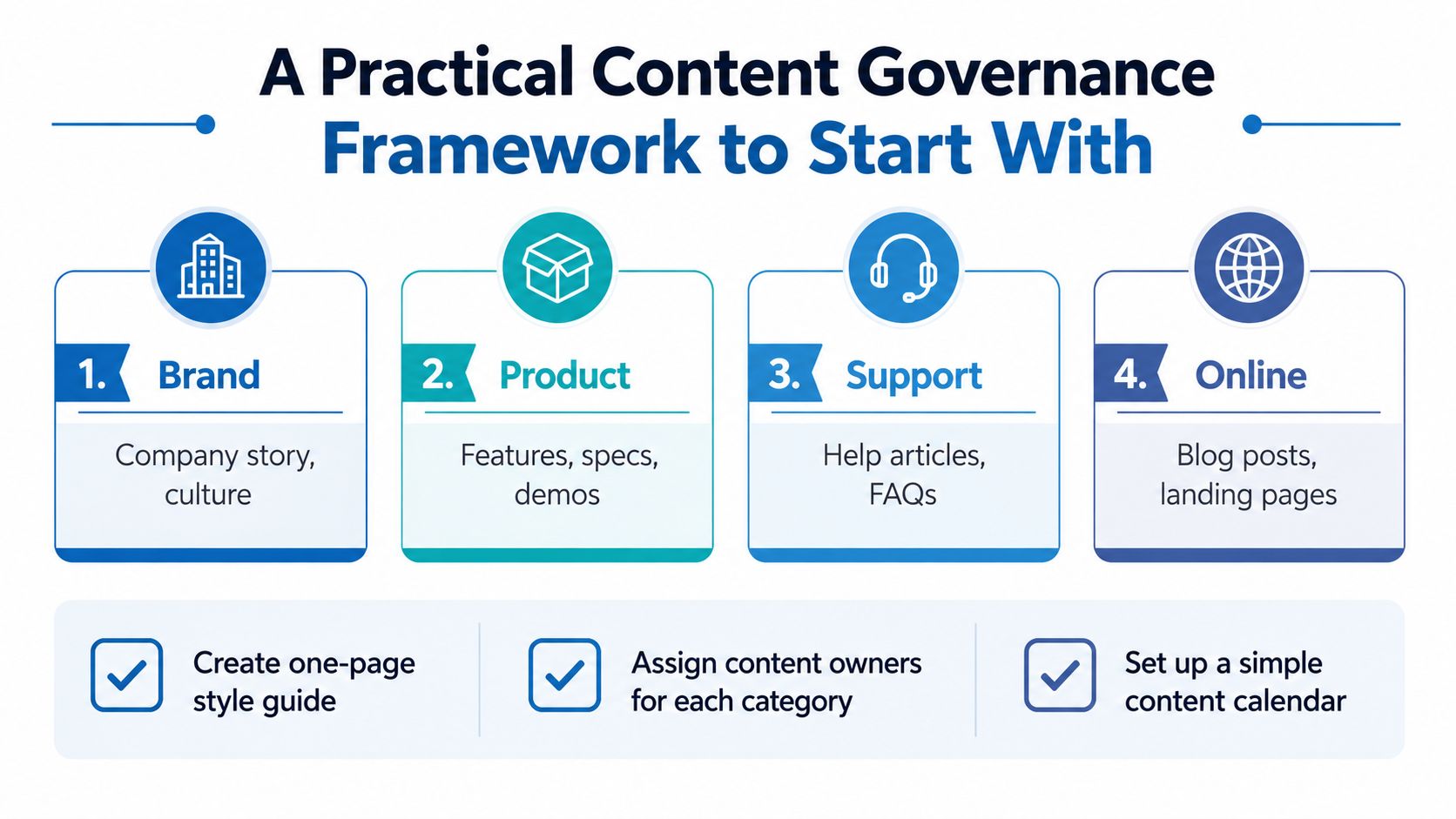
Start with a taxonomy, not a large policy manual. A taxonomy is the controlled set of categories used to organize content, and it gives each category a clear route through governance.
A simple brand taxonomy might include:
- Brand: Company story, leadership, culture, newsroom, and corporate information.
- Product: Features, specifications, comparisons, demos, and commercial claims.
- Support: Help articles, FAQs, troubleshooting guidance, and service information.
- Online Reputation Management: Reputation assets, executive profiles, response content, trust pages, and search-focused resources.
Taxonomy governance requires defined roles, decisions, and maintenance procedures so categories don't drift through ad hoc tagging, as described in taxonomy governance best practices. Each category can inherit a base rule set, then add specific controls.
An ORM page may require source citations, a visible freshness date, and a named communications approver. A support article may need a product specialist and a review trigger tied to software or policy changes. A brand page may require executive or corporate communications approval.
Put routing information in the record
Store governance metadata on every content entry. Useful fields include:
- Content type: Article, landing page, product page, profile, or support resource.
- Audience: Customer, journalist, employee, investor, or general public.
- Risk level: Low, medium, or high based on subject matter and potential exposure.
- Owner: The person accountable for accuracy and maintenance.
- Review cadence: The expected interval or event-based trigger.
- Retirement date: The point at which the owner must decide whether to update, merge, redirect, or remove the item.
A metadata governance example from Adobe includes fields such as status, last reviewed, review cycle, review owner, and severity to make maintenance responsibility visible. Adobe's metadata governance policy template shows how these fields can support standardized terminology and scheduled reviews.
Match approval to exposure
Use a simple matrix. Tier 1 content receives senior approval, Tier 2 content follows specialist review, and Tier 3 content can use self-service publishing with periodic checks. The labels matter less than the documented rule and the evidence that the rule was followed.
Pin a one-page checklist near the editorial board:
- Confirm the category and owner.
- Apply the correct policy.
- Record sources and risk level.
- Complete the required review gates.
- Set the next review or retirement action.
That small system gives a team enough structure to govern consistently without slowing every low-risk update.
Measuring Governance and Getting Started
A policy isn't working because it exists in a shared folder. It's working when the team can identify overdue content, correct errors, resolve ownership gaps, and retire pages that no longer serve users.
Useful operational measures include:
- Content past its review date: Shows whether maintenance work is keeping pace with the inventory.
- Draft-to-publish time: Reveals whether approval routing is proportionate or unnecessarily slow.
- Orphaned and duplicate pages: Highlights missing ownership and weak information architecture.
- Reputation-damaging inaccuracies corrected per quarter: Shows how quickly the organization detects and fixes public errors.
Expert guidance for enterprise frameworks recommends monitoring review cycle time, first-pass approval rates, and compliance-violation trends, then using the results to refine workflow controls. Acrolinx's framework guidance connects those measures with reducing the chance that policy gaps become public or legal problems.
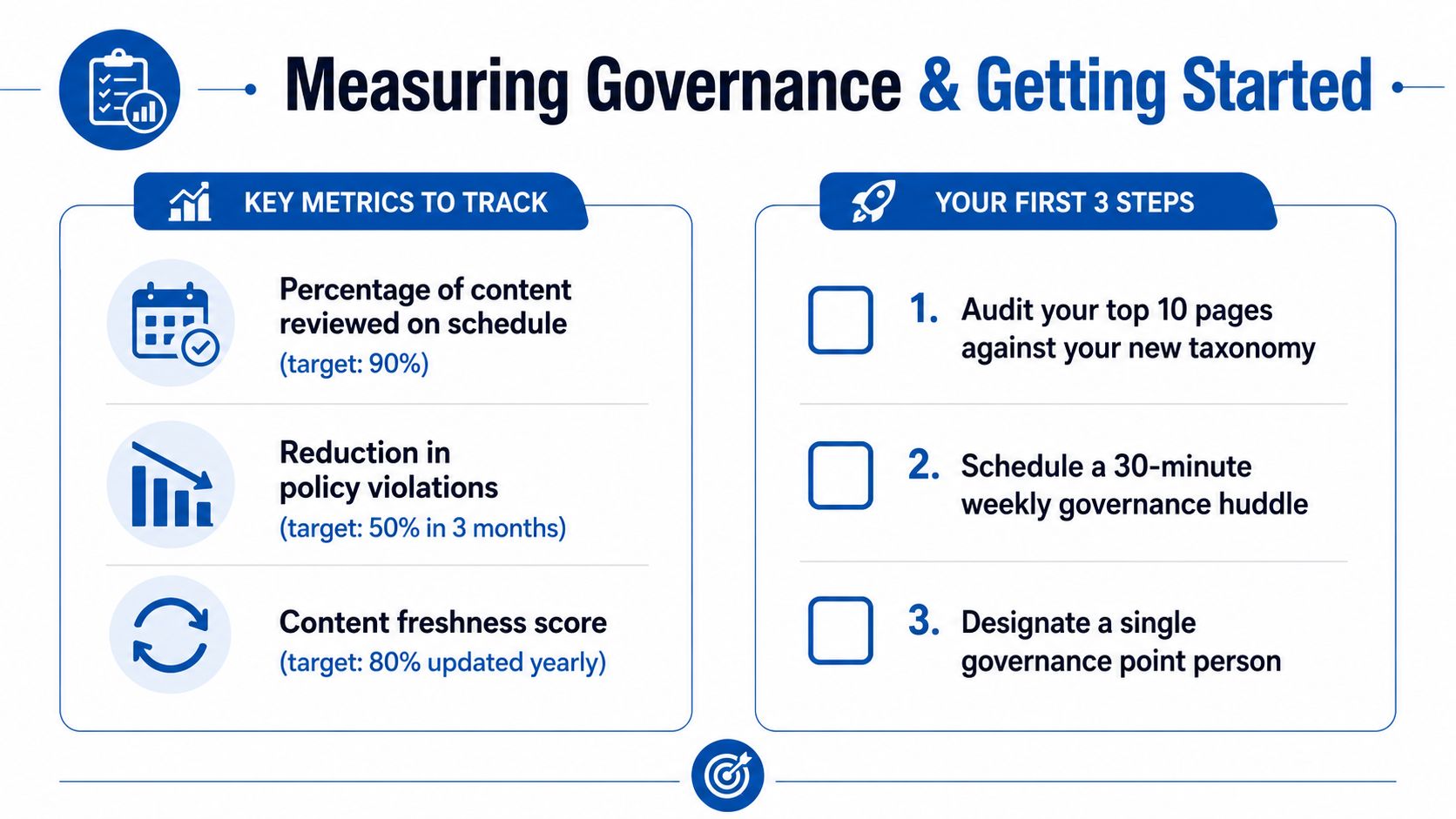
A manageable first month
Use the first month to establish control, not to perfect every rule.
- Audit the inventory: List public pages, social assets, profiles, support content, and reputation-related resources.
- Assign ownership: Give every important item a named owner, even if one person owns several categories.
- Write the one-page policy: Cover voice, accuracy, sourcing, legal triggers, approval rights, and retirement actions.
- Define the approval chain: Map content tiers to specific reviewers and publishers.
- Schedule the first quarterly review: Put the meeting on the calendar before the launch work becomes urgent.
For reporting and decision support, content performance analytics can help teams connect content activity with business and reputation signals. Small teams don't need a bureaucracy. They need a short policy, visible ownership, a lightweight workflow, and a recurring review habit.
Frequently asked questions
Is content governance only for large organizations? No. Small teams benefit because unclear ownership creates delays and errors regardless of size. One person can hold multiple roles, but the decisions and responsibilities should remain explicit.
Does governance mean every page needs legal approval? No. Approval should match risk. Legal or compliance review belongs on defined high-risk content, while routine material can follow a lighter editorial path.
Should old content always be deleted? No. Review its purpose and accuracy first. Update valuable pages, merge overlapping resources, redirect superseded URLs, and retire content that no longer informs users or represents the organization truthfully.
How does governance relate to Online Reputation Management? It controls the creation, review, maintenance, and retirement of the pages that shape public understanding of a brand. That includes positive assets, responses, profiles, support information, and content that could create search or trust risk.
Governance is judged by what gets corrected and retired, not just by how many posts ship. Start with the pages audiences already find, make ownership visible, and build the review habit around the content most capable of influencing trust.
TheBestReputation helps organizations coordinate SEO, public relations, content governance, monitoring, and reputation response workflows. Visit TheBestReputation to explore structured audits and action plans for managing the content audiences encounter across search and social channels.

