Reputation Management for Realtors: A Practical Playbook
A prospective client searches your name after a referral. They see a few prominent negative reviews, an incomplete Google Business Profile, inconsistent office information, and no clear evidence that you understand their neighborhood or property type. Your actual experience may be strong, but the search results tell a thinner story. The prospect contacts another realtor before you ever get the chance to explain what happened.
That gap is the central challenge in reputation management for realtors. Star ratings matter, but they’re only one part of a larger trust architecture. Buyers and sellers also look for local expertise, communication quality, transaction experience, authoritative third-party coverage, and signs that the agent handles problems professionally. The work is not about hiding an unpleasant review. It’s about making the full digital footprint accurate, credible, and useful.
Table of Contents
- Why Realtor Reputation Has Become a Conversion Factor
- Conducting a Complete Reputation Audit
- Building a Sustainable Review Acquisition System
- Optimizing Local SEO to Reinforce Your Reputation
- Using Media and Thought Leadership to Build Authority
- Responding to Negative Reviews and Crisis Situations
- Measuring Reputation Impact with Real KPIs
Why Realtor Reputation Has Become a Conversion Factor
A seller compares three agents after receiving a referral. One profile shows a complete biography, recent client feedback, neighborhood-specific guidance, and evidence of well-managed transactions. Another has a high rating but little detail. The third has outdated information and unanswered complaints. Before any consultation, the digital footprint has already shaped who appears trustworthy.
Real-estate decisions involve substantial money, uncertainty, and personal stakes. Prospects often compare a small group of agents before making contact, so the first page of search results can stand in for direct experience. An empty profile, stale review activity, or generic biography may create enough doubt for a prospect to choose someone else.
Consumer data supports treating reputation as a business function rather than a vanity project. In 2025, BrightLocal reported that 42% of consumers trusted online reviews as much as personal recommendations, down from 79% in 2020. That decline makes review quality, freshness, and response practices especially important for agents competing in markets where trust determines who gets the first call. The findings also indicated that detailed written feedback, photos, and videos can carry more credibility than star ratings alone. BrightLocal research summarized by SMK
A separate 2025 consumer study found that 39% of respondents always read local reviews, while 34% do so most of the time, and 94% place at least some trust in reviews. It also reported that 55% trust what reviews say about a business over what the business says about itself. GatherUp’s 2025 local review study For an agent, a polished self-description cannot compensate for a review profile that appears neglected or contradictory.
Practical rule: Treat every branded search as an unstaffed consultation. The prospect is asking, “Can I trust this person with my move?” Search results should answer with evidence, not adjectives.
The trust signal is broader than the rating
A UK survey offers a useful corrective to star-rating obsession. Only 10% of respondents said they completely trust reviews, yet 70% of buyers aged 25 to 34 still rely on reviews when selecting an estate agent. The same research found that 42% of consumers cited local-market knowledge as the dominant valuation factor. Victor Michael’s review and estate-agent trust analysis
Reviews influence selection even when confidence in reviews is limited. Prospects use them as clues, then test those clues against other signals. Does the agent discuss specific neighborhoods? Do clients mention clear communication and transaction guidance? Does the profile show relevant listings, service areas, and community involvement?
Reputation work should connect feedback with proof across the agent’s digital footprint. A review praising communication becomes more persuasive when the profile, website, and third-party coverage reinforce that pattern. Operational tools such as bulk mail for agents can support consistent client communication, but messages should invite honest feedback rather than manufacture praise.
Conducting a Complete Reputation Audit
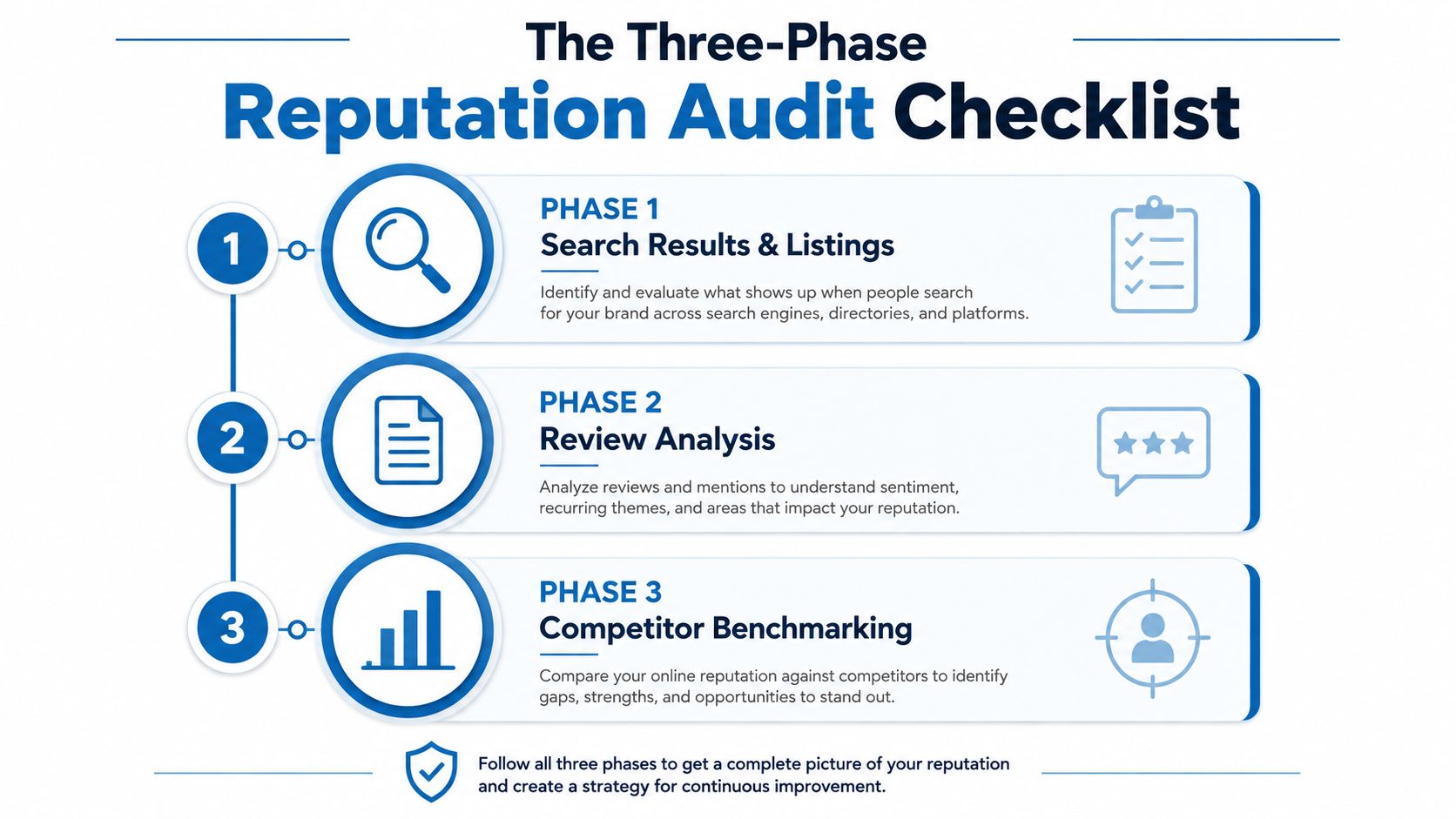
The first step in a repair project is not requesting more reviews. It’s observing the same digital environment a prospective buyer or seller sees. Search while logged out, use the locations where the realtor operates, and record the results before changing profiles or publishing new content.
Phase one searches the branded footprint
Search the realtor’s full name, name plus city, name plus brokerage, and service-specific phrases connected to the actual business. Review Google results, Google Business Profile, Zillow, Realtor.com, Yelp, social accounts, local directories, news coverage, and AI search results. Note which pages appear prominently, whether information conflicts, and whether a negative item is visible without a searcher needing to dig.
Separate conversion threats from cosmetic annoyances. A false allegation on a highly visible page deserves faster attention than an outdated directory description that few prospects encounter. Also record positive assets that could be strengthened, such as an expert profile, a detailed client testimonial, or a useful neighborhood article.
Phase two examines review quality and policy status
Read reviews for recurring themes, not just averages. Group feedback by communication, negotiation, local knowledge, transaction organization, responsiveness, and outcome. This reveals what the market already believes about the agent and where the client experience needs operational improvement.
Zillow has specific eligibility controls. Only buyers and sellers who have communicated or worked with an agent can submit a review and rating, and reviewers must create a Zillow profile. Zillow also moderates submissions before publication. Zillow’s agent review FAQ
Phase three benchmarks the strongest competitors
Compare the top local agents across profile completeness, review detail, review freshness, responses, categories, photos, service pages, directory consistency, and third-party mentions. Don’t copy a competitor’s positioning blindly. Identify the proof they surface that your client lacks, then decide whether the gap is caused by weak marketing, weak operations, or both.
A structured free online reputation audit can help organize these findings. Prioritize issues using three questions: how many prospects see it, how strongly does it affect trust, and how realistically can the team change it? That keeps the project focused on visible business risk rather than an endless list of minor profile edits.
Building a Sustainable Review Acquisition System
A review program should follow the client journey, not the agent’s memory. The best request usually arrives after a meaningful point of satisfaction, such as a successful closing, a clear resolution to a difficult issue, or a client expressing appreciation for specific guidance. Ask while the experience is still fresh, then make the next step easy.
Use neutral language. “We’d appreciate an honest review of your experience working with our team. If you choose to write one, mentioning the parts of the process that were most useful to you can help future buyers and sellers know what to expect” invites detail without demanding a positive result. Avoid telling clients what rating to choose, asking only happy clients, or offering compensation tied to favorable feedback.
Build requests into normal operations
Assign ownership inside the transaction workflow. A coordinator can send the first request after closing, while the agent follows up personally when a client has already volunteered positive feedback. Keep a record of who was asked, when the request was sent, which platform was used, and whether the client completed it. The system should work during busy periods, not only when the agent remembers to send individual messages.
The request channel should match the relationship. Email works well for a detailed written review, while a direct text can be appropriate when the client already communicates by text and has provided the required permission. Keep the message concise and link directly to the intended review destination. Never pressure a client to post the same statement across multiple platforms.
Understand platform differences
Zillow’s moderation rules give reputation teams a defined review-repair path. Its guidelines identify foul or inappropriate language, personal attacks, offensive comments, spam, irrelevant information, and compensation-linked submissions as reasons content may be rejected or removed. Zillow’s review guidelines
Google requires a different discipline around privacy. Its Business Profile rules prohibit soliciting content containing private or confidential information, including personal financial information, government IDs, name-linked contact information, sensitive records, images, transcripts, or links containing personal information. Google’s Business Profile content policy
Review volume alone isn’t a sustainable objective. Detailed comments about communication, neighborhood knowledge, negotiation, and transaction coordination create stronger evidence than a stream of vague praise. Use practical ways to leverage online reviews to turn legitimate feedback into website proof, social content, internal service improvements, and future story angles.
Optimizing Local SEO to Reinforce Your Reputation
A realtor can have excellent reviews and still remain hard to find for high-intent searches. Reputation becomes commercially useful when prospects encounter it while searching for an agent in a specific market, neighborhood, or property category. That requires alignment between the Google Business Profile, website content, directory data, reviews, and local authority.
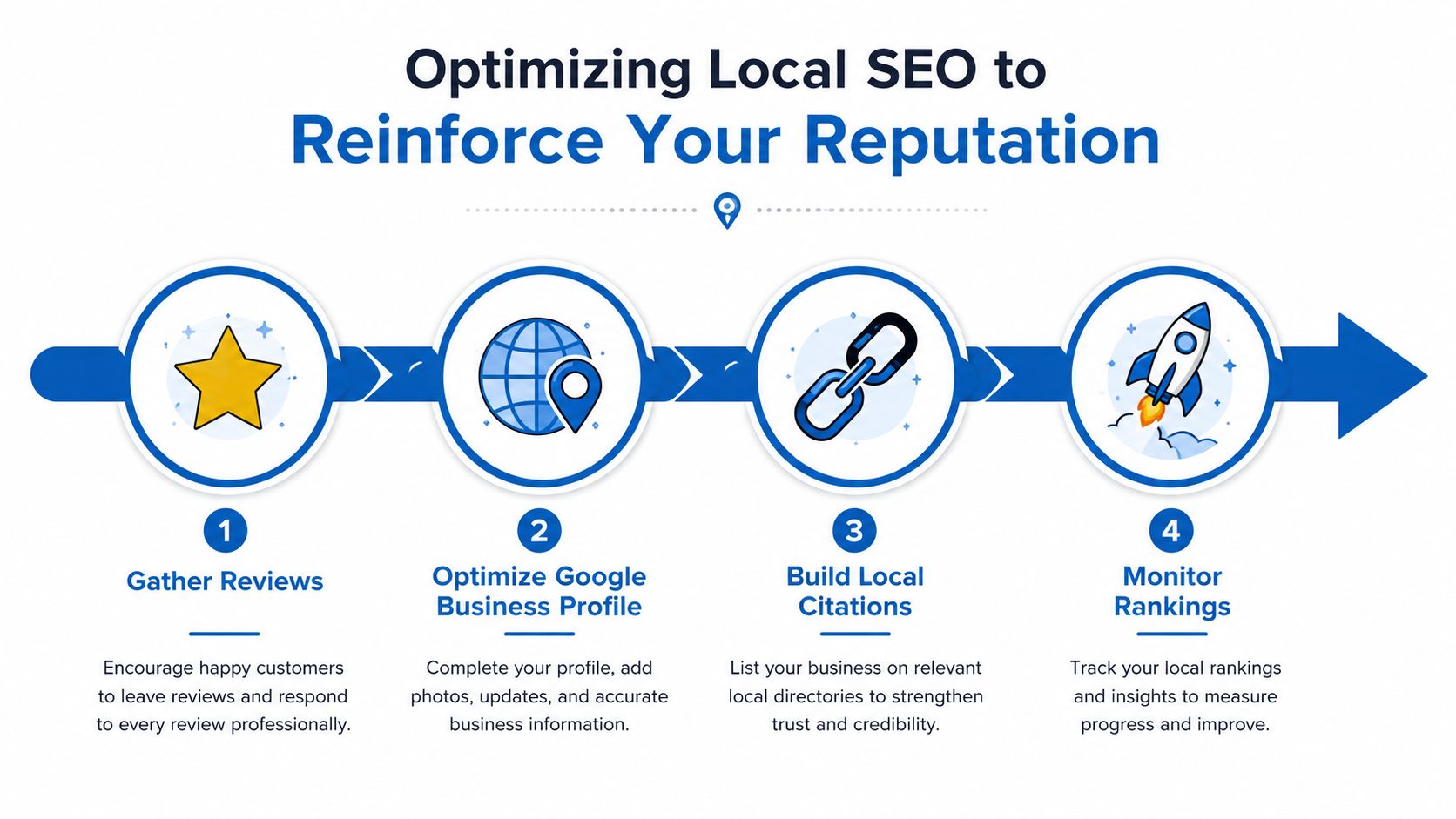
Start with the Google Business Profile. Select categories that accurately describe the business, define legitimate service areas, add current photos, publish useful updates, and make the services specific. A realtor targeting luxury homes in a particular city should not rely on a generic agent description. The profile should support the actual markets and services the realtor wants to win, such as waterfront property, relocation, first-time buyers, commercial real estate, or named neighborhoods.
Connect the profile to the website
Create supporting pages that answer real local questions. A page about buying a waterfront home should demonstrate familiarity with relevant communities, property considerations, and the client process. A first-time buyer page should explain how the agent communicates, coordinates professionals, and guides decisions. These pages work best when they provide practical information rather than repeating city names.
Keep the business name, address, and phone information consistent across local directories. Correct outdated offices, duplicate profiles, mismatched phone numbers, and old branding. Incomplete data weakens confidence even when the information is technically discoverable.
A complete Google Business Profile has measurable trust value. Independent local-search research reports that consumers are 2.7 times more likely to consider a business reputable when they find a complete profile and 70% more likely to visit that business in person. The same source reports that 88% trust online reviews as much as personal recommendations and 93% say reviews affect local buying decisions. Local SEO statistics from SHNO
Use visibility as a second-stage conversion test
Once the profile becomes visible, improve what the searcher sees. BrightLocal reported that listings with 5 stars earned 69% of Local Pack clicks, which reinforces the need to manage rating, freshness, and response quality after ranking is achieved. BrightLocal’s review click-through study
Watch the following video for a visual explanation of the local SEO workflow.
The most effective local SEO tactics for reputation combine these signals instead of treating reviews, content, and listings as separate projects.
Using Media and Thought Leadership to Build Authority
A profile can list an agent’s experience, but an independent interview shows how that expertise helps people make local property decisions. That distinction matters when search results already contain review platforms and social profiles, yet provide little outside evidence of local knowledge, communication quality, or transaction judgment.
A practical media strategy starts with useful market insight. An agent might comment on housing-market changes, relocation patterns, neighborhood development, luxury property, investment decisions, or the effects of interest rates. The angle should give a journalist’s audience meaningful context and avoid reading like an advertisement for listings.
Turn expertise into a repeatable pitch
Build a short source sheet covering the agent’s markets, property specialties, transaction perspective, and areas of demonstrated knowledge. Track local business journals, real-estate publications, community outlets, podcasts, and reporters who cover housing. Pitch one specific observation supported by the agent’s experience, followed by a concise explanation that can stand on its own.
A media placement shifts search-result composition, replacing review-platform clutter with independent proof of expertise. A prospect may find an interview or bylined article that shows how the agent evaluates neighborhoods, communicates decisions, and handles the practical details of a transaction.
A client-support workflow can help identify timely conversations and manage follow-up. For teams exploring automation around lead handling, Expressify AI lead automation can support organization alongside human media coordination. Automation can sort opportunities and reminders, but editorial judgment and authentic expertise still require the agent or team.
Make the placement discoverable
After publication, update the agent’s website and professional profiles to reference the coverage accurately. Use the exact name, brokerage, market, and topic associated with the article. Link to the original publication from a media page, then create supporting content that adds analysis without copying the article.
A media placement creates authority. Search strategy makes that authority findable.
This combined approach reflects the practical value of a thought-leadership content strategy. It gives prospects a fuller trust picture, particularly when review sentiment is mixed but the agent can demonstrate meaningful expertise, clear communication, and successful transaction experience.
Responding to Negative Reviews and Crisis Situations
A negative review creates two tasks. You must decide whether the content violates platform rules, and you must show future readers how the business handles criticism. Removing a review is useful when policy supports it, but removal alone doesn’t repair a pattern of poor communication or missing context.
Start by preserving evidence. Capture the review, reviewer profile, date, transaction records, and relevant communications. Classify the issue as genuine dissatisfaction, factual dispute, irrelevant content, personal attack, spam, privacy violation, or suspected manipulation. Then use the platform’s reporting process only when you can connect the complaint to a specific rule.
Choose the response before choosing the wording
For a communication complaint, acknowledge the experience without exposing private transaction details: “We’re sorry the communication did not meet expectations. We’d like to review what happened and discuss it privately. Please contact our office through the details on our profile.”
For a factual dispute, avoid arguing point by point in public. State that the account doesn’t match the available records, invite a private conversation, and document the evidence for the platform or counsel. Don’t identify confidential terms, financial information, or personal details in an attempt to win the comment thread.
If several complaints describe the same failure, treat them as operational evidence. Review the handoff process, response expectations, showing coordination, and closing communication. A polished reply won’t offset a recurring service problem.
During a fast-moving incident, appoint one decision-maker, pause improvised posts, monitor branded searches and social mentions, and publish a concise factual update when verified information is available. Escalate defamatory claims, privacy violations, threats, or coordinated abuse to appropriate legal and platform channels. Silence can be better than speculation, but it shouldn’t become an excuse to ignore legitimate clients.
Measuring Reputation Impact with Real KPIs
Reputation reporting should connect activity to visibility and conversations. Track review volume, review velocity, recency, rating direction, response rate, average response time, profile completeness, listings-in-sync status, local rankings, branded-search clicks, website actions, and lead-source attribution.
A useful report separates inputs from outcomes. Requests sent and responses published are inputs. More qualified calls from local searches, stronger branded-search engagement, and improved consultation quality are outcomes. Don’t claim causation from a single new lead. Compare trends against the work completed and record what changed.
| Metric | Target Benchmark | Review Frequency | Action Trigger |
|---|---|---|---|
| Review volume and velocity | Consistent growth from legitimate clients | Monthly | Requests are irregular or concentrated in one period |
| Review recency | A steady flow of current feedback | Monthly | The profile appears inactive compared with competitors |
| Response rate and response time | Every new review receives a thoughtful response | Weekly | Reviews remain unanswered or replies sound copied |
| Local Pack visibility | Improvement for priority markets and services | Monthly | The profile appears for branded searches but not target local terms |
| Profile completeness | All relevant fields, services, photos, and updates maintained | Monthly | Missing information or outdated details reduce confidence |
| Lead attribution | Increasing clarity about calls, forms, referrals, and search | Monthly | Staff can’t identify which reputation assets influence inquiries |
One benchmark for competitive review profiles says fewer than 10 reviews can be barely visible in competitive map packs, 50 reviews marks the beginning of competitiveness, and 200 or more reviews can represent entry into top-three visibility in dense urban categories. The same benchmark recommends weekly review responses and monthly funnel audits, while describing a possible 12 to 18 month period for disciplined programs to overtake larger competitors. Industry review and reputation benchmark
Those figures are benchmarks, not promises. Market density, category, profile quality, and service relevance still matter. A monthly meeting should end with decisions, such as repairing a directory cluster, improving a service page, changing the client request workflow, or escalating a policy-violating review.
TheBestReputation combines review management, local SEO, search-result repair, content governance, media relations, and crisis workflows for realtors and brokerages that need a stronger digital trust profile. Visit TheBestReputation to request an assessment of what prospects currently see and identify the highest-impact steps for building proof of local expertise, communication quality, and transaction experience.

