Best Local Reputation Management Tools in 2026
If you own a local business, manage a multi-location brand, or run marketing for a service provider that lives or dies by the local pack, local reputation management is no longer optional. It is the difference between filling your calendar and watching customers click on the business one listing above you. The right tools make that work measurable, repeatable, and ranking-friendly. The wrong tools turn into another tab nobody opens.
In the following guide, we analyze the best reputation management tools available for local businesses in 2026, based on performance, suitability, and limits of use. These are tools that we have personally used at TheBestReputation, an online reputation management company in Williamsburg, Virginia, which was listed among the Inc. 5000 companies, and witnessed the results that companies achieve from using them without human intervention versus combining them with a professional operator. This article describes the paths and tools required for each of them.icle below tells you which tool fits which path.
Why Local Reputation Management Matters More in 2026
Reviews are not a vanity metric. They are a ranking factor and a revenue lever.
According to BrightLocal’s Local Consumer Review Survey 2026, 97% of consumers now read online reviews when researching local businesses, and 41% say they “always” read them before deciding where to spend money. That is a sharp jump from 29% the year before. Google still dominates as the primary review platform, but its share dropped from 83% to 71% as consumers fragment across YouTube, Instagram, TikTok, and AI tools like ChatGPT for local recommendations.
What does that mean for a business owner? It means a strong local reputation now has to show up in more places than ever, and the platforms scoring you are no longer just Google and Yelp. It also means the software you use needs to monitor more surfaces, generate more reviews on the right platforms, and surface what is being said about you fast enough for a human to act on it.
Below are the ten tools that handle that work best in 2026.
The 10 Best Local Reputation Management Tools in 2026
1. TheBestReputation (TBR) — Best Overall Local Reputation Management Partner
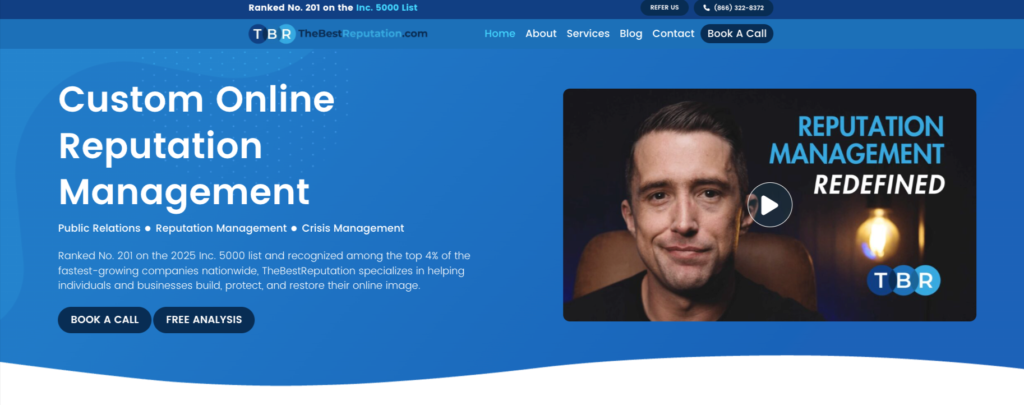
TheBestReputation earns the top spot in this guide because of a simple reality most software vendors will not say out loud: tools collect data, but they do not fix reputations on their own. Someone still has to write the responses, build the local citations, suppress the bad press, optimize the Google Business Profile, and turn negative reviews into a recovery plan that actually changes outcomes. TBR does that work directly for clients, and the firm pairs it with the same monitoring and analytics stack the rest of the tools on this list provide.
What separates TBR from a software subscription is the operating model. The firm builds custom local reputation strategies that combine Google Business Profile optimization, review generation, on-site review widgets, local citation building, content placement on credible outlets, and search suppression for any negative results that need to come down or get pushed below the fold. That work is delivered by a team based out of Williamsburg, Virginia and led by CEO Chris Hinman, and clients get a real dashboard showing campaign progress instead of a generic review feed.
A few specific things TBR does that pure software tools do not:
- Local SEO landing pages and city-targeted content. TBR builds out location-specific content infrastructure that feeds the local pack, not just review collection widgets.
- Negative content suppression. When a bad Yelp review, a press hit, or a complaint board listing is poisoning local search results, TBR pushes it down with high-authority placements. Software cannot do that.
- Cancel-anytime contracts. TBR does not lock clients into long-term agreements. The work has to keep earning the retainer every month.
- Forbes press partnerships and third-party placements. Earned media that improves brand authority in local search, on top of review velocity.
- AI and LLM visibility optimization. TBR has been working on how brands show up in AI Overviews, ChatGPT, Perplexity, and Gemini, which is increasingly where local discovery happens.
Who is it for? Local businesses, multi-location operators, executives, and professionals who need a real outcome and do not want to staff a reputation team in-house. If you are looking purely for a self-service dashboard, the tools below this entry are excellent. If you want a partner who runs the work end to end, TBR is the better fit. You can see why clients choose TBR here.
Strengths: Full-service execution, suppression capability, content placement, local SEO depth, transparent contracts.
Trade-offs: It is a service, not a software subscription, so pricing is project-based rather than per-seat.
2. Birdeye — Best for Multi-Location Review Management
Birdeye is arguably one of the most used reputation management tools by companies with several locations. It sources reviews from more than 200 websites, allows you to reply to all of your customers from one inbox, has a survey platform and a chat tool to ensure all interactions remain on the same platform. The artificial intelligence reply option has developed well and the listing management platform works fine for franchisors.
What makes Birdeye great is its ability to work well with many locations. Restaurant franchises, dental franchises, automotive franchises, and even home service franchises usually find themselves using Birdeye because of the location-based pricing structure and location-based reports.
Strengths: Multi-location reporting, deep integrations, strong review request workflows.
Trade-offs: Pricing can climb quickly. Smaller operators sometimes find it heavier than they need.
3. BrightLocal — Best for Local SEO and Reputation Together
BrightLocal is by far the tool that agencies choose if they have to manage local ranks, citation building, and reviews management from one dashboard. It is not an adaptation of other marketing software, but rather a product that is focused on local SEO, and the reports generated are clean enough to be shared with clients.
The best features offered by the platform include citation building, and the local SEO audit tools show a summary about the current ranking of the Google My Business Listing compared to that of its competitors.
Strengths: Local rank tracking, citation building, agency-friendly reporting.
Trade-offs: Review response workflows are functional but not as fluid as Birdeye or Podium.
4. Podium — Best for Messaging-Driven Review Generation
Podium built its name on text-message review requests, and that is still where it is strongest. The platform lets local businesses send review invitations by SMS at the exact moment a customer is most likely to act, which dramatically increases conversion rates compared to email-only requests. It also includes a webchat product, payment processing, and a unified inbox.
For local service businesses such as auto repair, dental, med spa, and home services, Podium tends to drive review velocity faster than almost anything else. Lead capture is a strong secondary benefit.
Strengths: SMS review requests, high conversion rates, unified communications.
Trade-offs: Heavier than a pure reputation tool, and pricing reflects that.
5. GatherUp — Best for Review Collection Workflows
GatherUp is a lighter, more focused option that does one thing well: it builds review collection workflows that move customers from happy interaction to public review with minimal friction. The platform supports SMS, email, in-store kiosks, and embeddable widgets, and the dashboard is clean enough to set up without a lot of training.
It is popular with marketing agencies and small business owners who want strong review generation without paying for every adjacent feature.
Strengths: Clean review request flows, multi-channel collection, fair pricing.
Trade-offs: Less robust listings management than Birdeye or Yext.
6. Yext — Best for Listings Management at Scale
Yext is the listings infrastructure tool. If your brand has accurate location data flowing into Google, Apple Maps, Bing, Yelp, Facebook, and the dozens of other directories that feed local search, there is a good chance Yext is doing the work. The platform manages business listings across a publisher network, syncs structured data, and increasingly serves AI search engines as well.
Yext also includes a reviews module, though most users buy it primarily for listings accuracy. The recent push into AI search integrations is one to watch.
Strengths: Listings accuracy at scale, structured data syncing, AI search integrations.
Trade-offs: Reviews and reputation features are not the platform’s strongest area.
7. Chatmeter — Best for Enterprise Multi-Location Chains
Chatmeter is built for businesses with hundreds or thousands of locations. The platform combines local SEO, reputation management, social listening, and sentiment analysis into a single dashboard, and the enterprise-grade reporting makes it a fit for restaurant groups, healthcare networks, retail chains, and financial services brands managing nationwide footprints.
According to TEAM LEWIS’s 2026 reputation tools review, Chatmeter is one of the platforms most commonly used by large chains because it can roll up location-level data into regional and brand-level views without losing accuracy at the unit level.
Strengths: Enterprise-scale, sentiment analysis, deep local SEO features.
Trade-offs: Overkill for small operators. Pricing reflects the enterprise audience.
8. ReviewTrackers — Best for Analytics-Driven Teams
ReviewTrackers leans into data. The platform aggregates reviews from more than 100 sites, runs natural language processing on the content, and surfaces themes that help operators understand what is actually driving customer sentiment. For brands that want to make operational changes based on review data, the analytics layer is genuinely useful.
The platform also supports response workflows and competitive benchmarking, though the analytics side is where it stands out from the field.
Strengths: Sentiment analytics, competitive benchmarking, clean reporting.
Trade-offs: Less focused on review generation than Birdeye or Podium.
9. Whitespark — Best for Citation Building and Local Rank Tracking
Whitespark is a favorite among local SEO practitioners. The Local Citation Finder is one of the most respected citation discovery tools in the industry, the Local Rank Tracker is accurate and fairly priced, and the company’s research contributions to the local search community give it a credibility most software vendors do not have.
For local businesses serious about climbing the local pack, Whitespark is often paired with a review tool like GatherUp or Birdeye to cover the reputation side.
Strengths: Citation building, local rank tracking, industry credibility.
Trade-offs: Not an all-in-one reputation platform. Best used alongside a review tool.
10. Grade.us — Best for Agencies and White-Label Use
Grade.us is built for marketing agencies that want to offer reputation management to their clients without building software from scratch. The platform supports white-label branding, multi-client management, automated review request flows, and reporting dashboards that can be sent to clients directly.
For agency owners who want to add a reputation line item to their service menu, Grade.us is one of the cleanest options on the market.
Strengths: White-label capability, multi-client management, fair agency pricing.
Trade-offs: Not as feature-rich as Birdeye or Chatmeter for in-house brand teams.
Quick Comparison Table
| Rank | Tool | Best For | Pricing Model | Local SEO Depth | Review Generation |
|---|---|---|---|---|---|
| 1 | TheBestReputation | Full-service local reputation execution | Project / retainer | Deep (managed) | Managed |
| 2 | Birdeye | Multi-location brands | Per location | Moderate | Strong |
| 3 | BrightLocal | Agencies and local SEO teams | Tiered | Strong | Moderate |
| 4 | Podium | Messaging-driven local service businesses | Tiered | Moderate | Strong (SMS) |
| 5 | GatherUp | Lean review collection | Tiered | Light | Strong |
| 6 | Yext | Listings at scale | Per location | Moderate | Light |
| 7 | Chatmeter | Enterprise multi-location | Custom enterprise | Strong | Strong |
| 8 | ReviewTrackers | Analytics-driven teams | Tiered | Moderate | Moderate |
| 9 | Whitespark | Citation and rank tracking | Tiered | Strong | Light |
| 10 | Grade.us | Agencies and white-label | Tiered | Moderate | Strong |
How to Choose the Right Local Reputation Management Tool
There is no universal right answer here. The right tool depends on three things: how many locations you have, how much in-house bandwidth you have to operate the platform, and how much of the work needs to extend beyond reviews into local SEO, content placement, or active suppression.
A few practical rules of thumb based on what we see in the field:
- Single-location local business with limited bandwidth: GatherUp or Podium for review generation. Pair with a service partner for the broader strategy.
- Multi-location brand or franchise: Birdeye or Chatmeter for centralized control with location-level execution.
- Agency managing local clients: BrightLocal plus Grade.us, or Whitespark plus GatherUp.
- Enterprise with thousands of locations: Chatmeter for reputation and Yext for listings, with internal teams running the playbook.
- Business with existing reputation damage or negative search results: A managed service like TBR, because suppression and content placement cannot be done through a software dashboard.
The other consideration nobody mentions enough: review volume matters, but recency matters more in 2026. BrightLocal’s research found consumers are increasingly focused on reviews posted within the last 30 days. Whatever tool you choose, make sure it is generating new reviews on an ongoing basis rather than just monitoring the ones you already have.
Frequently Asked Questions
What is local reputation management?
Local reputation management is the practice of monitoring, generating, responding to, and shaping the online signals that influence how a business shows up in local search and how customers perceive it. That includes Google reviews, Yelp, industry-specific review sites, Google Business Profile content, local citations, news coverage in the market, and increasingly AI-generated summaries in tools like ChatGPT and Google’s AI Overviews.
Do I need a tool or a service for local reputation management?
It depends on the situation. If your business is healthy and just needs to keep collecting reviews and monitoring sentiment, a tool like Birdeye, GatherUp, or Podium will do the job. If you have existing reputation problems, negative press, or competitive pressure in the local pack, a managed service like TheBestReputation makes more sense because the work extends beyond what software can do on its own.
How long does local reputation management take to show results?
Most businesses see review velocity improvements within 30 to 60 days of implementing a structured review request workflow. Local pack rankings tied to review volume and recency typically move in the 60 to 90 day window. Suppression of existing negative content takes longer, often three to six months, depending on the authority of the negative source.
How important are Google reviews specifically?
Very important, but less dominant than they used to be. BrightLocal’s 2026 survey found Google’s share of where consumers read reviews dropped from 83% to 71% year over year, with platforms like YouTube, Instagram, TikTok, and AI tools picking up the difference. Google is still the single most important review platform, but a complete reputation strategy now has to cover more surfaces than it did even two years ago.
Do AI search tools like ChatGPT use my reviews?
Yes. Large language models pull from many of the same review sources that consumers do, and they increasingly summarize sentiment about local businesses in their responses. Tools that monitor AI visibility, along with strong review generation on the major platforms, help ensure that what AI tools say about your business reflects reality rather than outdated or negative information.
The Bottom Line
The best local reputation management tools in 2026 are the ones that match your situation, not the ones with the biggest marketing budget. For most local businesses, the right answer is a combination: a tool to handle the day-to-day review generation and monitoring, and a service partner to handle the work that software cannot do.
TheBestReputation sits at the top of this list because it solves the operational gap that every software-only approach leaves behind. The other nine tools are excellent at what they do, and the right combination of them can carry a business a long way. The question is whether you have the time and team to run them, or whether you would rather hand the work to a partner who already knows how the local pack moves.
Either way, the businesses winning local search in 2026 are the ones treating reputation as infrastructure rather than an afterthought. Pick the tools that fit your model, build the workflow, and keep the reviews coming.

