Media Relations Strategy: A Practical Guide for 2026
Your company can do everything right on its own channels and still lose the story the first time a reporter asks a hard question. One unhelpful quote, one ignored email, or one stale press release sent to the wrong inbox can shape what buyers, investors, and searchers believe long after your team has moved on.
That’s why media relations strategy isn’t a distribution exercise. It’s a reputation engineering discipline that sits beside SEO, content governance, and crisis readiness, and it decides whether outside coverage reinforces your narrative or rewrites it. For a broader reputation lens, the online reputation management guide is a useful companion to this topic, especially if you’re trying to connect media work to search visibility and public perception. If you want the cleaner definition that connects the PR side to the ORM side, the internal 2026 guide to online reputation management is worth reading alongside this playbook.
Table of Contents
- Why Media Relations Decides Your Reputation Before You Do
- Setting Objectives, Audience, and Message Architecture
- Building a Recency-Weighted Media Map and Hit List
- Choosing Between Traditional Outlets and Nontraditional Channels
- Writing Pitches Journalists Open and Respond To
- Measuring Coverage Against Reputation and SEO Outcomes
- Your 90-Day Launch Plan and Crisis Playbook Touchpoints
Why Media Relations Decides Your Reputation Before You Do
A founder I worked with had a polished website, a strong LinkedIn presence, and a steady stream of customer wins. Then one critical article landed from a reporter the company had never spoken to, and the public story shifted overnight because the team had no earlier relationship, no prepared response, and no mapped narrative to counter it. Their own content still existed, but it no longer controlled first impression.
That’s the core job of media relations strategy. It shapes what journalists, searchers, and social audiences encounter before they ever reach your homepage, and that matters because third-party coverage often becomes the version people trust first. When media relations is weak, your brand leaves reputation to chance. When it’s disciplined, it helps determine which facts, sources, and angles get amplified.
Media relations is not just press release distribution
The old habit is to blast a release, wait, and call the day a win if a few outlets pick it up. That model breaks fast because journalists strongly prefer email-based pitching, with 96% preferring email pitches, 85% saying email is the best introduction method, and 92% not wanting social media pitches according to the survey cited by GTM 8020’s media relations statistics roundup. That same source notes 87% of PR professionals still use press releases, while poorly targeted pitches can hit a 90% irrelevance rate when they’re not tightly focused. The lesson is blunt, relevance beats volume, and channel discipline matters more than broadcast habits. GTM 8020’s media relations statistics
Practical rule: If you wouldn’t send the same note to a reporter, a creator, and a trade editor, don’t send it to all of them.
The more modern framing is closer to SEO than old-school publicity. Sprout Social’s public relations guidance emphasizes shared workflows, shared calendars, and defined metrics such as share of voice, sentiment trends, response time, and coverage reach before a campaign begins, while Public Relay describes strategy as starting with stakeholder segmentation, media prioritization, demographic and content analysis, and attribution work. That’s reputation engineering, not press clipping. It’s also why owned content, earned coverage, and crisis planning need to live in the same system.
For teams that still think of media relations as a side task, the result is usually predictable. A negative story outranks the company’s own explanation, a reporter’s unanswered inquiry turns into someone else’s version of the truth, and the brand spends weeks trying to clean up a narrative that could’ve been shaped earlier. Coverage isn’t just publicity. It’s infrastructure for what people believe next.
Setting Objectives, Audience, and Message Architecture
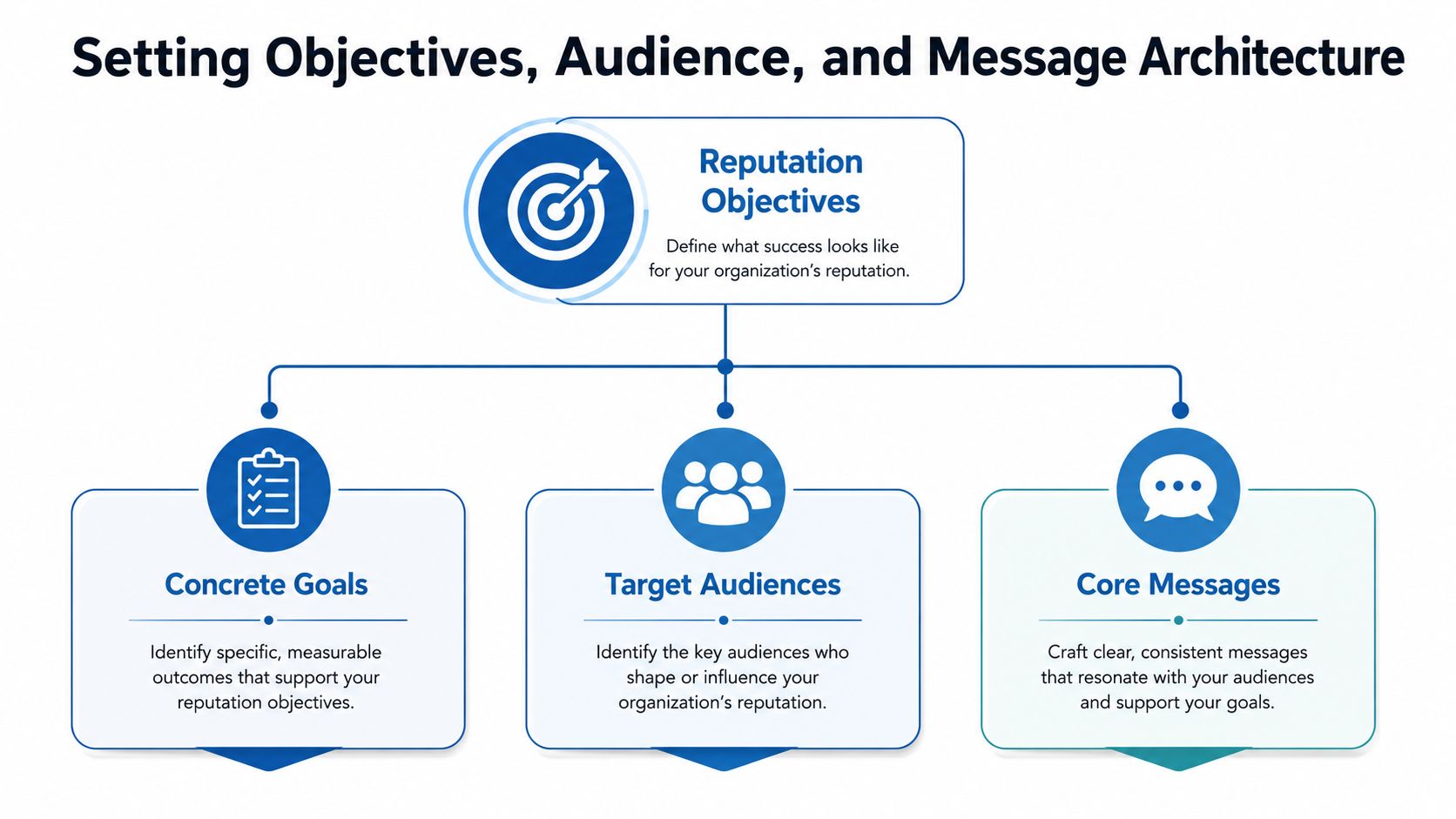
Weak programs start with a lazy objective like “get more press.” Strong programs start with an outcome tied to reputation, search, or stakeholder confidence. That could mean displacing a negative article, establishing executive credibility in a new vertical, or building third-party validation before a funding event.
Start with a measurable reputation outcome
The objective has to be specific enough that the team can tell whether the work moved the needle. Sprout Social’s guidance supports this kind of planning by pushing teams to define metrics such as share of voice, sentiment trends, response time, and coverage reach before launch. In practice, the objective statement should name the audience, the reputation gap, and the business moment you’re trying to support.
A useful format is simple. State the desired perception, the audience, and the proof point you want to create. Then write the same goal in plain language so executives can repeat it without sounding like they borrowed it from a dashboard.
Practical rule: If the objective can’t be understood by the CEO, the spokesperson, and the content lead in one reading, it isn’t ready.
Separate audiences before you write anything
Do not treat “the press” as one block. A journalist, a customer, an investor, and a regulator may all hear the same announcement, but they’re not looking for the same meaning. Public Relay’s strategy guidance starts with stakeholder segmentation and media prioritization for a reason, because the message that satisfies one audience can confuse another.
Build three layers. First, list the primary journalist or creator audiences by beat. Second, define the stakeholder group that cares about the outcome. Third, assign the one thing each group needs to believe after reading your coverage. That keeps the pitch from drifting into generic corporate language.
Pressure-test the message house
Your core message should stay stable, but its supporting language should flex. Write one core message, then create three derivative messages, one for a launch, one for defense after a critical article, and one for crisis response. The launch version can be more forward-looking. The defense version needs more proof and less flourish. The crisis version has to be short, specific, and defensible.
A simple pressure test helps. Read the message house against a proactive launch, a hostile article, and a live incident. If the words start sounding evasive, too broad, or too promotional, rewrite them before anyone starts pitching. That work is tedious, but it keeps your team from improvising under pressure later.
Building a Recency-Weighted Media Map and Hit List
Static media lists rot fast. A spreadsheet exported six months ago can look busy and still be useless because the bylines stopped, the beats shifted, or the reporter moved to another publication. The better operational unit is a living media map built around recency, outlet behavior, and fit.
Use recency, not nostalgia
One of the biggest gaps in media relations advice is timing intelligence. A lot of guides tell you to research journalists and tailor pitches, but they stop short of asking who is actively covering the beat right now. A recent practitioner example recommends looking for journalists who published in the last 30 to 60 days and building a 10- to 15-journalist hit list for a campaign, which is far more actionable than a sprawling list of names with no signal. This practitioner video on timing intelligence
That doesn’t mean you ignore legacy relationships. It means you separate active reporters from dormant contacts. If someone hasn’t written on your topic in months, they’re not your first call just because they once covered the category.
Segment the map by outlet behavior
Treat the media universe as categories with different jobs. National business press can create broad credibility. Trade publications can influence buyers. Regional outlets can make a story feel local and immediate. Niche newsletters, Substack writers, podcast hosts, and social-first creators can move specific communities faster than a large masthead can.
Use a one-page map with columns for beat, outlet type, recent coverage, preferred format, and pitch angle. Then add a note on whether the outlet favors commentary, data, founder stories, or reactive analysis. That way your team isn’t guessing when a journalist ignores a product pitch that never matched their pattern in the first place.
Keep the database alive
Workflow beats enthusiasm. Monitor new bylines through RSS feeds, LinkedIn signals, and direct platform checks, then refresh the list after each campaign instead of waiting for a quarterly cleanup. The internal rule is simple, a journalist database that isn’t updated is a liability, not an asset.
For teams building their monitoring stack, the online reputation monitoring tools and services guide is a practical reference point because the same discipline that tracks reputation risk also helps maintain media list quality. You want one source of truth, not a pile of disconnected tabs that nobody trusts.
Choosing Between Traditional Outlets and Nontraditional Channels
Mainstream publications still matter, but they’re no longer the only path to visibility. A strong media relations strategy now weighs traditional authority against channel-specific influence, and the right answer depends on the audience, the story, and the speed you need.
Match the channel to the audience
Traditional outlets work well when the goal is broad legitimacy, executive credibility, or investor-facing validation. Trade press often works better than national press for technical stories because the reader already cares about the category. Broadcast can be valuable for simple, visual, or highly local stories, but it’s a poor fit for nuanced product explanations.
Nontraditional channels can outperform traditional media when the audience is narrow and the topic is specialized. A niche newsletter writer, a YouTube creator, or a community voice on Reddit or Quora may reach exactly the people who will use the information. That’s why an academic PR text notes that “reaching out to bloggers could be more beneficial than targeting news reporters” for some stories, especially when the subject is technical or audience-specific. Academic PR text on bloggers and reporters
Evaluate credibility by fit, not follower count
A small audience isn’t a weakness if the audience is the one you need. A niche B2B newsletter can outperform a general business mention for a very specific SaaS launch because the readers are already in-market. The same logic applies to podcast hosts, LinkedIn operators, and creator-commentators who have earned trust inside a defined circle.
Practical rule: Ask whether the outlet reaches your buyer, your skeptic, or your defender. If it reaches none of the three, it’s noise.
For a deeper look at one nontraditional channel that often punches above its weight, the podcasting guide is useful because podcasts often function as credibility engines, not just awareness plays.
Build a decision matrix before the campaign starts
Use a simple matrix with four columns, audience fit, credibility, speed, and content format. Traditional outlets usually score high on authority and lower on speed. Nontraditional channels often score high on specificity and conversational depth. The point isn’t to choose one camp. It’s to select the mix that matches the business moment without wasting energy on channels that can’t carry the message.
The best campaigns I’ve seen use both. They use the traditional hit for legitimacy, then layer in niche creators, newsletters, or community voices to make the story travel inside the exact market that matters. That sequence works because it respects how people discover information now.
Writing Pitches Journalists Open and Respond To
Most pitches fail before the first line of body copy matters. The subject line is flat, the hook is buried, and the message reads like marketing collateral instead of something a journalist can use. If the outreach feels self-absorbed, it gets ignored.
Keep the pitch short and useful
Practitioner guidance consistently says a pitch should be short, clear, and non-salesy, with a concise and compelling subject line. That is the right baseline, because reporters decide in seconds whether your note deserves attention. A strong pitch usually has a subject line, one sentence that explains why the story matters now, three bullets that show value or proof, and one clear ask.
Practical rule: The first sentence should tell the reporter why this matters to their audience, not why it matters to your pipeline.
Use different versions for different formats. A news pitch should be tighter and more time-sensitive. A feature pitch can carry more context and a human angle. A podcast pitch should sound conversational and point to the exact discussion value the host gets from the guest.
Respect the inbox and the boundary
The survey cited earlier makes one thing obvious, email is the channel journalists want. That means social DMs and cold calls are usually a worse bet unless the reporter has invited them or explicitly works that way. If there is no response, do not assume the story is dead, but do not crowd the inbox either.
A sensible follow-up cadence is polite, sparse, and useful. Add a new angle, new data, or a sharper proof point if you follow up. Do not send a “just checking in” note that adds nothing. If the reporter never engages, move on cleanly.
Three pitch frames that work better than generic blasts
- Proactive news pitch: Lead with the announcement, then explain the relevance to the beat and the audience.
- Exclusive or embargo pitch: Say why the outlet is getting it first, what they can verify, and what timing window applies.
- Reactive commentary pitch: Tie the expert response to an active story and make it easy for the reporter to quote or call back quickly.
For teams managing deliverability and inbox placement, the MailGenius email deliverability tool is worth checking before outreach ramps up, because even a well-written pitch is useless if it never lands where it should. I have seen strong media work get derailed by basic email hygiene, not bad ideas.
Your pitch also needs to fit the rest of your reputation system. If the message in the inbox does not match the message on your site, in your owned content, or in your crisis materials, journalists notice the gap fast. That is why media relations sits between PR, SEO, and readiness work. The pitch is not only a request for coverage, it is a controlled entry point into how the market understands your brand.
A useful test is simple. Before you hit send, read the pitch as if you were a skeptical editor deciding whether to trust the source, reuse the angle, or file it away. If the note does not help that decision, it needs another pass.
Measuring Coverage Against Reputation and SEO Outcomes
If a placement can’t be connected to a reputation outcome, a search outcome, or a stakeholder outcome, it’s just noise in a report. Coverage should help your name show up with the right context, not just generate a vanity clip for the deck.
Track the metrics that change decisions
Sprout Social’s public relations guidance pushes teams to define share of voice, sentiment trends, response time, and coverage reach before launch. Those are useful because they tell you whether the media program is expanding visibility, improving perception, and speeding up communication when it matters. Public Relay’s attribution-first approach reinforces the same idea, measure the outlets and messages that reach the target audience.
| KPI | What It Measures | Reputation Signal |
|---|---|---|
| Share of voice | How much of the category conversation you own | Whether your brand is becoming more visible in the market |
| Sentiment trends | Direction of tone in coverage and mentions | Whether perception is improving or slipping |
| Response time | How quickly the team answers media or stakeholder issues | Whether the brand looks prepared and credible |
| Coverage reach | How far the story travels across the right audience | Whether the message escaped your immediate circle |
Connect earned media to SEO and owned content
A good placement should do more than sit in isolation. Turn transcripts into blog posts, quote snippets into social content, and podcast answers into long-form owned commentary. That way the same insight supports search, social, and newsroom-style assets instead of disappearing after publication.
The internal guide to measuring reputation management ROI is useful here because it frames the same problem from the reputation side, not just the media side. In practice, you want coverage to strengthen the page-one ecosystem around your brand, not live in a separate reporting folder.
Watch for the pivot signals
If coverage is frequent but irrelevant, the pitch is off. If replies are sparse, the list is stale or the angle is weak. If positive coverage isn't showing up in search around branded terms, owned content and SEO support may be underpowered.
A weekly report is usually enough. It should show what landed, what moved, what didn't, and what the next outreach batch should change. That cadence keeps the team from mistaking activity for progress.
Your 90-Day Launch Plan and Crisis Playbook Touchpoints
The fastest way to turn media relations into an operating system is to assign real work to real weeks. A 90-day plan forces discipline, creates handoffs between PR, content, and SEO, and makes crisis response much easier because the same assets already exist.
Weeks 1 to 4 build the foundation
Start with the strategy document, the audience map, and the message house. Then build the recency-weighted media map, clean the contacts, and create the first 10- to 15-journalist hit list. This is also the time to check sender health and email hygiene before outreach starts, and tools like MailGenius can help catch deliverability issues before they sink a campaign.
Weeks 5 to 8 push outreach and conversion
Launch the first pitch batch and tailor it by outlet type. Track replies, adjust subject lines, and convert any strong response into a next-step asset, whether that's an interview, a byline, a podcast booking, or a reactive quote. Then recycle usable material into owned content so one placement can keep working.
Weeks 9 to 12 stress-test the system
Run a crisis simulation using the same map and message architecture you built for normal outreach. If a negative story breaks or a reporter calls for comment on a sensitive issue, the team should know who owns triage, who approves language, and what holding statement can go out first.
A basic crisis activation checklist should name the spokesperson, the reviewer, and the fallback contact. It should also define the response window, because a slow answer can look like avoidance even when the facts are on your side. The best crisis teams don't invent a process under pressure, they activate one that already exists.
TheBestReputation helps organizations connect media relations, SEO, and reputation management into one working system, so coverage doesn't disappear after it's published. If you want support building a media map, tightening your message architecture, or getting crisis-ready before the next reporter call, visit TheBestReputation and see how its media and reputation programs fit together.

