AI Search Optimization for Reputation: A Practical Guide
Category: Online Reputation Management
A procurement lead is evaluating your company. Before they visit your site, they ask ChatGPT a simple question: “Is this brand safe to partner with?”
The answer comes back fast. It sounds confident. It blends a stale business directory profile, an angry employee post, an old outage discussion, and a third-party article that no longer reflects who you are. Your team never approved that framing, but it's now the first summary a decision-maker sees.
That's why AI Search Optimization has changed the reputation playbook. The issue isn't only whether your page ranks. It's whether an answer engine describes your brand accurately when someone asks about trust, quality, safety, leadership, pricing, or controversy. In 2026, that summary often matters more than the blue links below it.
Table of Contents
- The Moment Your Brand Gets Summarized Without You
- What AI Search Optimization Actually Means
- How AI Is Rewriting the SERP
- Five Reputation Use Cases That Change With AI Search
- The Implementation Roadmap for Reputation Teams
- Measuring What AI Search Optimization Is Actually Worth
- Risks, Bias, and the Controls You Need in Place
- Building the Right Stack and Operating Model
The Moment Your Brand Gets Summarized Without You
In the old search model, a buyer saw a page of results and did the interpretation themselves. They might compare your site, a review platform, a news article, and a forum thread. You still had a reputation problem if the mix was bad, but the user had to assemble the narrative on their own.
Now the machine assembles it for them.
That shift matters most for branded and reputation-sensitive queries. A prospect doesn't have to click five sources and reconcile contradictions. They get one synthesized paragraph. If the answer is incomplete, outdated, or slanted by weak source selection, your first impression is damaged before your sales team ever joins the conversation.
A lot of teams still frame AI Search Optimization as a visibility exercise. That's too narrow. Reputation teams know the harder problem is brand accuracy. It's not enough to be mentioned. You need the model to retrieve the right sources, weigh them correctly, and summarize them in a way that reflects current reality.
For companies already dealing with mixed search results, the problem compounds. Old review pages, low-context forum posts, former employee commentary, thin directory listings, and scraped bios can all become ingredients in the answer. The model doesn't care which team “owns” those inputs internally. It only sees available material.
Practical rule: If an AI system can find a misleading source more easily than your canonical explanation, it will often summarize the easier source.
That's where PR, ORM, SEO, legal, and executive communications have to work together. PR can shape earned coverage. SEO can improve retrieval and extractability. ORM can suppress, replace, or reframe harmful inputs. Legal can define what must be corrected, removed, or escalated. If those functions stay siloed, the model gets a fragmented story.
The brands handling this well usually start by treating AI answers as a live reputation surface, not as a side project. That means testing branded prompts, reviewing the narrative for accuracy, and building corrective assets that answer engines can use. A deeper look at that discipline appears in this guide to AI search reputation management.
What AI Search Optimization Actually Means
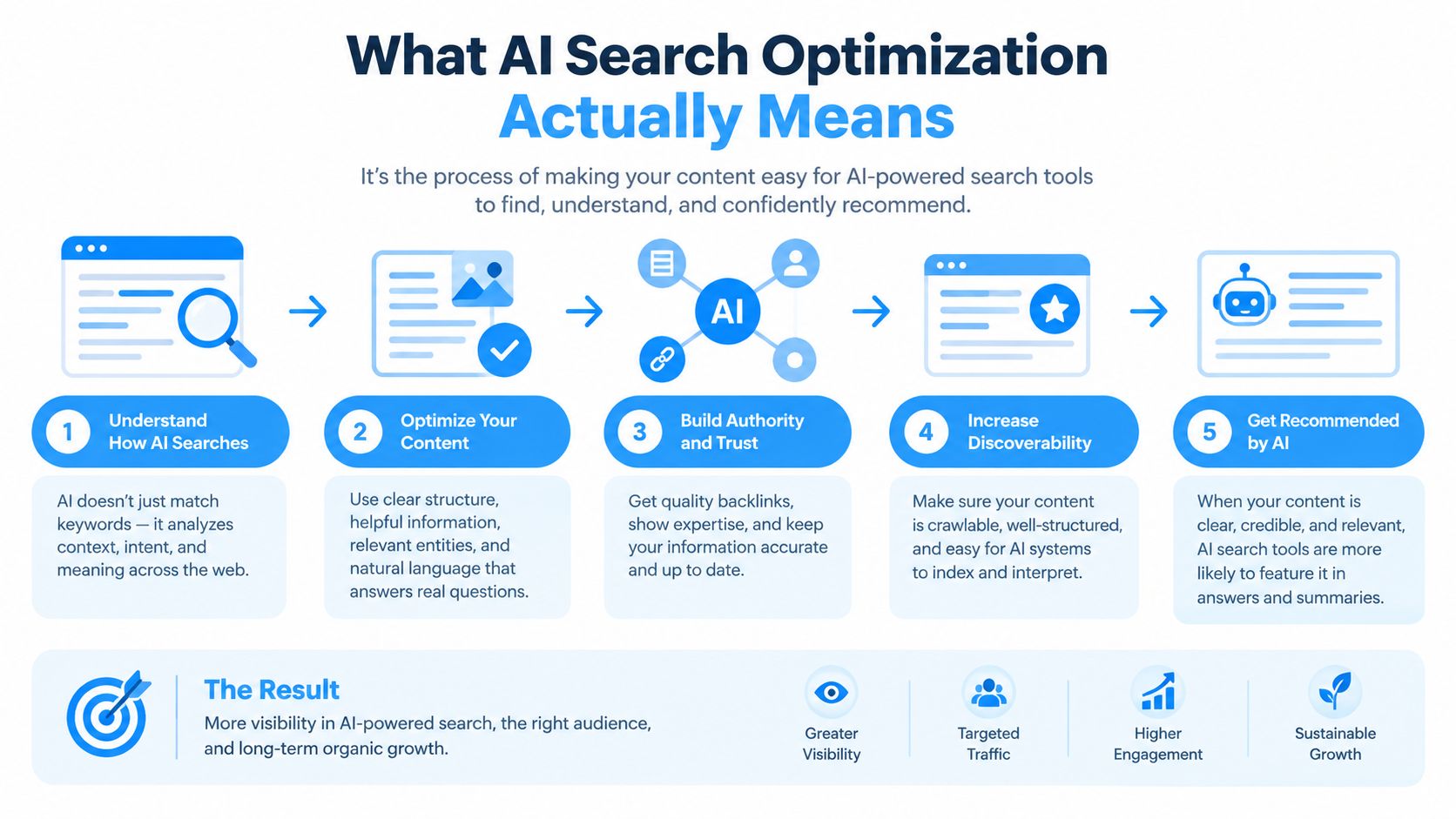
The simplest way to explain AI Search Optimization is this: the AI behaves like a research assistant. It looks for documents, reads them, decides which ones seem trustworthy, writes a fresh answer, and sometimes shows citations.
That process sounds abstract until you break it into parts.
The actual loop behind the answer
Retrieval comes first. The system has to find candidate sources about your brand, product, executive, or issue.
Grounding comes next. The model compares those sources, looks for overlap or conflict, and leans on the material it considers more reliable or more relevant.
Summarization is where the reputational damage or benefit often happens. The model compresses many pages into one paragraph, list, or recommendation.
Citation is the visible clue users get. In Google AI Overviews, answer panels cite source URLs used in the response, and one industry guide reports they typically cite 4 to 7 source URLs per answer in this overview of Google AI Overviews.
How it differs from traditional SEO
Traditional SEO asks, “Can I rank this page high enough for a click?”
AI Search Optimization asks, “Can I make my brand facts, explanations, and framing easy for a model to retrieve, trust, quote, and cite?”
That difference matters. A page can rank well and still be poor AI source material if it buries the answer, mixes too many ideas together, uses vague wording, or lacks clear entity signals. The reverse can also happen. A page with strong structure and clean factual framing can become useful to answer engines even when it wasn't built for classic ranking alone.
A working definition worth repeating inside your team is this:
AI Search Optimization is the practice of making your brand's most important facts easy for answer engines to retrieve, interpret, summarize, and cite accurately.
For CMOs, the operational consequence is straightforward. You're not only competing for position one. You're competing for answer eligibility and citation share. That's why question-led structure, concise answer blocks, author clarity, and machine-readable entities matter so much.
One practical pattern that keeps showing up is rewriting sections into direct-question headings followed by a 40 to 60 word answer block, especially on pages that already rank in the top ten, as outlined in this Google AI Overview citation strategy. If you want a legal-industry example of how this is being diagnosed in the field, the law firm AI visibility diagnosis is useful because it frames visibility as a source-and-answer problem, not just a ranking problem.
For a broader ORM view of the discipline, this explanation of answer engine optimization is a helpful companion.
How AI Is Rewriting the SERP
The classic results page is being compressed into a smaller number of moments that matter. AI Overviews, AI Mode, and standalone answer engines don't ask the user to inspect ten links first. They present a pre-digested answer at the top of the journey.
That changes click behavior, source concentration, and how reputation influence is measured.
What the data already shows
A major milestone came as Google's AI Overviews spread rapidly across search behavior. One dataset reported they appeared on about 13.14% of all U.S. desktop searches in March 2025, up from 6.49% in January, while another 2026 benchmark found they were triggering on roughly 48% of all tracked queries. Independent analysis also found AI Overviews present on 86.7% of business-intent searches in April 2026, up from 56.9% in April 2025, according to this collection of AI SEO statistics and benchmarks.
Clicks change when that box appears. A Pew analysis found users were less likely to click result links when an AI summary showed up, and a randomized field experiment reported that removing AI Overviews increased outbound clicks from 0.38 to 0.61 per search while reducing organic clicks by 38% on triggered queries, as covered in Search Engine Journal's summary of the field study.
That's why standard dashboards understate what's happening. Rankings might hold steady while influence shifts upward into the summary itself.
Classic SERP vs. AI-Summarized SERP
| Dimension | Classic SERP | AI-Summarized SERP |
|---|---|---|
| User behavior | User compares several links | User often accepts a synthesized answer first |
| Brand visibility | Depends on rank and snippet | Depends on inclusion, framing, and citation |
| Traffic path | Click-first behavior is common | Zero-click behavior becomes more common |
| Reputation risk | Weak sources sit beside strong ones | Weak sources can be blended into the answer |
| Reporting | Rank, sessions, CTR | Citation share, answer accuracy, branded lift |
| Optimization target | Position on the page | Position inside the paragraph |
Why baseline measurement matters now
If you don't know what the pre-AI search experience looked like for your core branded and non-branded terms, it's hard to prove what changed. A practical way to frame that baseline appears in Month17's baseline setup for SEO, especially for teams trying to separate ranking changes from answer-surface changes.
The strategic shift is simple but uncomfortable. You are no longer optimizing only for where your page appears. You are optimizing for whether your brand is selected, how it is characterized, and which facts get pulled into the answer. That's why AI Search Optimization belongs inside modern generative engine optimization and not as a footnote to traditional SEO.
Five Reputation Use Cases That Change With AI Search
The mechanics become more useful when tied to real ORM work. Teams don't need another abstract framework. They need to know where this changes decisions on Monday morning.
Brand-accuracy recovery
Sometimes the problem isn't low visibility. It's bad synthesis.
An answer engine may misstate your founding story, bundle old incidents into a current description, or confuse your brand with another company. The fix isn't arguing with the model. The fix is publishing canonical, sourceable statements on assets the system can retrieve cleanly.
That usually means:
- Creating one factual source of truth: a current company profile, leadership page, issue explainer, or fact page written for extraction.
- Reconciling duplicates: old bios, legacy product pages, and stale partner listings that contradict the canonical version.
- Using structure the model can quote: short answer blocks, clear headings, and explicit language about what is and isn't true.
Crisis narrative control
During a live issue, third-party coverage often arrives before your full statement does. If early coverage defines the event, the model may inherit that framing.
The first move is speed with clarity. Publish a concise incident page, a timestamped FAQ, and a public-facing explanation that answers the questions reporters, customers, and answer engines are all likely to ask. Then support it with earned coverage and executive commentary that reinforces the same frame.
When a crisis breaks, the model doesn't wait for internal alignment. It summarizes whatever the open web gives it first.
Review sentiment shaping
Review management now has an extraction layer. The question isn't only how people rate you. It's how review language contributes to AI descriptions of your customer experience.
Google removes reviews only when they violate content policies such as fake engagement, off-topic content, restricted content, conflicts of interest, or personal information, as outlined in this guide to review removal and reputation management. So the practical work is twofold: challenge policy-violating reviews when justified, and improve the quality of authentic review signals that remain visible.
Executive profile defense
Executive reputation has become an entity problem. Models pull from bios, speaking pages, interviews, social profiles, databases, and earned media. If those conflict, the summary drifts.
Use consistent bios, author markup, and current executive profile pages. Then check whether the same role, company description, and expertise areas appear consistently across high-trust third-party profiles.
SERP feature targeting
Not every reputation intervention needs a new article. Sometimes the right target is a feature. That could be AI Overviews, AI Mode, People Also Ask, or a knowledge panel field.
Ownership matters here, so define it explicitly.
| Use Case | Primary AI Surface | Core Tactic | Owner |
|---|---|---|---|
| Brand-accuracy recovery | ChatGPT, Gemini, Perplexity | Canonical fact pages and correction assets | Corporate comms |
| Crisis narrative control | AI Overviews, AI Mode | Fast FAQ and incident explainers | Crisis comms |
| Review sentiment shaping | Google surfaces and answer engines | Review policy enforcement and response quality | Customer experience plus ORM |
| Executive profile defense | Answer engines and knowledge entities | Bio consistency and author identity signals | Executive comms |
| SERP feature targeting | AI Overviews and related features | Query-specific content blocks and markup | SEO plus content |
Teams working through these scenarios often also need a branded-prompt workflow like this guide to ChatGPT reputation management.
The Implementation Roadmap for Reputation Teams
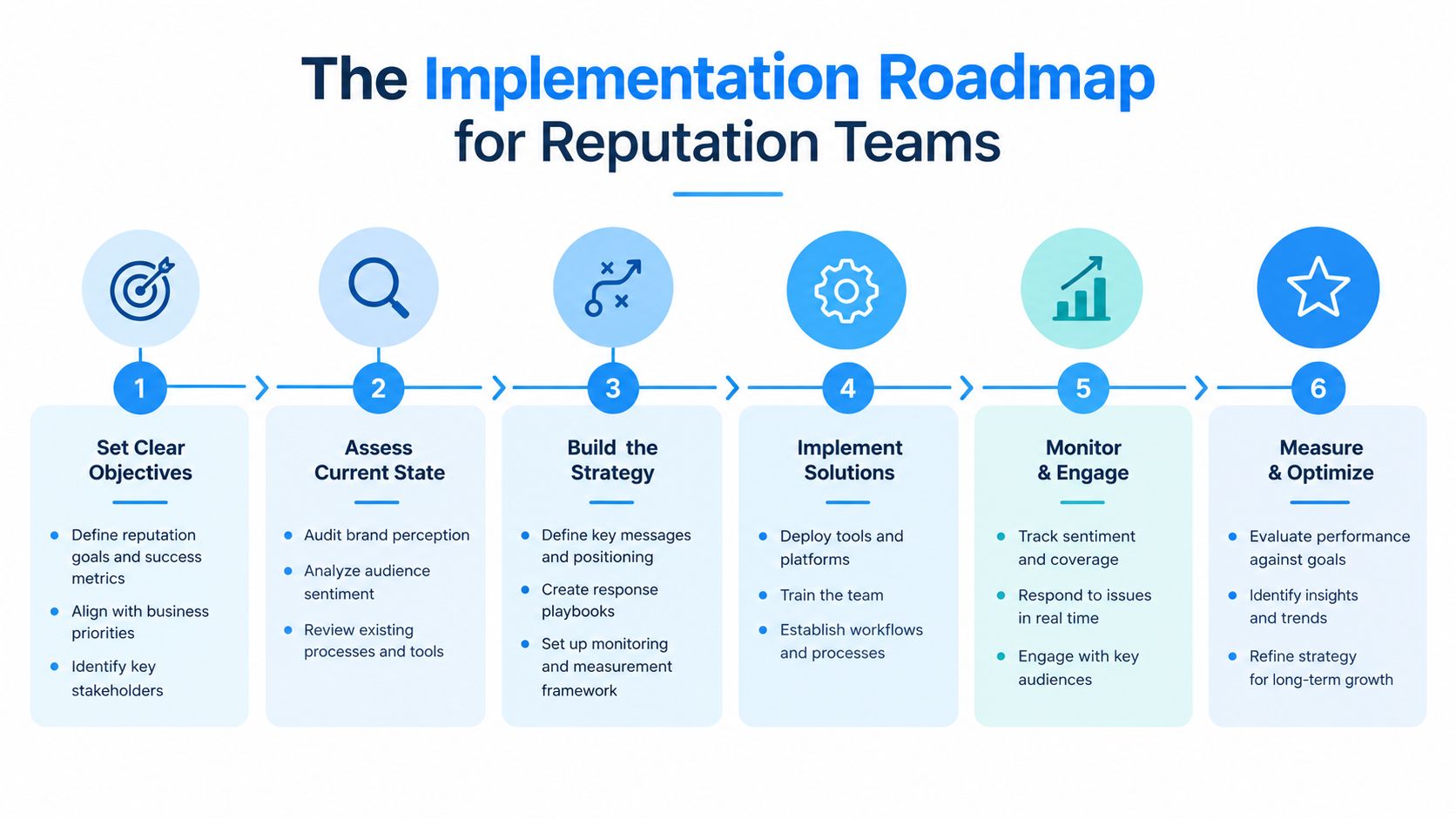
Most companies don't need a massive rebuild. They need an operating routine. Good AI Search Optimization for reputation work is cumulative. You tighten the source picture, improve retrieval conditions, publish cleaner facts, and keep testing.
Stage one audit the answer surface
Start with the queries that matter commercially and reputationally. Brand name. Founder name. “Is [brand] trustworthy.” “Best alternative to [brand].” “[Brand] reviews.” Product safety and compliance questions.
For each prompt, log:
- Which engine produced the answer
- Which sources were cited
- Whether the answer was accurate
- Whether the framing was favorable, neutral, or harmful
- What source was missing that should have been present
This is manual at first. That's fine. Early signal quality matters more than dashboard volume.
Stage two clean up the entity layer
Answer engines don't only read pages. They infer entities.
That means your company description, leadership roles, category terms, and product naming should match across your site, LinkedIn, Crunchbase, major directories, author bios, and any profile likely to be retrieved. If one profile says you're a software platform and another says you're an agency, the model may blend both.
A lot of teams skip this because it feels unglamorous. It's usually one of the highest-impact fixes.
Stage three build canonical answer assets
Create pages that answer reputation-sensitive questions directly. Not in legalese. Not hidden in PDFs. Not buried under marketing copy.
Useful asset types include:
- Company fact pages for mission, leadership, ownership, locations, and product scope
- Issue explainers for known incidents or recurring misconceptions
- Executive bios with consistent role and expertise framing
- Customer trust pages that clarify policies, security, or service standards
- Review response templates written so humans and machines can both understand them
Stage four distribute to sources that get reused
Owned content matters. It's not enough.
If answer engines consistently rely on industry publications, business databases, major profiles, or high-trust commentary sources in your category, your digital PR plan should target those environments. For online reputation management campaigns, this connection is direct because AI Overviews cite and link source pages, so improvements in page structure, authority signals, and answer clarity are used to influence what appears in search-generated summaries, as described in this framework for getting cited in Google AI Overviews.
Stage five measure and refresh on a cadence
Treat prompt outputs the way mature SEO teams treat rankings. They aren't one-and-done. They need retesting and refreshes.
One useful threshold question at this stage is whether you need a specialty platform. If your prompt set is small, an internal spreadsheet and screenshot archive can work. If you're monitoring many brands, executives, locations, or issue clusters, tooling helps. One option in that mix is TheBestReputation's AIOverview workflow, which scans a site across major AI search engines and reports on Google presence, AI search presence, and brand mentions.
Measuring What AI Search Optimization Is Actually Worth
Many programs go soft here. Teams do the work, see anecdotal improvement, and still struggle to defend budget because clicks alone don't tell the story anymore.
The measurement model has to widen.
The KPI set that matters now
The reporting gap is large because a rising share of influence happens without a site visit. SparkToro and Similarweb data cited in 2026 found 68% of U.S. Google searches ended without a click to the open web in the first four months of 2026, up from about 60% in 2024, and the same report notes that 61% of teams increased investment in AI search optimization, according to this State of AI Search 2026 coverage.
That means classic traffic dashboards miss part of the value. For reputation work, the KPI mix should include:
| KPI | Classic SEO | AI Search Optimization |
|---|---|---|
| Primary visibility metric | Rank position | Citation share across answer engines |
| User action signal | Organic clicks | Presence in the answer plus click capture |
| Brand narrative metric | Limited | Answer accuracy and message alignment |
| Competitive benchmark | Share of rankings | Share of citations and answer inclusion |
| Early business signal | Sessions | Branded search lift and inquiry quality |
| Reporting challenge | Attribution after click | Attribution when no click happens |
How to score answer quality
A simple monthly rubric works better than a complicated one nobody maintains.
Track:
- Accuracy: Did the answer get the basic facts right?
- Completeness: Did it omit a key trust or context point?
- Message alignment: Did it reflect how the brand should be described?
- Citation quality: Were the cited sources ones you'd want a buyer to see?
You don't need a giant model for this. A stable prompt set and disciplined human review are usually enough to reveal trend lines.
Measurement rule: If your dashboard can't show whether the AI answer got more accurate over time, it isn't measuring reputation impact.
One more nuance matters for brand-sensitive organizations. Existing coverage suggests only about 20% of URLs overlap between LLM optimization and Google top-10 results, while Google's 2026 AI Mode query length was reported as 3x longer than a traditional search query, according to this AI SEO statistics roundup on brand accuracy and query behavior. That's a reminder that traditional search visibility and AI answer visibility are related, but they are not the same reporting problem.
Risks, Bias, and the Controls You Need in Place
AI Search Optimization becomes dangerous when teams treat it like a content growth hack instead of a reputation surface.
The failure modes are familiar to anyone who has run ORM during a crisis. Hallucinated executive facts. Outdated allegations pulled into present-tense summaries. Low-credibility citations raised because the model found them first. Geographic or demographic bias in which sources are selected. Internal messaging accidentally turned into public-facing copy before legal review.
The controls that reduce damage
The first control is a fixed prompt audit set across Google AI Overviews, AI Mode, ChatGPT, Gemini, and Perplexity. Keep it stable enough to compare month to month, and broad enough to catch reputation edges.
The second is source discipline. Decide which owned and earned properties count as preferred factual references for your brand and executives. Then keep those properties current. Contradictory public assets are an invitation to drift.
The third is human review for crisis-adjacent queries. No brand should automate sensitive answer shaping around litigation, safety, layoffs, discrimination claims, regulatory matters, or executive misconduct without review from comms and legal.
The technical side still matters
A 2026 arXiv study found AI Overviews were triggered for 64.7% of question-form queries versus 9.5% of non-question queries. Another benchmark study found AI Overviews were generated for 51.5% of representative real-user queries, showed very low overlap across engines with under 0.2 average Jaccard similarity, and found lower retrieval probability when sites blocked Google's AI crawler, as detailed in this arXiv paper on AI search retrieval and query structure.
That means governance alone isn't enough. Query phrasing, machine-readable structure, and crawler access all affect whether your corrective content can even enter the answer set.
Run a quarterly risk review. PR should own message risk. SEO should own retrieval conditions. Legal should own escalation boundaries. If nobody owns the overlap, the answer engine will.
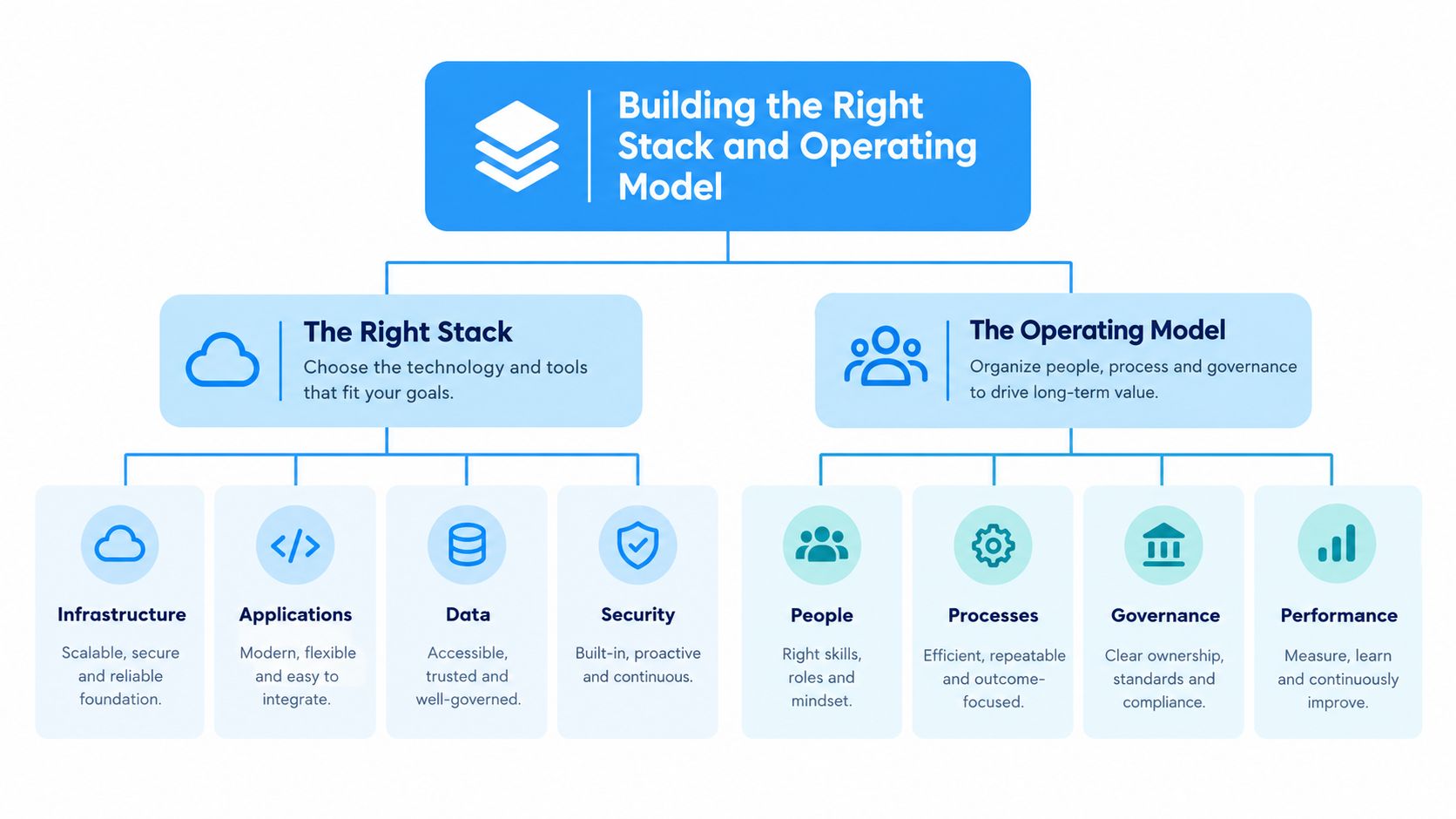
Building the Right Stack and Operating Model
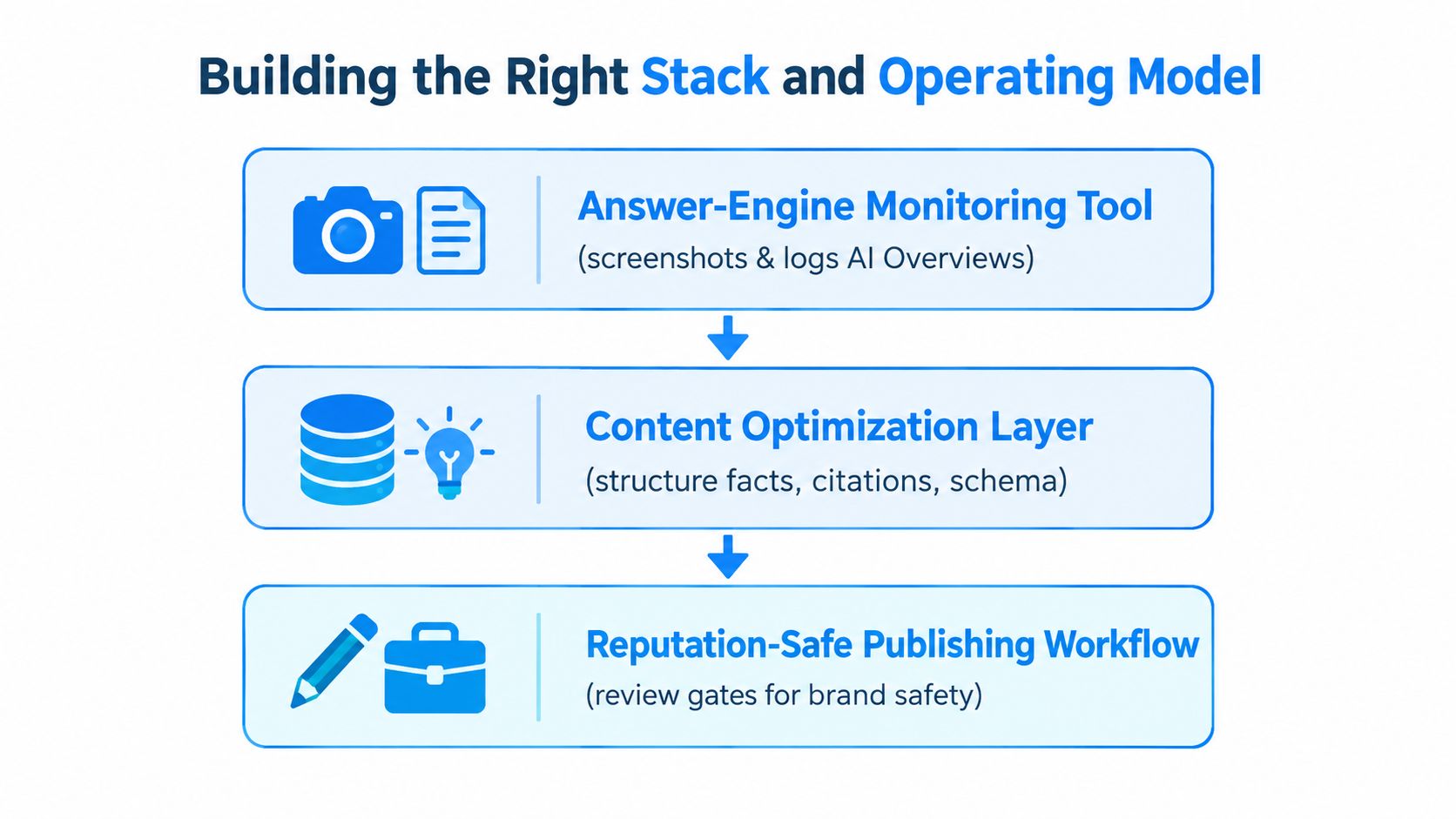
Don't buy an AI-SEO platform and assume the problem is solved. Reputation work needs a stack that reflects how answers are made.
The stack that makes sense
Layer one is answer-engine monitoring. You need screenshots, logs, and a prompt history for branded queries across Google, ChatGPT, Gemini, and Perplexity. Without that, you can't verify drift or improvement.
Layer two is entity infrastructure. That includes your schema, company and executive profile pages, LinkedIn, Crunchbase, Google knowledge surfaces, and any structured source that helps machines resolve who you are and what's true.
Layer three is publishing governance. PR, legal, SEO, and brand shouldn't approve separate versions of the truth. They need one workflow for factual updates, issue responses, executive bios, and corrective content.
Who should own what
A workable operating model usually looks like this:
- Corporate communications owns the prompt set for reputation, trust, leadership, and crisis questions.
- SEO or technical content owns extractability such as page structure, answer formatting, markup, and crawl accessibility.
- PR owns earned-source development so authoritative third-party citations reinforce the same message.
- Legal owns escalation and red lines for sensitive claims and removal requests.
- Executive comms owns leadership entity consistency across all public profiles.
If your footprint is small, you can run this internally with a lean cadence. If you have multiple executives, locations, products, or active reputation risk, specialty support becomes more useful. The key isn't the tool. It's whether the tool fits a cross-functional workflow that improves what AI says about you.
If your team is seeing AI answers become the first impression of your brand, TheBestReputation can help you audit those answers, identify the sources shaping them, and build the content, PR, and governance workflow needed to improve accuracy. For organizations treating AI Search Optimization as a reputation issue instead of a traffic tactic, visit TheBestReputation to see how integrated ORM and PR support can shape what decision-makers read first.
