Gemini Reputation Management: A 2026 Playbook
Gemini reputation management usually means one of three things, and the right fix depends on which one you’re facing. It could mean managing how Gemini the AI describes your brand, managing reputation for a person or company named Gemini, or managing Gemini the product’s own public reputation.
If your brand looks clean on Google but messy inside Gemini, you’re dealing with a multi-surface governance problem, not a single bad prompt. The practical playbook below separates those three contexts so you don’t waste time applying the wrong remedy to the wrong surface.
Table of Contents
- The Three Meanings of Gemini Reputation Management
- How Gemini Reads the Web and Why That Matters for ORM
- The Gemini Reputation Audit Checklist You Can Run This Week
- Monitoring Gemini Chat, AI Overviews, and Search in Parallel
- Gemini Chat Versus AI Overviews Versus Traditional Search
- Content Strategy That Shapes What Gemini Cites
- Review Remediation and Removal or De-Indexing Paths
- Crisis Response and Your First 30 Days
The Three Meanings of Gemini Reputation Management
The phrase gets used loosely, and that’s a mistake. In practice, Gemini reputation management falls into three very different buckets, and each one needs a different response.
The three contexts you need to separate
Context A, the AI product view. You want Gemini to describe your brand accurately in chat, in AI Overviews, and in other Google-generated answer surfaces. That’s the classic ORM use case, and it’s the one people typically mean when they search for help.
Context B, the Gemini-named entity. Your company, founder, app, fund, or project is called Gemini, so your reputation graph is colliding with the AI product itself. In that case, search visibility, reviews, and entity clarity matter as much as model behavior.
Context C, Gemini the product. You’re managing public trust around Google’s AI system itself, which means brand communications, safety perception, and product credibility are the issue.
Pick the right context before you touch the content plan. If you blur them together, you’ll either overcorrect the wrong surface or miss the one causing the damage.
A fast diagnostic helps. Ask yourself, “Am I trying to change what Gemini says, clean up a brand that shares the name, or protect Gemini’s own reputation?” That answer determines whether you should prioritize entity work, review work, crisis work, or all three.
The rest of this guide is built for Context A first, then it branches into the naming collision and product-trust cases where needed. If you need a general primer on the discipline behind this work, the online reputation management guide is the baseline to read before you start rebuilding a brand graph.

If you want outside help, the list of best Gemini SEO agencies is useful because it shows how different firms frame the problem, some as AI visibility, others as entity SEO, and others as broader ORM.
How Gemini Reads the Web and Why That Matters for ORM
Gemini does not invent a brand narrative from thin air. It assembles one from the sources Google already trusts, which means your reputation work has to shape the source set, not just the wording on one page.
The retrieval stack is the real battleground
Independent analyses say Gemini’s answers are primarily assembled from Google Search index candidates, with about 44.2% of citations coming from Google’s top organic results and a strong dependence on Knowledge Graph, structured data, and freshness (Far and Wide on how to rank in Gemini). That means canonical pages still matter. If your about page, leadership page, product page, and contact page are weak, vague, or inconsistent, Gemini has less trustworthy material to work with.
Google-owned properties matter just as much. Reputation work has to treat Knowledge Graph, Google Maps, Business Profile, YouTube, and review data as part of the same entity system, because Gemini often reflects a source network rather than a single URL (Everything PR on Gemini citation source index). If your listings disagree with each other, Gemini doesn’t see one clean brand, it sees competing claims.
Practical rule: if a fact is true but scattered across weak or mismatched sources, Gemini may ignore it. If that fact is repeated in consistent canonical pages, entity markup, and trusted third-party mentions, it has a better chance of surfacing.
Entity-first beats page-first
Most ORM teams get it wrong. They keep writing more content when the problem is really entity clarity. A brand’s representation is only as strong as the structured footprint Google already trusts, so the objective is to make your organization legible across the graph, not just visible on one site.
That’s why Organization, Person, and sameAs markup matter. It’s why consistent names, addresses, leadership names, and category labels matter. And it’s why a reputation fix that improves organic rank can improve Gemini citations too, because the model is leaning on the same underlying retrieval infrastructure.
If you want the SEO mechanics behind that chain, the SEO for AI search guide is the right companion piece, because the logic is the same even when the surface changes.

The implication is simple. If the entity layer is messy, Gemini’s answer will be messy. If the entity layer is clean, your corrective work has something stable to build on.
The Gemini Reputation Audit Checklist You Can Run This Week
Run the audit in five working days, and do it with screenshots, not memory. Gemini disputes get ugly fast because people argue about what the model said, then fail to document where it came from.
Day 1 through Day 3, start with your owned and structured assets
Day 1, Knowledge Panel and Wikidata. Pull your Knowledge Panel, verify whether a Wikidata entry exists, and inspect every sameAs link. Log each claimed attribute, because a wrong founder name or category label can echo through the graph.
Day 2, prompt testing. Query Gemini in multiple variations of brand, executive, product, and risk prompts. Screenshot every answer and tag every cited URL. You’re looking for source patterns, not one-off wording.
Day 3, canonical pages. Audit your about, contact, leadership, product, and pricing pages. Check schema, NAP consistency, and tone. If those pages read like sales copy instead of a clear source of truth, Gemini has less to trust.

Day 4 through Day 5, move to the wider graph
Day 4, review profiles. Compare Google Business Profile, Trustpilot, G2, BBB, Yelp, and app store listings. Look for mismatched names, stale addresses, category drift, and exaggerated claims. Gemini doesn’t need perfect consensus, but it does need less contradiction than your current footprint probably has.
Day 5, news and Wikipedia footprint. Check notability, recency, and edit history. If a negative story is ranking and your neutral sources are thin, Gemini will usually lean on the stronger public record, not on the brand’s preferred version.
Score every asset as Gemini-readable, ambiguous, or blocking. If you have more than one blocking asset in the entity layer, stop improvising and get a formal ORM diagnostic before you create more content that points to the wrong facts.
A paid diagnostic makes sense when the issue crosses categories, especially when branded search, reviews, and AI outputs all disagree. That’s usually the sign that the source graph, not the prompt, is the problem.
Monitoring Gemini Chat, AI Overviews, and Search in Parallel
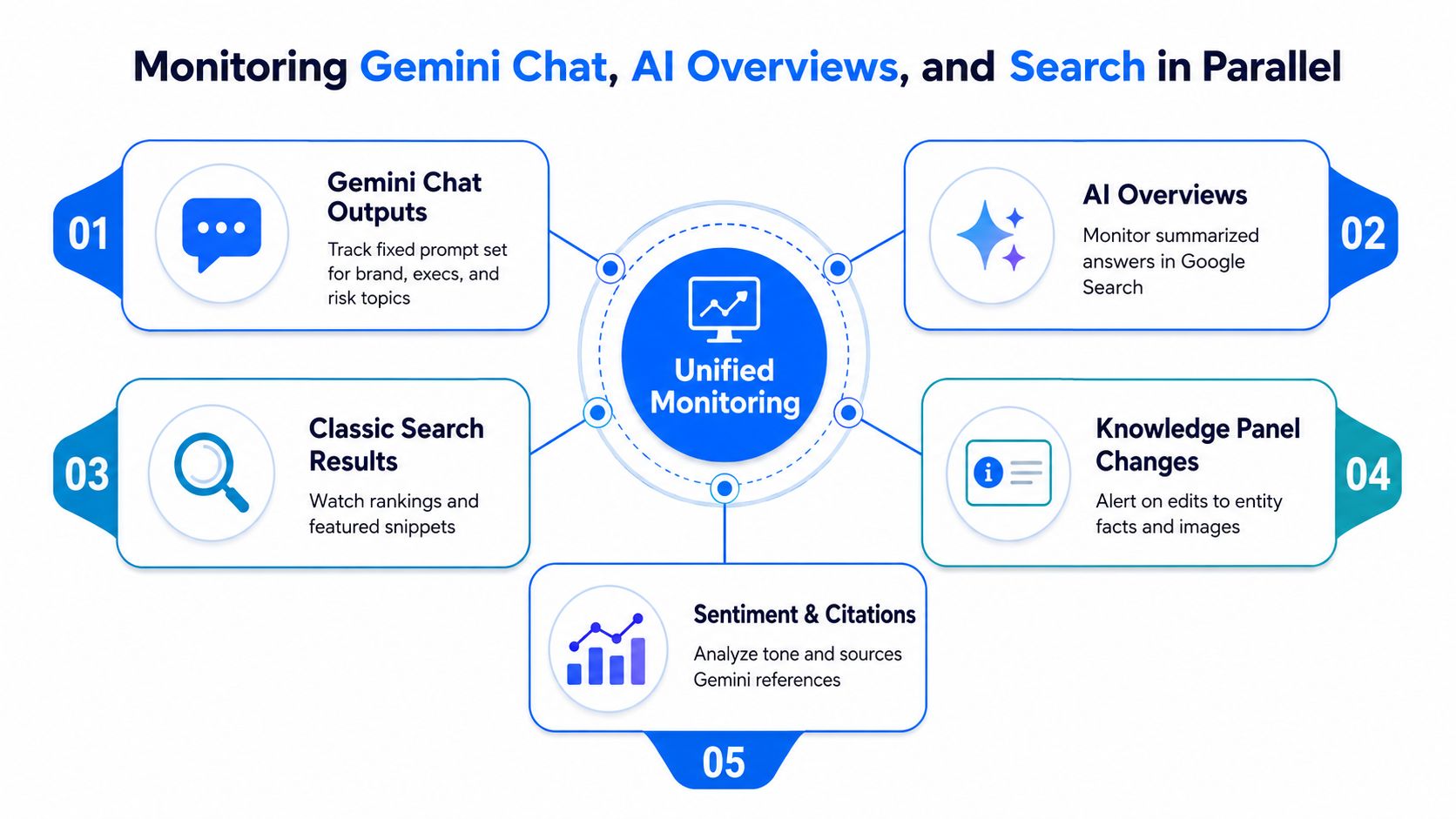
One dashboard won’t save you here. You need parallel monitoring streams, because a clean SERP can coexist with a bad chat answer, and a clean chat answer can coexist with a polluted review graph.
Build separate tracks for separate surfaces
Gemini chat outputs should be tested against a fixed prompt set that covers your brand, executives, products, and known risk topics. Refresh it weekly, and keep the exact wording of each answer, because model language changes faster than expected.
AI Overviews need query-level monitoring, not a vague sentiment dashboard. They’re triggered by search queries, and they can shift as the query intent shifts. Traditional SERP tracking still matters, but it should sit beside the AI layer, not replace it.
Knowledge Panel changes deserve their own alerting. Entity facts and images can change without a visible site update, which means a correction on your website doesn’t automatically mean the panel is fixed.
Review graph monitoring belongs in the same stack. Track Google, Trustpilot, G2, and the vertical sites that matter in your category, because repeated negative patterns there can feed the same narrative Gemini later summarizes.
Social listening is the seed layer. Gemini will often read the internet that already exists, so you want to catch emerging language before it hardens into a reusable story.
If you need a playbook for deciding what to watch first, the reputation risk monitoring guide is the right operational companion.
Don’t collapse different crises into one
A hallucinated line in chat is not the same crisis as a bad Google review cluster. They may share a root cause, but they don’t share the same escalation threshold, owner, or fix path. Treat them separately until the evidence says they’re connected.
That distinction matters because teams waste days arguing over whether “the AI is wrong” when the deeper issue is a weak source graph. The monitoring job is to identify which surface broke first, then assign the correct owner before the problem multiplies.
Gemini Chat Versus AI Overviews Versus Traditional Search
These surfaces look similar from the outside. They are not similar operationally, and using one remediation playbook for all three is lazy.
| Surface | Answer Generation | Primary ORM Lever |
|---|---|---|
| Gemini Chat | Conversational synthesis from retrieval plus model priors | Reshape the source set and entity signals |
| AI Overviews | Query-scoped live summary from Google’s index and Knowledge Graph | Strengthen entities, canonical content, and Google-owned surfaces |
| Traditional SERP | Page-ranked results based on links and on-page relevance | Standard SEO, link equity, and page optimization |
Gemini chat is the most dangerous when a harmful source gets paraphrased across many prompts. You don’t fix that by “correcting the prompt.” You fix it by changing the source mix that Gemini keeps reusing.
AI Overviews are more query-bound, so the issue is usually entity quality and source selection. If your structured footprint is weak, the summary will drift toward whatever Google can verify faster.
Traditional search is still the easiest to influence with classic SEO. Strong pages, clean structure, and better links can move rankings, which then helps the other surfaces indirectly because Gemini often consumes the same web signals.
Don’t force one workflow onto three different machines. The remediation math is different, and the owner should be different too.
Content Strategy That Shapes What Gemini Cites
The fastest way to get cited correctly is to become the clearest source of truth in your category. That means writing for machine readability without making the content sound robotic.
Build a canonical hub and then support it
Start with a canonical hub that says who you are in plain English. Include Organization, Person, Product, and FAQPage schema, plus same-as profiles that point to real, consistent entities. The tone should be neutral, not salesy, because Gemini and AI Overviews summarize neutral copy more cleanly than hype.
Then surround that hub with corroboration. Earned media, respected directories, customer reviews, and topic-specific explainers all help because Gemini reads consensus across the source graph, not just one polished homepage. A strong press mention in a relevant outlet often displaces a weak or harmful source faster than another self-published blog post.
Write for entity clarity, not keyword density
Use names consistently. Use job titles consistently. Use product labels consistently. Don’t make your About page sound like an ad when it needs to sound like a record.
That discipline matters more than a lot of agencies admit. Gemini rewards consensus, recency, and structured clarity. It doesn’t care how clever the copy sounds if the facts are inconsistent across sources.
I’d rather see a brand publish one precise, well-marked canonical page and three corroborating references than ten fluffy posts that repeat the same weak claims. If you need an outside team that combines search, content, and reputation workflows, TheBestReputation is one option in that lane, because it works across SEO, media, review, and crisis programs.
Review Remediation and Removal or De-Indexing Paths
Start with the review graph, then move to removal or de-indexing only when the facts justify it. Too many brands jump straight to takedown language when a structured response would solve most of the visibility problem.
Use the lightest effective fix first
For reviews, begin with flagging, replying, and suppressing through new legitimate review velocity. If the review is fake, impersonating someone, or clearly abusive, that changes the escalation path, but you still need documentation before you ask a platform to act.
For harmful pages, direct publisher outreach is usually the first move. If the issue involves copyrighted images, you may need a DMCA notice. If the content is defamatory, doxxing, or impersonation, that’s when legal review starts to matter.
De-indexing is not deletion. It means removing a URL from Google’s search index rather than erasing the page itself, which is often the right move when the content is still on the publisher’s site but shouldn’t keep appearing for a brand search (SmartMoneyMedia on deindexing).
Pick the path based on the content type
| Content Type | First Action | Legal Threshold | Realistic Timeline |
|---|---|---|---|
| Fake review | Platform flag and response | Low unless it includes impersonation or fraud | Fast if the platform agrees |
| Defamatory article | Publisher outreach, then counsel review | Higher, especially if facts are disputed | Often slow |
| Copyrighted image | DMCA notice | Clear ownership or infringement | Variable |
| Outdated but true page | De-indexing request or suppression strategy | Usually low | Often slower than removal |
| Impersonation or doxxing | Immediate escalation | High urgency | Time-sensitive |
The hard truth is that harmful coverage that still ranks can keep feeding Gemini even after it gets suppressed elsewhere. If you can’t remove it, you need to displace it with stronger, cleaner sources that answer the same query space.
Crisis Response and Your First 30 Days
Gemini-specific crises don’t behave like ordinary SEO problems. The same damaging story can show up in chat, in AI Overviews, in knowledge panels, and in review summaries at the same time, so recovery has to happen in parallel.
Build the war room before the narrative hardens
Your war room needs one owner for search, one for content, one for legal, and one for communications. If you have an executive, a product lead, or a founder in the blast radius, they need a review path for every public statement before it goes out.
Holding statements should be written for AI summarization, not just human reading. Keep them short, factual, and stable. Gemini will often compress long messaging into a few lines, so fluff creates drift.
Fast-turn owned content matters here. Publish a clear About page, a direct FAQ, and any correction page you need to anchor the record. Then update entity fields and push Knowledge Graph corrections where possible.
The broader crisis template behind that workflow is laid out in the crisis communication plan template, and it’s worth adapting before you need it.
A simple 30-day sequence
Week 1: audit the surface area, capture screenshots, and establish the monitoring stack.
Week 2: ship the canonical content fixes, schema updates, and review responses.
Week 3: push removal, de-indexing, or publisher outreach where the evidence supports it.
Week 4: begin earned media outreach and continue source displacement on the queries that matter most.
If you wait to “see if it settles,” you usually lose the window. The brands that recover fastest treat Gemini as a live reputation surface and manage it with the same discipline they’d use for a public-facing PR incident.
If Gemini is already showing your brand differently than Google does, TheBestReputation can help you map the entity gap, tighten the source graph, and handle the review, content, and crisis steps that follow. Visit TheBestReputation to start with a focused audit and get a plan that’s built for Gemini, AI Overviews, and the rest of the reputation stack.
