Localized Marketing Strategy: A Practical Framework
You're running ads, publishing content, and updating profiles as part of a localized marketing strategy, but one location gets calls while another sits quiet. The national campaign looks fine in aggregate. At street level, hours are wrong, reviews go unanswered, and the page for a busy branch says nothing that a nearby customer needs.
That's not a channel problem. It's an operating problem. A localized marketing strategy works when listings, reviews, content, and measurement are governed together, market by market, and judged by calls, visits, and trust rather than rankings alone.
Table of Contents
- The Six Parts of a Localized Marketing Strategy
- Researching Local Audiences Before You Spend
- How Local Search Ranking Works and What You Control
- Allocating Effort Between AI and Traditional Discovery
- Localizing Content, Language and PR Coverage
- Review and Reputation Tactics That Stay Within Policy
- Coordinating Many Locations Without Losing Consistency
- KPIs and Measurement for Local Performance
- Confirm Your First Market and Run a 90-Day Test
The Six Parts of a Localized Marketing Strategy
A family in one city searches on a phone for a pediatric dentist who can see a child today. On the same results page, a national brand runs a polished, generic message about healthy smiles. The family doesn't need a slogan. They need a nearby office, today's hours, insurance details, a phone number that works, and reviews from other parents on that side of town.
A localized marketing strategy is a plan that adapts where, when, and how you reach people in each market while a shared brand core stays fixed. Think of a restaurant chain's master recipe. The core dish doesn't change, but local menus adjust for taste, available ingredients, and season. You protect recognition without forcing every market to eat exactly the same meal.
The framework at a glance
| Component | Question It Answers | Main Output | Typical Owner |
|---|---|---|---|
| Audience research | Which markets differ, and how? | Market profiles and local search queries | Marketing lead |
| Local search visibility | Can nearby customers find and choose you? | Accurate listings, location pages and citations | Local SEO specialist |
| Content and PR localization | What do local audiences need to hear, and in which language? | Market content modules and regional media pitches | Content and PR team |
| Review and reputation | What do customers say, and how do we respond? | Monitoring, response standards and policy-safe review requests | Reputation manager |
| Multi-location coordination | What stays central, and what flexes locally? | Governance rules, approval workflow and shared glossary | Operations and brand team |
| KPIs and measurement | Is local activity producing results? | Dashboards split by market, device and query | Analytics owner |
These six parts form a loop, not a checklist. Research tells you which queries matter. Those queries shape location pages and profiles. Reviews reveal whether the promise on the page matches the experience in the branch. Measurement then shows which markets deserve more content, more PR, or a basic operational fix.
Bad listing data breaks the loop at the start. If the address, phone, or hours are wrong, strong content sends people to a dead end, reviewers complain about confusion you created, and your dashboard blames demand for what's really a data failure.
If a customer can't trust your hours, they won't trust your bigger claims either.
Small product brands face a version of the same problem when retail buyers, distributors, and shoppers in different regions need different proof. If you're building that kind of groundwork, you can explore resources for small CPG brands alongside your local search work, so market entry planning and local visibility don't develop in separate silos.
I would start in one of two places. For a new market, start with audience research, because you don't yet know the language, competitors, or trust signals that drive choice. For existing locations, start with a listings audit, because inaccurate facts are already taxing every campaign you run.
Researching Local Audiences Before You Spend
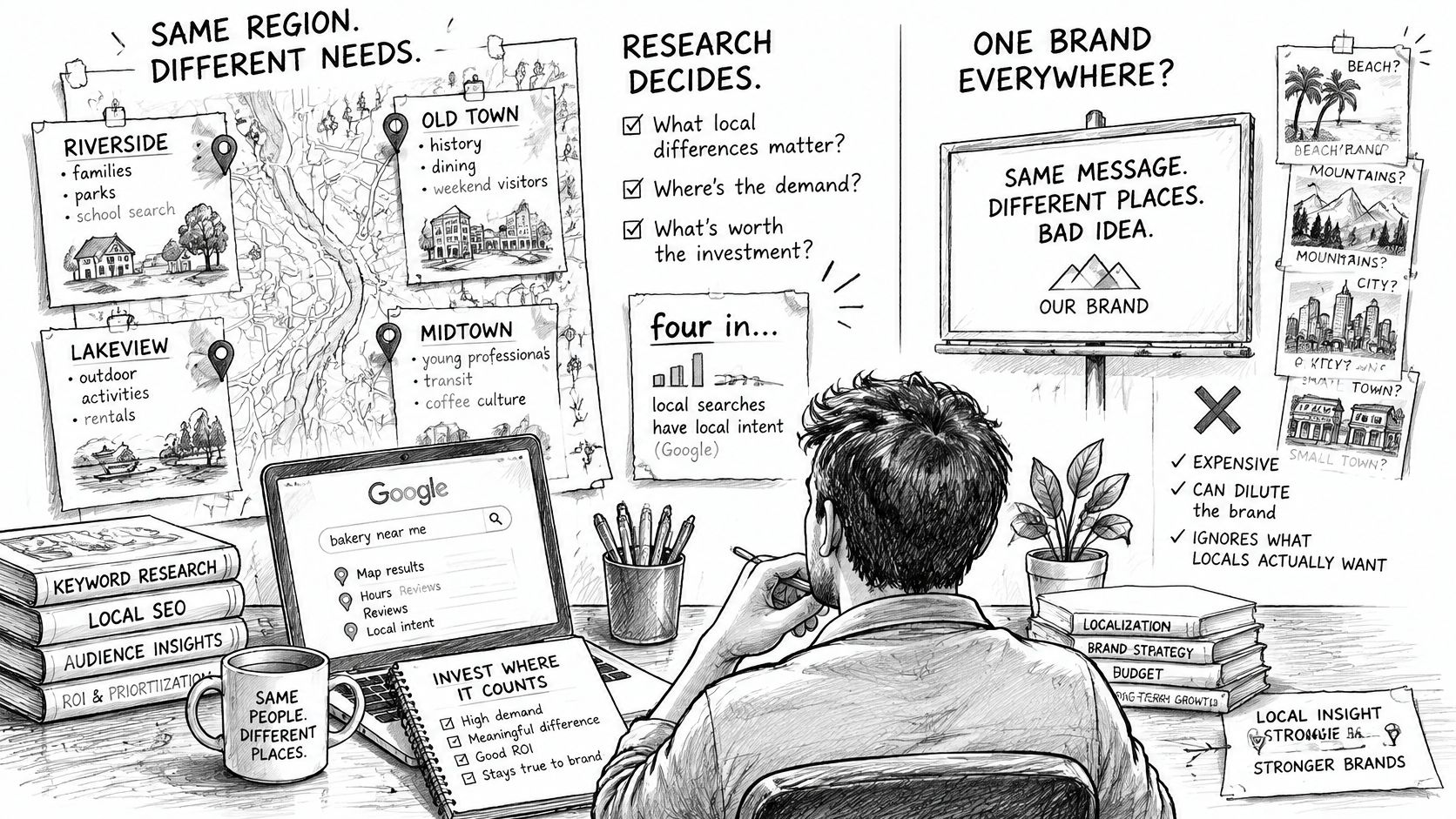
Research decides which local differences deserve money. Adaptation isn't free. Every market variant needs writing, approval, publishing, and maintenance, and if you localize everything, you'll dilute the brand and exhaust the team on differences customers don't care about.
The reason to start here is intent. A Google consumer study found that 4 in 5 consumers use search engines to find local information such as business addresses, opening hours, product availability, and directions. It also found that 50% of consumers who conducted a local search on a smartphone visited a store within one day, compared with 34% of those who searched on a computer or tablet, and that 18% of smartphone local searches led to a purchase within one day, versus 7% of non-local searches.
That behavior rewards businesses that know exactly what each market is trying to do, on which device, and how quickly.
A six-step research sequence
- Map segments by service area: Split markets by city, region, or realistic travel area, not by country alone. A statewide average hides the suburb that drives most calls.
- Pull real local queries: Export data from Google Search Console and Business Profile insights. Keep the exact wording customers use, including neighborhood names, landmarks, and misspellings that recur.
- Mine reviews by location: Tag recurring praise, complaints, staff names, wait times, parking, pricing confusion, and service terms. Customers describe local needs in their own language, often better than your copy does.
- Interview frontline staff: Ask each branch what people call about every week, what they misunderstand, and which competitor they mention. Ten minutes per location beats a generic persona workshop.
- Check the local calendar and media: Note community events, school schedules, weather patterns, sports seasons, and the outlets residents read. Timing and proof should fit that calendar.
- Record claim limits: Write down regulatory and cultural limits before anyone writes copy. This matters most in healthcare, finance, and legal services, where a persuasive local claim can create compliance risk.
Say a dental group runs offices in two cities. In one, patients search for emergency tooth pain and same-day appointments, and reviews praise fast callbacks. In the other, patients search for veneers and whitening, and reviews focus on cost clarity. One landing page template with the city name swapped in serves neither group well.
A regional bank can split the same way. Customers in one market ask about fees and account switching. Customers in another care about branch access, ATM coverage, and Saturday hours. The product is identical. The decision path isn't.
Decision rule: Adapt only where a difference changes a search, a purchase, or a trust signal.
If the difference doesn't change what someone types, clicks, believes, or buys, keep the national version. That restraint leaves budget for the markets where localization can move a real action.
How Local Search Ranking Works and What You Control
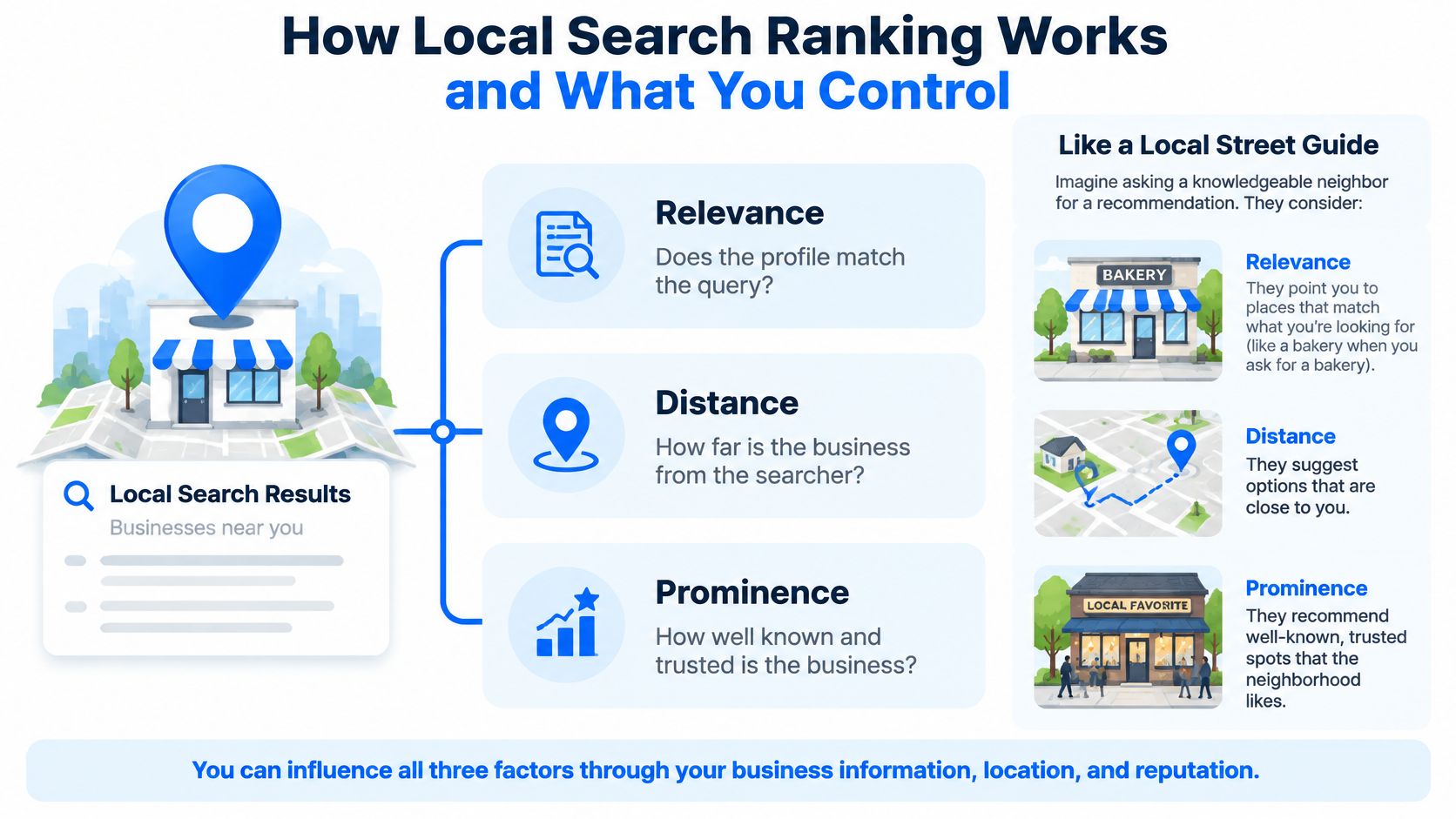
Local ranking works a bit like asking for a neighborhood reference. You want someone relevant to the job, close enough to help, and known well enough that other people vouch for them. Google uses a similar logic at scale.
Google's local ranking guidance says rankings primarily depend on relevance, distance, and prominence, and it explicitly states that more reviews and positive ratings can improve local ranking. You don't control all three equally, so spend effort where control is real.
Relevance is mostly your data quality
Relevance asks whether your Business Profile matches the search. Complete and detailed information helps Google connect a location with the right queries.
Fix these first:
- Primary category: Pick the category that describes the main business, not every service you'd like to sell.
- Secondary categories and services: Add real services offered at that branch. Don't copy the flagship location's list onto a smaller office.
- Descriptions and attributes: State who you serve, what happens at that location, languages spoken, accessibility, and appointment options in plain language.
A focused review of how local SEO ranking factors connect helps you separate profile fixes from website work instead of treating them as one vague task.
Distance is the factor you manage around
Distance measures how far the business is from the searcher. When a user doesn't provide a location, Google estimates it from available location signals. You can't set the searcher's location, and you shouldn't pretend a branch serves an area it can't reach.
What you can control is honest service-area settings, sensible branch placement over time, and location pages that make coverage clear. Inflated service areas create calls you can't serve and reviews you don't want.
Prominence is earned in public
Prominence reflects how well known the business is. Signals include links from other websites and the number of reviews a business has.
Build it locally, not generically:
- Citations: Keep name, address, and phone consistent on directories customers and search engines use.
- Local links: Earn links from chambers of commerce, professional associations, event pages, suppliers, and local press.
- Reviews: Maintain a steady, policy-safe request process so each branch builds its own record.
Each branch also needs its own machine-readable identity. Google's LocalBusiness structured data guidance requires each physical location to be defined as a separate LocalBusiness entity using the most specific subtype available, with a PostalAddress and geo coordinates at at least five decimal places of precision.
Pair that markup with a location page containing unique local proof. Name the staff who work there. Show real photos of the office and neighborhood. Explain parking, transit, service limits, and nearby areas served. Duplicate city templates with the town name swapped in give Google and customers little reason to prefer one branch over another.
I would fix category and service accuracy first. It's contained, measurable, and often gives the fastest return because it corrects the queries Google associates with you before you spend on links or new content.
Allocating Effort Between AI and Traditional Discovery
AI discovery deserves a place in the plan. It doesn't deserve to jump the queue ahead of accurate listings and reviews.
A 2025 U.S. consumer study reported by Business Wire found that 84% search for local businesses online daily, 60% click AI-generated search overviews, 75% read at least four reviews before deciding, and 53% are unlikely to visit a business with inaccurate listings. Put against that, a second 2025 survey in the same reporting found 78.7% primarily use traditional search engines, while only 2% primarily use AI assistants for local-business discovery.
That gap sets the allocation:
- Fix listings and hours first: Inaccurate data loses customers before channel strategy matters.
- Build reviews steadily: Use a consistent, policy-safe request process, because most prospects read several reviews.
- Keep traditional search as the main investment: Location pages, profiles, and local links still carry most discovery.
- Make content AI-readable: State services, hours, service areas, prices where appropriate, and answers to common questions in plain text, backed by structured data per branch. A clear primer on answer engine optimization can help you format those answers without abandoning conventional search.
- Track AI as an extra signal: Log AI-driven visits, mentions, and assisted calls by market.
Effort should follow the channels your local customers use. Your market research will show whether that's maps, search, reviews, social, or an AI assistant, and the mix can differ by city.
Localizing Content, Language and PR Coverage
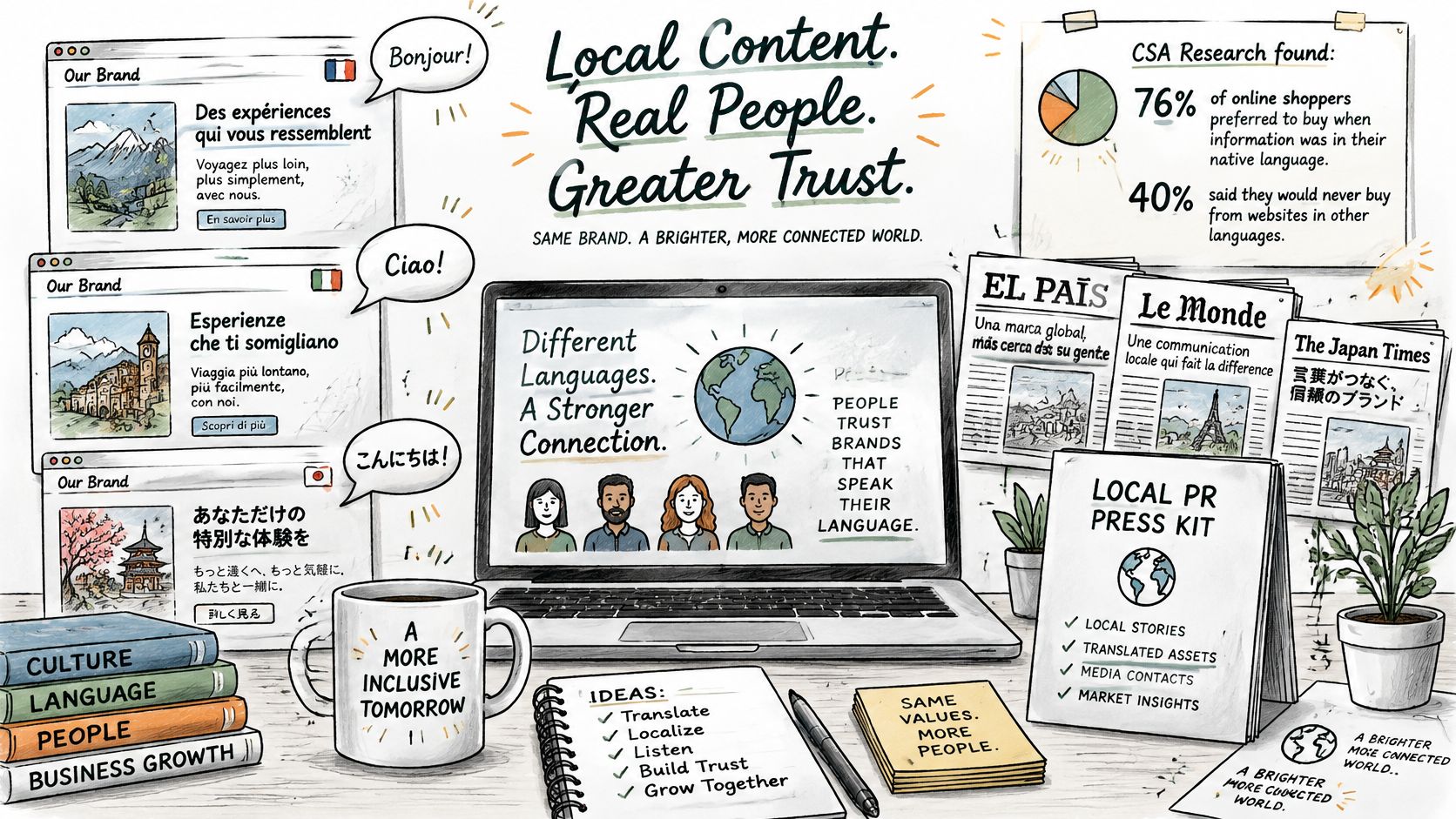
A local reader may recognize the words on a page and still doubt whether the service fits their needs. Translation makes words understandable; localization aligns terminology, examples, imagery, offers, and proof with local expectations.
In a 2020 study of 8,709 consumers across 29 countries, CSA Research reported that 76% of online shoppers preferred to purchase products when information was presented in their native language, while 40% said they would never buy from websites in other languages. The study also reported that 75% were more likely to purchase again when customer care was offered in their language, and 66% of business users said they would pay up to 30% more for a localized technology product.
A page can be grammatically correct yet use the wrong service name, show an unfamiliar neighborhood, or make a claim local rules do not allow. Review the full customer path, including landing pages, intake forms, review responses, and support scripts. In many U.S. service areas, a large share of residents speak a language other than English at home, making language-aware customer information a basic access issue.
Build modular content, not one-off variants
Use two layers:
- Global brand and compliance layer: Keep positioning, legal claims, visual identity, approved terminology, and essential facts consistent.
- Market modules: Adapt local proof points, regional media targets, named spokespeople, regulations, seasonal events, review themes, and service terms.
Assign each module an owner, approval workflow, publication date, target geography, and rollback status. Without those controls, a seasonal offer can remain live after it expires, a retired spokesperson can stay on a page, or a claim can persist after rules change.
Coordinate distribution as well as content. A documented content distribution strategy helps keep a local story consistent across owned pages, regional media, and social channels, while allowing each format to suit its audience.
Localize PR around local proof
Regional journalists need a reason to cover a story beyond a national announcement with a city name inserted. Offer local data, a customer problem relevant to the region, a named spokesperson, and a clear effect on residents or employers. A branch leader can also contribute a bylined article to regional trade press when they can address a specific market issue.
For example, a national insurer promoting family protection can adapt its imagery, terminology for dependents and coverage, and proof points to local expectations. A literal translation may preserve the original wording but leave readers unsure whether the offer reflects their circumstances.
Test the adaptation in one market. Keep the offer and audience constant, then compare adapted and literal versions on engagement, qualified leads, branded search, and sentiment. If adaptation does not improve meaningful actions, simplify the content.
Review and Reputation Tactics That Stay Within Policy
One rule shapes every review decision. Google's Business Profile review policy guidance permits removal only when a review violates its policies, and a negative review is not removable merely because it is unfavorable. Build your workflow around that limit instead of promising managers a cleanup you can't deliver.
Prohibited content includes reviews not based on a real experience, paid or incentivized reviews, content posted through multiple accounts at one person's request, and reviews submitted to undermine a competitor. Google also prohibits offering payment, discounts, free goods, or services in exchange for a review, a revision, or removal of a negative review, and it prohibits selectively soliciting only positive reviews.
Run the same workflow at every location
- Monitor daily: Check Google, Yelp, Facebook, and industry platforms that matter in your category. Tag every review by location, service, and theme.
- Classify before you react: Mark each review as a genuine experience, a possible policy violation, or a disputed fact. Don't let the star rating make that decision.
- Respond with specifics: Aim to respond within a day or two. Name the relevant branch or service when appropriate, state verifiable facts, acknowledge the problem without arguing, and give an offline route with a named contact.
- Report violations with evidence: Use the platform process and document what you can prove, such as no matching transaction, a competitor connection, or a pattern of duplicate accounts. Screenshots and timestamps help. Opinion doesn't.
- Ask consistently: Request reviews from all customer types on the same schedule, after a completed service, through a neutral prompt. If you need a compliant request process, follow a practical guide to getting more reviews without selective solicitation.
Specific responses do more than soothe the reviewer. They help the next prospect judge how you handle delays, billing questions, or a missed appointment. A vague apology repeated 40 times reads like a script. A short, factual answer reads like accountability.
| Situation | Permitted Action | Prohibited Action |
|---|---|---|
| Genuine but unfavorable review | Respond with specific facts and an offer to resolve offline | Requesting removal because the review is negative |
| Review not based on a real experience | Report it through the platform with supporting evidence | Offering payment to have it changed or removed |
| Routine review requests | Ask all customer types on the same schedule | Asking only satisfied customers to review |
| Customer offers a discount in exchange for a review | Decline the offer and keep requests neutral | Offering discounts, free goods or services for a review |
| Review suspected to be posted to undermine a competitor | Report it with evidence of the pattern | Posting retaliatory reviews or responses |
The penalties aren't theoretical. Violating fake-engagement rules can trigger profile restrictions, including temporarily blocking new reviews, unpublishing existing ratings, or displaying a warning that fake reviews were removed. One branch manager trying to hit a rating target can damage the whole profile.
Don't trade a short-term star rating for a public warning on your profile.
Outside help is worth considering when defamatory or inaccurate content sits beyond what platform reporting can fix, or when multiple locations can't keep up with monitoring and escalation. Assess any specialist on policy compliance, evidence standards, reporting transparency, and whether they'll tell you plainly when a genuine negative review should stay and be answered.
Coordinating Many Locations Without Losing Consistency
Think like a franchise operator. The name, logo, and legal entity stay fixed. Hours, local offers, staff stories, and community updates flex by branch. Customers should recognize the brand instantly and still get facts that belong to their neighborhood.
The failure mode is mundane, which is why it persists. Say a 40-branch clinic chain closes one office, but its hours remain live on three directories for months. Patients call a disconnected number, arrive at a locked door, and leave reviews about reliability. Nobody ran a bad campaign. Nobody owned the record.
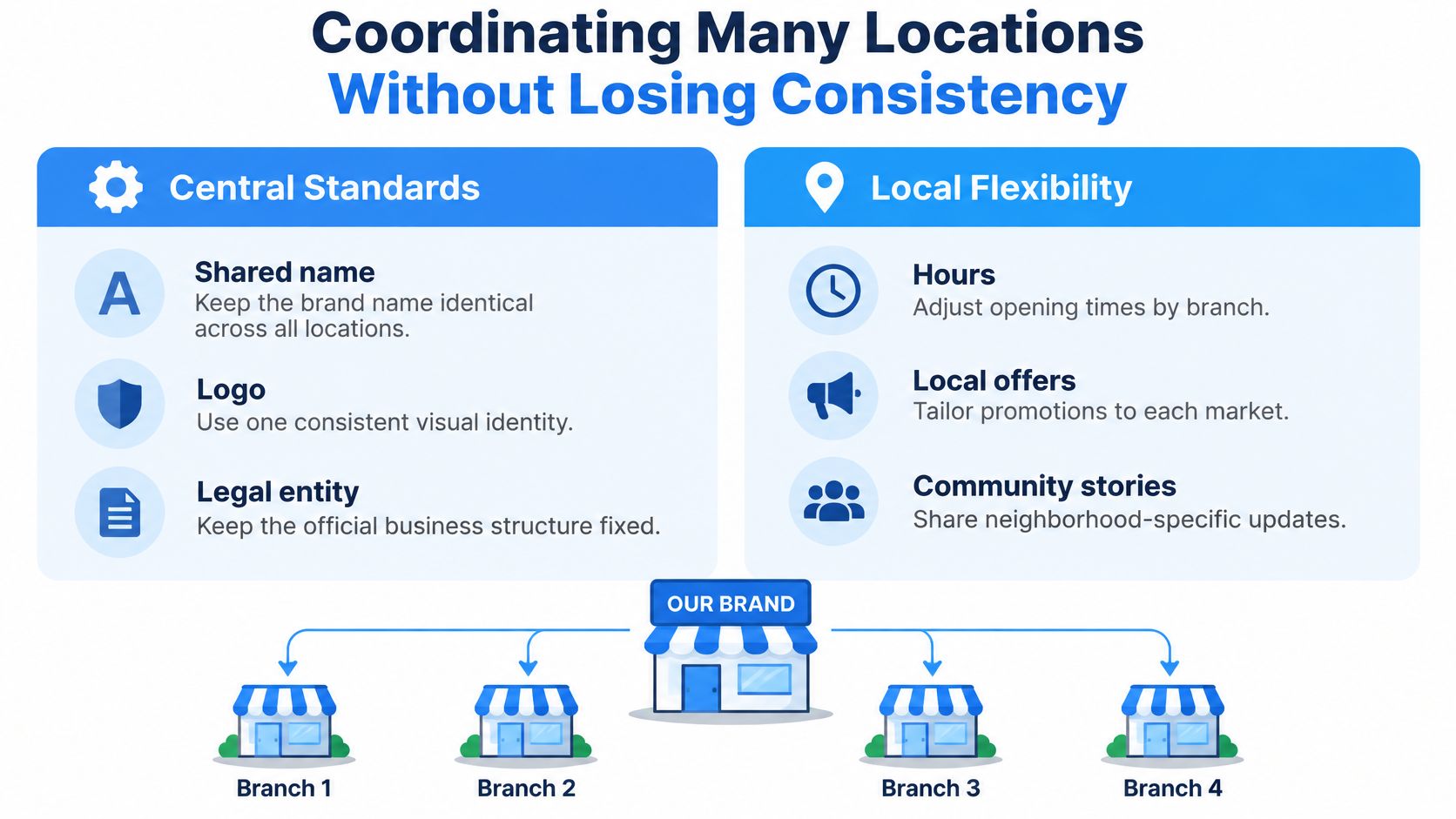
A six-step coordination checklist
- Maintain one master record per location: Store legal name, address, phone, hours, categories, services, and URL in one controlled source, because directories and internal pages copy from it.
- Set approval rules: State which changes local staff can publish, such as holiday hours or event photos, and which need central sign-off, such as pricing, regulated claims, and new services.
- Build a shared glossary: Define service names, abbreviations, and approved claim language so every branch describes the same service the same way.
- Assign a review owner per location: Give that person response templates as a starting point, then require local facts and tone in the final reply.
- Audit every quarter: Check listings and location pages for duplicates, outdated hours, mismatched phone numbers, closed services, and broken booking links.
- Set an escalation path: Name who can act within hours on a wrong address, a viral complaint, or a safety issue. A ticket queue measured in days isn't an escalation path.
A retailer shows the opposite risk. A branch creates a local promotion that undercuts national pricing policy, customers screenshot it, and other stores spend the week refusing to honor a price they never approved. Local flexibility without approval rules becomes a customer service problem.
Duplicate listings and inconsistent details weaken trust in smaller ways every day. Two profiles for one office split reviews. Three phone numbers make call tracking unreliable. Mismatched names make a legitimate branch look like a copycat business.
I would make the master record and approval rules the first change. They're unglamorous, but they stop new errors while you clean up old ones, and every later content or review initiative gets easier once the facts stop drifting.
KPIs and Measurement for Local Performance
A national average is where local problems go to hide. Split reporting by market, device, and query type, or you'll credit a strong city for covering a weak one and miss the branch that's losing ready-to-buy customers.
The device split alone justifies that discipline. Google research reported that 50% of smartphone users who performed a local search visited a store within one day, compared with 34% of computer or tablet users, and that 18% of local smartphone searches led to a purchase within one day, versus 7% of non-local searches. Treat those figures as directional evidence, then validate them against your first-party analytics and CRM data.
That means the mobile path has to be measured as a conversion system. Track whether a searcher can see accurate hours, tap to call, get directions, check service availability, book, and read reviews without friction.
The local KPI set
| KPI | How to Calculate | Healthy Trend | Data Source |
|---|---|---|---|
| Local search visibility | Impressions and clicks from local queries, by market | Steady or rising share in each market | Search Console and Business Profile insights |
| Calls and direction requests | Profile action counts and tracked call volume per location | Growth month over month | Business Profile and call tracking |
| Store visit proxy | Visits within 24 hours of a local search | Rising alongside local impressions | Analytics and location data |
| Review velocity | New reviews per location per month | Steady flow without sudden gaps | Review platform exports |
| Average rating by location | Mean star rating of reviews per location | Stable or improving | Review platform exports |
| Review response rate | Share of reviews answered within a set window | Rising toward the response standard | Review platform exports |
| Branded search lift | Change in branded searches per market after a campaign | Positive lift against baseline | Search Console |
| Qualified leads per 100 visits | Qualified calls and forms divided by location-page visits, multiplied by 100 | Rising without a fall in lead quality | Analytics and CRM |
Read the rows together. Rising impressions with flat calls can mean weak relevance, poor hours visibility, or a page that doesn't answer the next question. Rising calls with falling qualified leads can mean your service area or category is too broad. Strong ratings with low review velocity can hide a branch that's coasting on old goodwill.
Test localization against a national control
Keep the offer and audience constant. For 60 to 90 days, compare localized pages and ad assets containing city, ZIP code, service area, phone, and directions against generic national variants. Measure qualified calls, form completions, direction requests, visit proxies, and conversion rate by geography.
Don't change price, creative theme, and landing page at the same time and then call the result a localization test. You'll learn that something changed, not what caused it.
Track AI-driven discovery as an additional signal in the same dashboard. Log AI mentions, referral visits, and assisted conversions by market, but don't let a new AI metric replace listing accuracy, review response, or call quality.
Reading rule: Judge each market against its own baseline, not against your best city.
Markets differ in population, competition, seasonality, and branch maturity. A smaller market that lifts qualified calls against its own baseline may be performing better than a large market with higher raw volume and no growth.
Confirm Your First Market and Run a 90-Day Test
Pick one market or one location cluster. Don't launch everywhere at once. A focused test gives you readable results, a manageable cleanup list, and a workflow you can copy after it works.
- Audit and fix accuracy: Check listings, hours, phone numbers, categories, duplicates, and reviews for the cluster. Fix every factual gap before you create anything new.
- Choose two revenue queries: Pick two local searches tied to real services and build or repair one location page for each, with local proof and a clear next step.
- Set one review workflow: Name the owner, set the response standard, and use the same neutral request process for every customer.
- Track for 90 days: Record the baseline before work starts, then follow calls, direction requests, visits, branded searches, review velocity, and qualified leads.
- Decide from actions: Extend, adjust, or stop based on lift in calls, visits, and branded searches, not on impressions alone.
Use two sequencing rules. If listing accuracy is poor, fix it before new content. If reviews are thin, build a legitimate request process before buying ads that send more people to a weak profile.
When negative content or reviews are damaging a market beyond what platform policies can address, a specialist such as TheBestReputation can be assessed on local SEO competence, policy compliance, transparent action plans, and reporting on rankings and sentiment. This week, choose the cluster, export its listings and reviews, and fix the first wrong fact you find.
If inaccurate listings, thin reviews, or damaging search results are costing you calls in a priority market, TheBestReputation can audit your local presence, build a policy-safe review and content workflow, and report progress by location. Visit TheBestReputation to request a structured assessment and a clear plan for your first 90-day local test.
