Earned Media vs Paid Media for Online Reputation
A negative article ranks beside your company name. A one-star review appears beneath it. A Reddit thread repeats the complaint, and a prospect sees all of it before they ever speak with your sales team. You can put an ad at the top of the results, but the buyer still has to decide whether the rest of the page feels credible.
That's the practical issue behind earned media vs paid media. Paid media gives you fast, controllable visibility. Earned media gives you independent validation that can influence trust, sentiment, branded search behavior, and the way your company is represented in search and AI-generated summaries. For online reputation management, the right answer usually isn't choosing one channel. It's assigning each channel the job it can perform.
Table of Contents
- Why Earned Media vs Paid Media Matters for Your Online Reputation
- What Earned Media and Paid Media Actually Are
- Side-by-Side Comparison Across the Criteria That Matter
- How to Measure Each Channel Without Fooling Yourself
- Reputation Scenarios and When to Lean on Each
- Integrating Earned and Paid Media in a Reputation Campaign
Why Earned Media vs Paid Media Matters for Your Online Reputation
A page dominated by a Glassdoor complaint, a one-star Reddit thread, and a negative news article creates a reputational problem before a prospect reaches your website. A page anchored by a respected feature, an authoritative review, and a clearly labeled sponsored explainer sends a different signal. The difference isn't cosmetic. It changes how quickly people trust your explanation, whether they continue researching, and how much resistance your sales team faces.
Paid media lets you buy placement. You control the headline, landing page, audience, and timing while the campaign runs. That speed matters when a negative result has just appeared or when a crisis requires an official response. But an ad identifies itself as a paid message. It can occupy valuable space without making the surrounding organic results more believable.
Earned media works differently. A journalist, customer, reviewer, podcast host, or external publisher decides that your company is worth mentioning. You can shape the story through evidence, outreach, and responsive communications, but you can't fully script the result. That independence is precisely why the coverage can carry more weight.
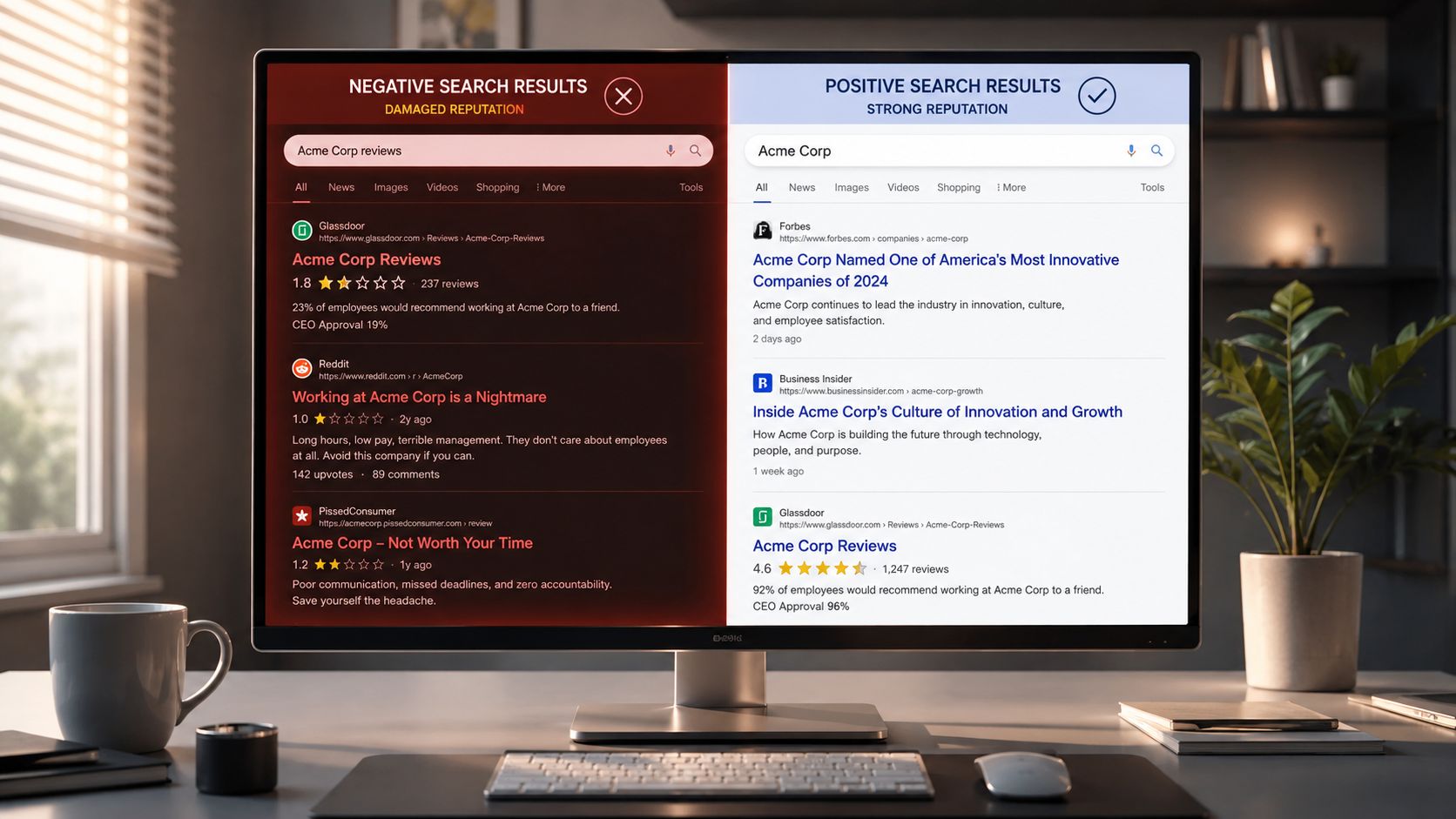
The SERP is a trust environment
Online reputation management uses the PESO model for reputation management, which separates paid, earned, shared, and owned channels. That framework matters because page one is a mixed environment. Your website and profiles are owned assets. Ads are paid assets. Reviews, editorial coverage, forums, and independent articles are earned or shared signals.
A paid result can push a message into view, but it can't erase the buyer's question: “Why should I believe this company?” Earned coverage answers that question indirectly by giving the buyer an outside reference point.
The economics support a combined approach. A 2026 industry summary citing Nielsen-based research reports that 92% of consumers trust earned media, including word-of-mouth and online reviews, more than any other form of advertising, compared with 41% who trust paid ads. The same source reports 4.7x higher ROI for earned editorial placements, along with a 31% lead-to-close rate for earned placements versus 12% for paid ads. These figures come from the earned media statistics summary, and they illustrate why third-party validation can matter more than raw visibility in reputation-sensitive decisions.
Practical rule: Use paid media to control what appears immediately. Use earned media to make the page believable after the buyer starts checking.
Paid visibility also needs protection. If you're spending to send prospects into a search environment filled with negative results, review protecting ad spend on social media with a reputation-focused workflow. Your campaign may be generating clicks, but the surrounding narrative can still reduce confidence and waste the investment.
What Earned Media and Paid Media Actually Are
In ORM terms, earned media is third-party validation you didn't directly pay for. It can include a journalist's profile, an independent review, a trusted subreddit mention, a podcast discussion, or an external article that search systems may use as context. The defining feature is not that the coverage costs nothing. Public relations, research, outreach, and content development all require resources. The defining feature is that the publisher or reviewer retains editorial independence.
Paid media is visibility you rent through spend. It includes search ads, display ads, boosted social posts, sponsored content, paid advertorials, and paid placements on media or review platforms. You control the message more closely, but the audience knows the placement was purchased. Paid media can create immediate exposure, yet the placement generally disappears when the budget or booking ends.
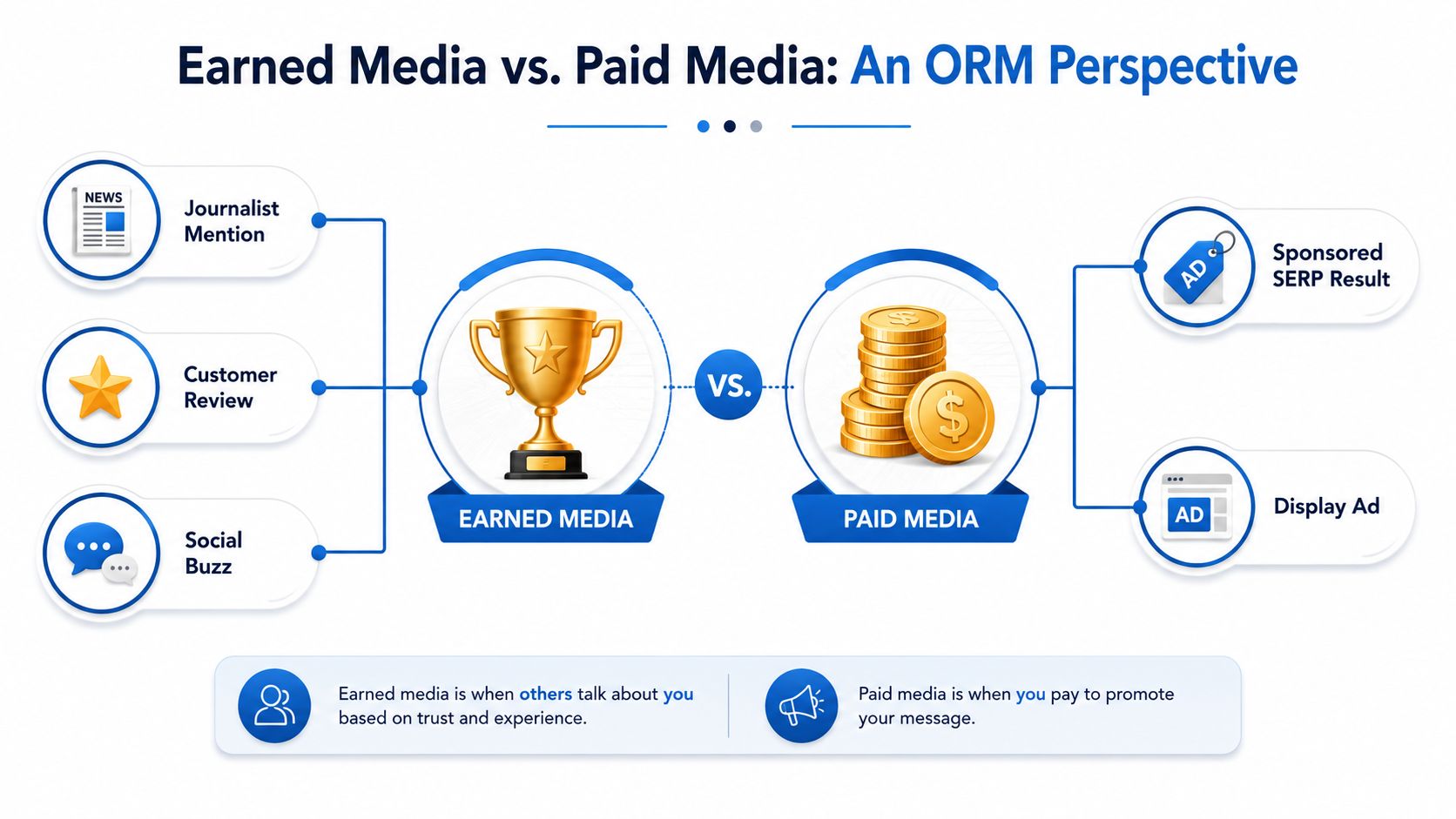
The ORM boundary between the channels
Consider two articles about the same executive. A genuine profile written by a Forbes contributor after interviews and independent research is earned media. A sponsored advertorial published with a paid label is paid media, even if it appears on a respected business site. Both may rank, but they communicate different trust signals.
The same distinction applies to reviews. An unsolicited G2 review from a customer is earned feedback. A paid placement on a review marketplace is a commercial asset. You can promote either one, but you shouldn't report them as if they carry the same editorial weight.
Owned media sits between these channels as the infrastructure you control. Your website, blog, executive profile, company LinkedIn page, and customer resource center are owned assets. They give you a stable place to publish a correction, explain a product, or host evidence. They don't become earned just because they rank well.
The media relations strategy for ORM should therefore focus on creating credible reasons for independent people to cover your company. A press release can support that effort, but distribution alone doesn't guarantee editorial attention. A useful story, verifiable expertise, timely data, or a meaningful response to an issue gives journalists and reviewers something they can evaluate.
This distinction is also important in AI-shaped discovery. A company's own description may inform a summary, but an external review or editorial reference can provide the validation that makes the description persuasive. Paid media can expose the brand to more people. Earned media helps those people decide whether the brand deserves confidence.
Side-by-Side Comparison Across the Criteria That Matter
For ORM, the useful comparison isn't reach versus cost. You need to ask which channel changes the first page, who controls the message, how long the asset remains visible, and whether the exposure improves the credibility of the surrounding results.
| Criterion | Earned Media | Paid Media |
|---|---|---|
| Trust | Stronger independent validation from journalists, customers, reviewers, or external publishers | Lower perceived credibility because the placement is purchased |
| Cost | No direct cost of buying the editorial placement, but requires strategy, outreach, content, and relationship work | Direct and recurring spend for placement, clicks, or impressions |
| Control | Limited editorial control after a story is accepted | High control over copy, targeting, timing, and landing page |
| Speed | Slower and dependent on relevance, timing, and publisher interest | Fast launch and predictable placement while budget is active |
| SEO impact | Can create durable third-party references, links, and narrative assets | Can occupy sponsored SERP space but doesn't replace organic authority |
| Durability | May continue attracting readers and reinforcing the narrative after publication | Stops delivering visibility when spending stops |
| Crisis value | Builds an independent explanation or counter-narrative | Buys immediate response space and directs users to controlled information |
| AI discovery value | External coverage, sentiment, reviews, and citations can strengthen perceived authority | Paid exposure may not provide the same independent validation in summaries |
Earned media wins on trust, link equity, AI citation pull, and long-term SERP staying power. It loses on speed and predictability. A journalist may reject the pitch, change the angle, or publish on a different schedule. A review can contain criticism you can't edit.
Paid media wins on launch speed and message control. You can send traffic to a crisis statement, promote an executive interview, or keep a replacement page visible for a defined campaign period. The trade-off is a trust ceiling. Readers discount paid placements, especially when the organic results underneath contradict the ad.
The hidden cost is strategic. Paid media without earned support can generate exposure that converts poorly because the prospect sees no independent proof. Earned media without paid support can take too long to seed the page, particularly during a crisis. Mature programs treat the channels as near-equal budget lines, not substitutes. A global benchmark cited by Harvard Business School reports that B2B marketers allocate roughly 24% of digital marketing budgets to earned media and 25% to paid media, as described in Harvard Business School's earned versus paid media analysis.
AI search makes the distinction sharper. Search summaries and AI Overviews can draw on third-party citations, reviews, and sentiment signals when forming an answer. Ads can buy attention around that answer, but earned references help determine whether the answer sounds credible.
How to Measure Each Channel Without Fooling Yourself
Reputation programs often fail in reporting before they fail in execution. Teams apply paid metrics to earned coverage, celebrate impressions without checking sentiment, or credit every branded conversion to the most recent ad. That produces a polished deck and an inaccurate picture of page-one performance.
Measure paid media as a controlled distribution system. Track impression share, cost per qualified visit, branded search lift, conversion rate, and the SERP placement held while the campaign runs. Paid dashboards commonly use CPM, CPC, CPA, and ROAS because those metrics show how reliably spend buys exposure or action. The earned, owned, and paid media KPI guidance explains this operational distinction and supports pairing earned reporting with analytics attribution rather than forcing every channel into one dashboard.
Use a separate evidence set for earned media
Earned coverage needs a quality and persistence review. A mention in The Washington Post shouldn't be treated as interchangeable with a small, low-authority blog mention merely because both produce one referral session.
| Metric Family | Paid Media KPIs | Earned Media KPIs | Common Mistake |
|---|---|---|---|
| Visibility | Impression share, frequency, SERP placement | Share of voice, publication prominence, referring domain quality | Treating every impression as equal |
| Traffic | Cost per qualified visit, CPC, conversion rate | Referral traffic, engaged visits, dwell time on third-party URLs | Counting clicks without checking visitor quality |
| Reputation | Branded search lift, ad sentiment signals | Sentiment, message pull-through, review context | Reporting reach while ignoring negative framing |
| Durability | Placement held while spend remains active | Placement persistency after the story ends | Assuming a campaign result lasts indefinitely |
| Business outcome | CPA, ROAS, qualified conversions | Leads, assisted conversions, source-attributed sales | Giving the final click all the credit |
Use a 30-day review to catch immediate movement and technical problems. Check whether paid placements are appearing, whether earned URLs are indexed, whether referral traffic is qualified, and whether sentiment is moving in the intended direction.
Use a 60-day review to evaluate narrative spread. Look for additional mentions, branded search behavior, links, review references, and whether the new assets are competing with the negative results.
Use a 90-day review to test durability. Paid performance should be judged against the spend required to maintain visibility. Earned performance should be judged by persistent rankings, continued referral activity, third-party references, and sustained share of voice.
For teams building a more rigorous measurement layer, B2B content performance analytics can help connect content activity with search and conversion evidence. The rule is simple: don't kill paid too early because a crisis needs immediate coverage, and don't over-credit earned media for conversions it never influenced.
Reputation Scenarios and When to Lean on Each
A channel decision becomes easier when you start with the reputational event rather than the media label.
A sudden review crisis
A wave of negative Trustpilot or Google Business Profile reviews needs immediate control. Paid search and social placements can direct customers to an official response, updated service information, or a support path while your team investigates the source. That doesn't repair the review profile by itself. The second move is earned outreach, customer resolution, accurate documentation, and legitimate third-party coverage that reflects the underlying facts.
Decision cue: Buy time with paid media, then earn the evidence that makes the response credible.
A negative press article on page one
Don't respond by buying ads alone. Publish or strengthen a factual owned resource, brief relevant journalists, and pursue an earned counter-story that addresses the issue with evidence rather than promotional language. Paid amplification can then send qualified audiences to the replacement content and help it gain attention while the earned asset builds authority.
Decision cue: Use earned media to change the narrative, and paid media to accelerate the replacement.
Email outreach can support the media process, but deliverability matters. Before sending a campaign to journalists or stakeholders, use a practical resource on how to check if emails are going to spam so important pitches don't disappear before they're read.
A product recall with regulatory risk
This is an earned-led situation. Buyers need clear information from trusted outlets, regulators, specialists, and recognized industry voices. Paid media should support owned communications and retarget people who have already visited the official recall information. It shouldn't make a sensitive event look like an advertising opportunity.
Decision cue: Prioritize accurate earned coverage, with paid media limited to directing people to authoritative information.
An executive launch or funding announcement
A paid-led teaser can create controlled awareness around the launch. Once the announcement is live, pursue an exclusive interview, a respected business profile, or industry commentary that gives the executive independent credibility. The earned article can then support the executive's search profile, while paid distribution reaches audiences who didn't encounter the original coverage.
Decision cue: Use paid media to create momentum, then earn the proof that the announcement matters.
Integrating Earned and Paid Media in a Reputation Campaign
The strongest ORM campaigns don't run paid and earned media in separate lanes. They use paid media for immediate control, earned media for durable authority, and owned content as the destination where claims, documentation, and updates can be reviewed.
A practical sequence starts with paid media in week one. Secure relevant SERP real estate, promote the official explanation, and direct users to pages that answer the questions created by the reputational event. At the same time, prepare the evidence and story angles required for journalist outreach. Paid media handles the urgent visibility problem while the earned program develops.
Weeks two through six should focus on earned media nurturing. Build relationships with relevant reporters, respond to expert requests, offer informed commentary, and provide documentation that makes independent coverage possible. Don't chase volume for its own sake. A smaller number of relevant, credible references can do more for a reputation than a large group of weak placements.
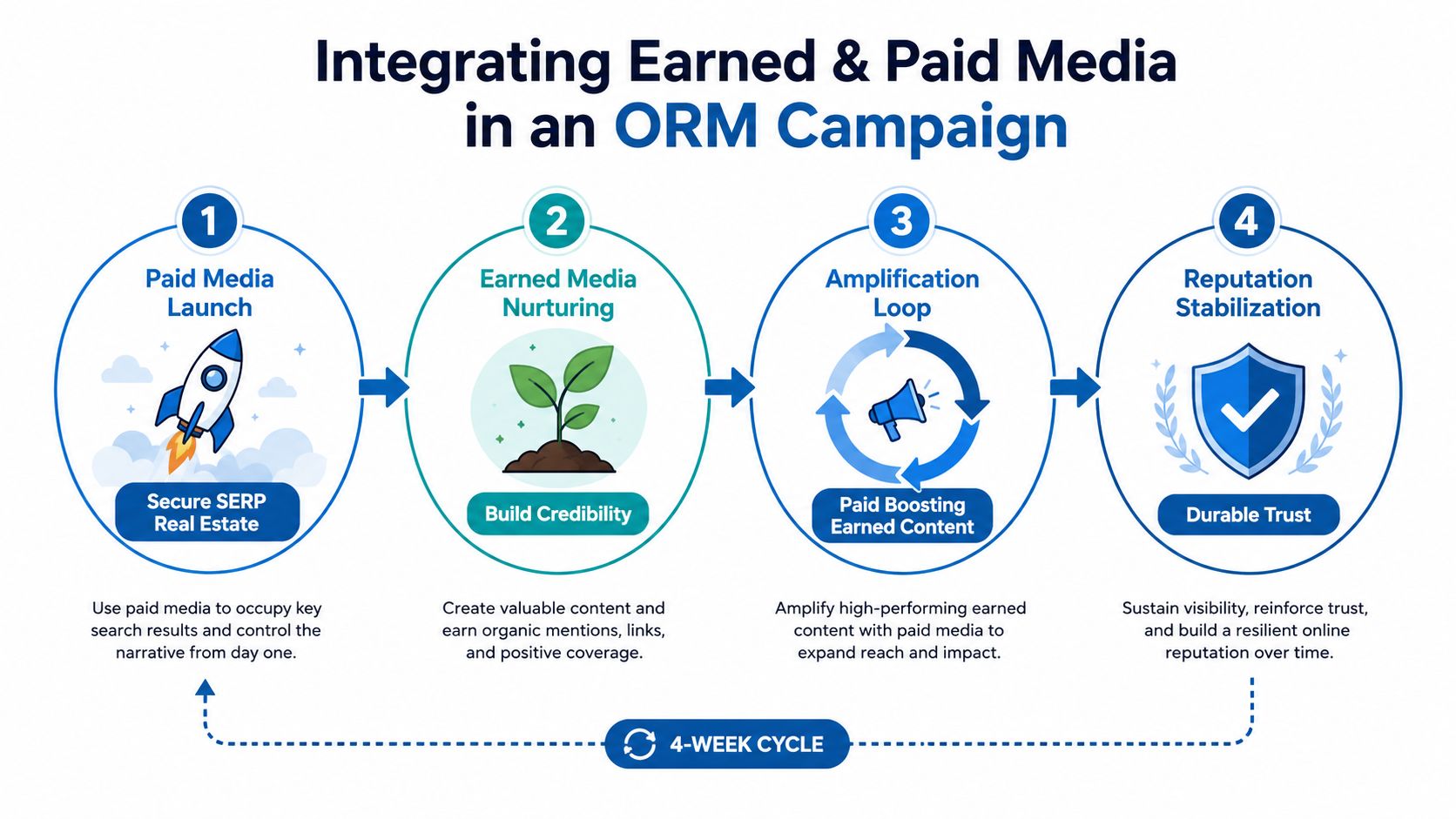
Build the amplification loop
Once earned coverage appears, paid media can amplify it to relevant audiences. Promote the interview, feature, review, or expert article where appropriate, then retarget people who engaged with that coverage or visited the owned evidence page. This gives paid spend a more credible destination and lets the earned asset do more work across the funnel.
The relationship also works in reverse. Paid campaign data can show which messages attract qualified attention, which objections appear repeatedly, and which audiences need clarification. Use those signals to refine the questions you answer in earned pitches and executive content.
AI discovery makes this coordination necessary. Current industry guidance describes earned signals such as sentiment, reviews, and social engagement as inputs to paid amplification decisions, while practitioners are adding indicators such as AI citation share to broader reputation reporting. The Conference Board's critique of Advertising Value Equivalency also captures the larger measurement shift. Treating editorial coverage as if it were merely purchased ad space has been discredited, so reporting should focus on credibility, engagement quality, sentiment, and business outcomes.
Campaign rule: Paid media creates the opening. Earned media supplies the credibility. Owned media preserves the record.
If your goal is page-one stabilization, start with paid support for urgent controlled assets, then invest in earned coverage that can remain visible after the campaign ends. If the goal is a product launch, use paid distribution to test and accelerate the message, then pursue independent coverage. If the goal is crisis response, prioritize factual communication, trusted third-party validation, and disciplined attribution over reach alone. A coordinated thought-leadership content strategy for crisis management can help turn executive expertise into durable reputation assets.
TheBestReputation combines SERP audits, SEO, media relations, thought-leadership development, review workflows, and crisis monitoring to help organizations influence what audiences find across search and social. If negative results or weak third-party validation are limiting your paid performance, visit TheBestReputation to request a structured reputation assessment and action plan.

