Fake Review Detection: Key Strategies for 2026
Fake review detection isn’t a hygiene task anymore. On popular UK e-commerce platforms, an estimated 11% to 15% of reviews in consumer electronics, home and kitchen, and sports and outdoors were fake, and government-backed research concluded that at least 10% of all product reviews on third-party e-commerce platforms are likely fake too, with subtle deception also nudging consumers toward purchase in the UK government-backed report. When fraud reaches that level, the issue isn’t just bad content. It’s distorted trust, distorted rankings, and distorted revenue.
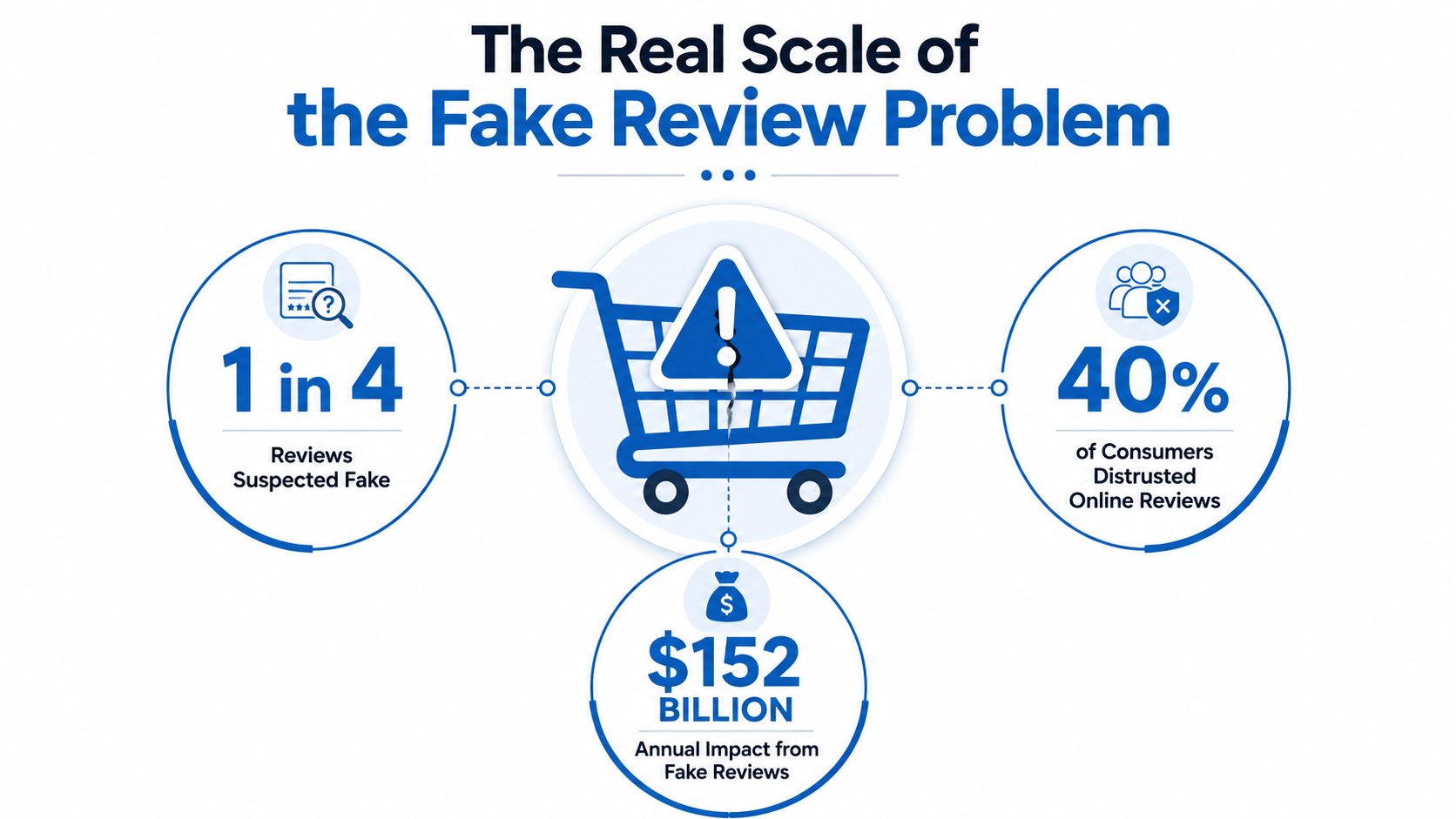
Table of Contents
- The Real Scale of the Fake Review Problem
- Behavioral and Metadata Signals That Expose Fake Reviewers
- Content Analysis and Linguistic Red Flags
- Detecting Coordinated Campaigns and Review Networks
- Automated Detection Tools and AI Systems
- Escalation Workflows and Platform Reporting
- Building a Sustainable Fake Review Defense Strategy
The Real Scale of the Fake Review Problem
Why the problem is bigger than a few bad actors
Fake reviews do not sit at the edges of the marketplace. They are embedded in the review systems buyers use every day, and that changes how businesses should think about fake review detection. A UK government-backed study found that 11% to 15% of reviews across three common categories on popular platforms were fake, and it also concluded that at least 10% of all product reviews on third-party e-commerce platforms are likely fraudulent. That is not a rare anomaly; it is a structural problem.
That same research matters because it measures more than volume. It also found that even subtle fake reviews can significantly increase the proportion of consumers who buy the reviewed product. That is the business case in plain terms: fake reviews influence conversion, not just perception.
Businesses feel this in three places at once: search visibility, purchase confidence, and brand trust. A review profile with suspicious bursts can change how customers interpret your offer before they ever visit your site. A local profile with manipulated ratings can also create a credibility gap that is hard to close later.
Practical rule: treat every suspicious review as both a content issue and a distribution issue. If the fraud is coordinated, the damage spreads across the whole profile, not just one line item.
A smarter response starts with multi-signal monitoring, not isolated flagging. That means combining reviewer behavior, language patterns, and network structure instead of trusting any single clue. The best reputation programs also keep genuine feedback visible, because customer reviews and testimonials carry more weight when they are surrounded by a steady base of authentic activity.
What the old detection mindset misses
A lot of businesses still look for obvious tells: awkward grammar, over-the-top praise, or a single suspicious star rating. That misses how modern fraud works. Deceptive reviews can be written cleanly, posted in clusters, and spread across multiple products or locations to look organic.
The better mental model is this: fake review detection is really fraud pattern detection. The text matters, but it is only one layer. If the surrounding behavior and account history look wrong, the content usually follows.
Fraud rings also leave network-level signals that single-review checks can miss. A burst of similar ratings across related listings, repeated phrasing from different accounts, or review timing that tracks too neatly across profiles can point to coordination rather than coincidence. I have seen cases where the individual reviews looked passable, but the posting pattern exposed a shared operator behind them.
That is also why teams should check adjacent trust signals, including account hygiene and contact data. If you are already screening inbox sources, a tool like how to detect fake emails can help you separate genuine customer activity from low-quality lead sources that often feed review abuse. The pattern is the same. Bad actors reuse infrastructure until someone maps the network.
Behavioral and Metadata Signals That Expose Fake Reviewers

Start with the reviewer’s footprint, not the sentence
The fastest way to catch suspicious activity is to look at what the account does around the review, not just what the review says. Research on fake-review detection notes that behavioral features can be as effective as verbal features, including signals like the number of likes or dislikes, average posting rate, and review updates alongside review length and content semanticscholar paper. That matters because real users leave irregular footprints, while paid accounts often look unnaturally efficient.
Review timing is usually the first thing I check. A profile that posts many five-star reviews in a short window, then goes quiet, deserves attention. The same goes for an account that only reviews products from one seller or one category, especially when the rhythm looks too neat to be casual.
Location and account metadata matter too. If a reviewer claims experiences that do not fit the business geography, or if the profile looks newly created right before a rating burst, the pattern is worth documenting. On platforms like Google, Yelp, and Amazon, that mismatch can say more than the wording itself.
Use the surrounding data to test the story
Suspicious review patterns deserve a wider check of the account’s support signals. Cross-check email identity, account age, and behavioral consistency across channels. If you are already screening inbox sources, how to detect fake emails is a useful companion because the same identity mismatch that weakens an inbox profile often shows up in review fraud accounts too.
A quick review audit usually surfaces the same red flags:
- Burst posting: one account leaves multiple reviews within a compressed time window.
- Narrow target pattern: the profile reviews only one brand, one seller, or one product cluster.
- Low diversity: the account’s history lacks the natural mix you would expect from a genuine buyer.
- Metadata mismatch: timing, location, or purchase history does not fit the claimed experience.
- Suspicious consistency: the same style appears across unrelated listings.
Genuine reviewers are messy. Fraud rings are organized.
That is why I do not rely on one account signal alone. I look for combinations: a new profile, a narrow review history, and synchronized activity together. When those line up, manual review usually beats automation because a human can see whether the pattern tells a story or just looks odd at first glance.
The strongest teams also check whether the same reviewer behavior shows up across separate listings, sellers, or locations. A coordinated campaign often leaves a pattern at the network level, with multiple accounts rotating through the same targets, same timing, and similar metadata. A short review profile can be a bad sign, but a cluster of accounts behaving in sync is harder to explain away and much more useful for enforcement.
For teams that want to go one layer deeper, a structured look at online sentiment analysis signals can help separate ordinary customer variation from organized manipulation. The practical trade-off is simple. Automation is better at spotting volume and repetition across a large set of reviews. Manual review is better at deciding whether those patterns reflect a fraud ring, a shared contractor, or a legitimate customer base that is unusually concentrated.
Content Analysis and Linguistic Red Flags
Language matters, but less than people think
Text analysis still catches a lot of fraud, but it’s a mistake to treat grammar as the main test. Reviews with extreme sentiment, repetitive phrasing, keyword stuffing, or copy that reads like ad copy instead of customer experience are all worth reviewing. Those signals often show up when the author is trying to sound persuasive rather than specific.
The trouble starts when teams overfit to style alone. A bilingual customer, a transliterated post, or a code-switched review can look unusual without being fake. Recent literature on multilingual fake-review detection points out that low-resource languages and mixed-language reviews are still under-studied, which is one reason grammar-based heuristics break down outside English-only datasets multilingual review.
What to look for in actual review text
A strong linguistic review audit checks for patterns across multiple posts, not a single odd sentence. Sentiment extremes matter when they arrive without detail, especially if the review sounds promotional or unusually hostile and offers nothing concrete. If the same phrases keep appearing across accounts, the probability of coordination rises fast.
For teams that want a more structured view of tone, sentiment analysis APIs can help surface outliers at scale. They’re not a replacement for judgment, but they’re useful for triaging large review volumes before a human reads the borderline cases.
A simple content review usually includes:
- Specificity check: real customers mention use, context, or trade-offs.
- Repetition check: fake reviews often reuse the same sentence patterns.
- Marketing-language check: genuine buyers rarely write like ad copy.
- Sentiment balance check: authentic reviews usually contain nuance, not pure praise or pure attack.
The key is to avoid false confidence. A clean-looking sentence isn’t proof of authenticity, and a clumsy sentence isn’t proof of fraud. The strongest reading comes from combining the text with reviewer behavior and campaign-level context. For a wider look at tone across customer feedback, online sentiment analysis is most useful when it’s paired with manual verification, not used as a standalone verdict.
Detecting Coordinated Campaigns and Review Networks

Look for the campaign, not the single review
The biggest shift in mature fake review detection is moving from “Is this review fake?” to “Is this cluster coordinated?” Research on network structure showed that just two graph features, clustering coefficient and eigenvector centrality, could identify products buying fake reviews with high accuracy and outperform models using many metadata, text, and image features network study. That matters because fraud often behaves like a campaign, not an isolated act.
Coordinated attacks leave traces in time, relationship structure, and overlap. You’ll often see synchronized bursts, reviewer reuse across related businesses, and review patterns that travel together across products or locations. The individual review may look ordinary, but the network around it doesn’t.
What the network tells you that text can’t
I’ve seen profiles where every review looked passable on its own, yet the timing gave the game away. Multiple accounts posted within a narrow window, used similar phrasing, and then vanished. That’s exactly the kind of pattern that manual moderation misses when teams only inspect star ratings one by one.
A single suspicious review is a warning. A coordinated burst is a problem.
Businesses should map reviewer overlap, not just count negative comments. If the same cluster keeps appearing across competitors or neighboring locations, the issue may be a marketplace of paid placements rather than one unhappy customer. That distinction changes the response, because you’re no longer dealing with feedback quality; you’re dealing with organized manipulation.
This is also why text-only moderation is weak against adversaries. Fraud operators can rewrite language faster than they can hide shared timing and network structure. Graph signals are harder to spoof at scale, which is why the most effective programs combine behavior, content, and network analysis instead of depending on a single filter.
Automated Detection Tools and AI Systems

What automation does well, and where it still fails
AI handles review screening at a scale humans cannot match, but scale does not guarantee accuracy. In benchmark comparisons, human detection lands around 57% accuracy, while AI and machine learning approaches reach roughly 90% in some review tests benchmark review. That gap explains why platform teams use automation as a first pass, especially when they need to sort through bursts that may be part of a coordinated campaign rather than random spam.
Platforms are also looking beyond the review itself. Amazon says it uses AI to analyze hundreds of signals across reviewers, reviews, account behavior, and content, and it removed over 250 million suspected fake reviews in 2023 before customers saw them Amazon enforcement overview. That approach matters because organized fraud usually leaves patterns across accounts, timing, and linked listings, even when each individual review looks ordinary.
Why model quality can still mislead you
Headline scores can make a model look stronger than it is in real use. The benchmark review shows how much results shift by dataset and evaluation design, with one Yelp-focused study reporting only 67.8% accuracy on real-life reviews, a CS229 Yelp project reporting 81.92% accuracy, 82.49% AUC, and 81.42% F1, and another study reaching 95% accuracy and F1 on its test set benchmark review. A DeBERTa-based model also reported 98% accuracy, 98% precision, 97% recall, and 97% F1, but production teams still need validation on their own data before treating that kind of result as settled.
A practical tool stack should also pull in structured context, not just review text. For teams comparing scraping and enrichment workflows, check out AI web scraping capabilities for collecting the surrounding business data that pure language models often miss.
Practical rule: use automation for triage, not final judgment, unless the model has been tested on your own platform data.
The strongest systems use multiple signals and regular retraining because spam tactics change fast. Static keyword rules age badly, and content-only models get brittle when fraudsters adjust phrasing or spread the same script across many accounts. Human review still matters when the system has to decide whether a cluster is noisy, manipulative, or part of a wider ring.
For organizations that need cleaner escalation paths and evidence handling, AI reputation management services can help when automation is paired with documentation and response logic instead of being treated like a shortcut.
Escalation Workflows and Platform Reporting
Report patterns with evidence, not annoyance
A removal request works better when it looks like a case file. Save timestamps, account names, review URLs, screenshots, and anything that shows a cluster instead of a one-off complaint. Platforms are more likely to act when the report points to policy violations and coordinated behavior, not just “this feels fake.”
Google, Yelp, Amazon, and other platforms all handle abuse differently, so the framing should match the platform’s own enforcement language. If the issue is individual spam, flag the review. If it’s a campaign, document the pattern across accounts, dates, and related listings. That distinction often decides whether the report gets reviewed seriously.
Escalate when the pattern repeats
If the first report is rejected, don’t stop at the rejection notice. Repackage the evidence, add the network pattern, and show why the cluster is broader than a single comment. When needed, involve legal counsel or a reputation management professional who can preserve evidence and coordinate the response.
A good incident record should include:
- Review copies: screenshots and archived URLs.
- Timing evidence: when the reviews appeared and in what sequence.
- Account patterns: new profiles, narrow histories, or repeated language.
- Business impact notes: rating shifts, profile disruptions, or customer complaints.
For teams that want a cleaner operating model, incident response playbook principles translate well here. Treat review fraud like a reputational incident, not a moderation nuisance, because the response gets stronger when ownership, documentation, and escalation are clear.
Building a Sustainable Fake Review Defense Strategy
Make detection part of routine reputation work
A durable defense combines behavior, content, and network review into one repeating audit. That means checking new profiles, timing clusters, repeated language, and account overlap on a regular schedule instead of reacting only after a rating drop. The teams that stay ahead of fraud usually have a simple rule: suspicious patterns get reviewed fast, documented once, and escalated consistently.
The cleanest approach is also the least dramatic. Build monitoring routines, set internal thresholds for when a cluster needs human review, and keep authentic review generation active so fraudulent content doesn’t dominate the profile. That doesn’t eliminate fake reviews, but it does make them easier to spot and less damaging when they appear.
Your practical checklist is simple:
- Watch behavior first: timing, history, and review diversity.
- Scan content second: repetition, sentiment extremes, and ad-like phrasing.
- Map networks third: overlap, clustering, and coordinated bursts.
- Escalate early: preserve evidence before platforms or attackers change it.
Fake review defense belongs inside online reputation management, not outside it. If you treat it as a one-off cleanup task, you’ll keep chasing symptoms. If you turn it into a standing workflow, you get faster reporting, better search visibility, and a profile that’s much harder to manipulate.
If fake reviews are distorting your ratings or you suspect a coordinated campaign is hitting your profiles, visit TheBestReputation to discuss review removal, monitoring, and reputation protection. Their team helps businesses document abusive patterns, escalate policy violations, and build a stronger review profile that holds up under pressure.
