PR Crisis Management: A Playbook for Reputation Repair

Only 49% of U.S. businesses have a formal, documented crisis communications plan, while 28% rely on an informal plan and 23% have none or are unsure, according to Capterra's 2023 crisis communications research. That preparation gap is why many companies lose narrative control within hours of a digital incident, especially when cyberattacks and technology failures account for 28% and 22% of crisis events, respectively.
PR crisis management isn't a polished statement published after the damage is done. It's an operating system for detecting risk, verifying facts, assigning authority, responding across the channels where people are talking, and repairing the digital record after the immediate attention fades. Social platforms have made the first response public, searchable, and easy to compare with every later update.
The field itself has matured considerably. A 2023 bibliometric study in Humanities and Social Sciences Communications traced explicit crisis communication research back to 1968 and identified 1,850 articles by 3,277 authors across 1,222 institutions, 646 journals. That history matters because effective crisis work is no longer improvised reputation control. It combines communication judgment with monitoring, governance, stakeholder coordination, search strategy, and measurable recovery.
Table of Contents
- The Readiness Gap in Modern PR Crisis Management
- Building a Crisis Management Infrastructure Before It Breaks
- The First Hour Protocol for Real-Time Response
- Digital Remediation and SEO Recovery Strategies
- Coordinating Media Relations and Stakeholder Communication
- Post-Crisis Analysis and Measurable Recovery KPIs
The Readiness Gap in Modern PR Crisis Management
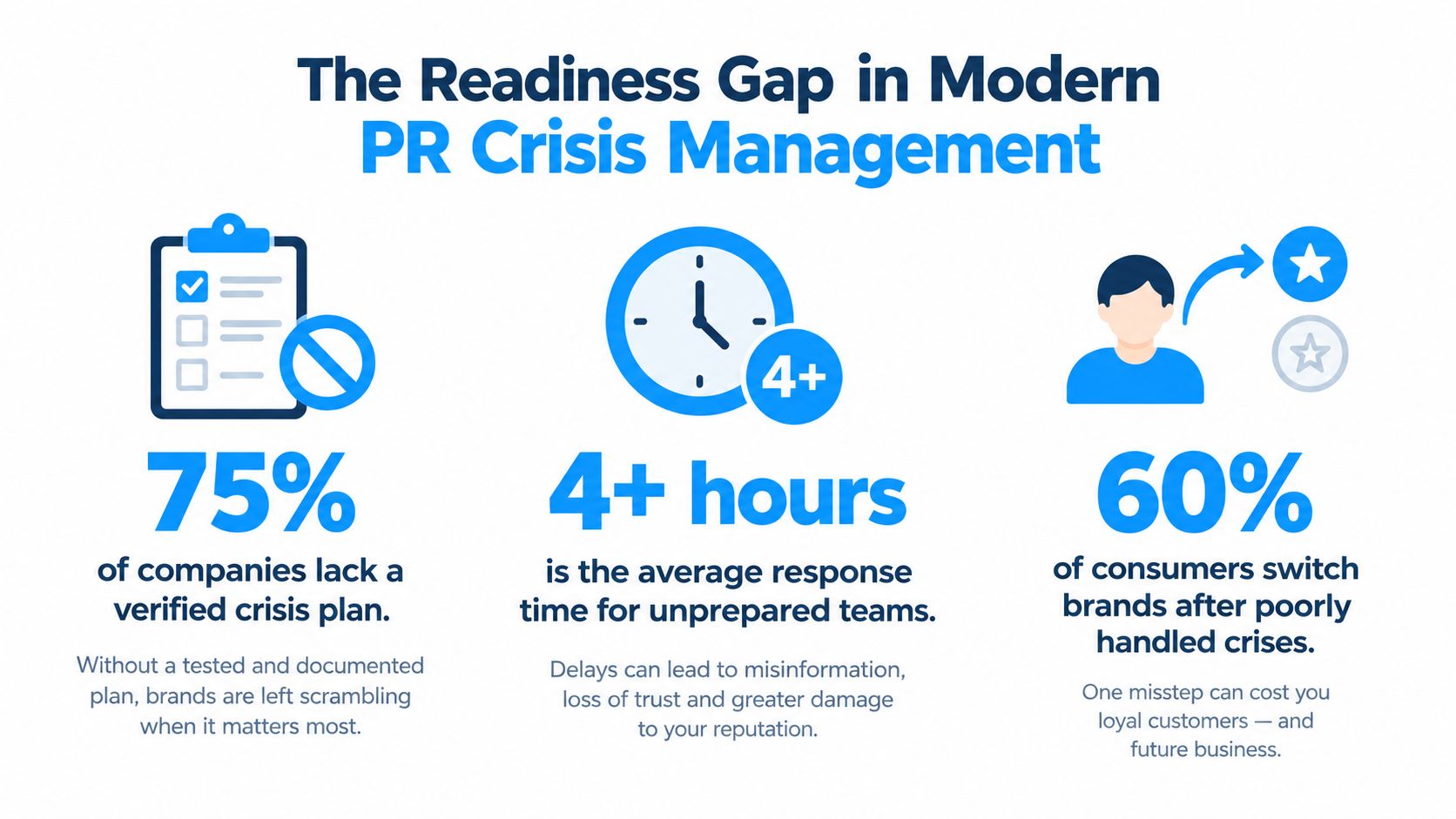
A crisis plan only helps if people can find it, understand their authority, and use it under pressure. Yet the Capterra survey shows that fewer than half of U.S. businesses had a formal documented plan in 2023, while the remaining organizations either depended on informal arrangements or lacked a plan altogether. The problem isn't just missing paperwork. It's the absence of agreed decisions before the incident creates conflicting priorities.
Cyberattacks represented 28% of crisis events, and technology failures represented 22%, according to the same Capterra survey. Those incidents often require communications, legal, technical, customer support, executive leadership, and security teams to act together. A communications-only plan can't explain who verifies the facts, who approves a holding statement, who contacts affected customers, or who decides that an issue has escalated beyond routine service recovery.
Why documentation changes the response
Preparedness creates speed without forcing the team to guess. A useful playbook should include:
- Incident categories: Define what counts as a customer-service issue, emerging reputation risk, operational incident, or full crisis.
- Escalation authority: Name the people who can activate the response team, pause campaigns, approve public language, and involve counsel.
- Message controls: Store approved holding statements, fact sheets, channel owners, and update protocols in one accessible location.
- Stakeholder priorities: Record which audiences need direct contact first, including employees, customers, partners, regulators, and journalists.
- Recovery ownership: Assign responsibility for search results, reviews, media follow-up, social monitoring, and post-incident reporting.
The most useful readiness test isn't whether the document looks complete. Ask whether a new team member could identify the incident lead, locate the current facts, and publish an approved first response without relying on personal memory.
A practical reputation-risk monitoring approach should also distinguish signal from noise. Overreacting to every complaint exhausts the team and can amplify a minor issue. Underreacting to a fast-moving allegation leaves outside voices to define the story.
Operational rule: A crisis plan should tell people what to do in the first minutes, not merely describe the organization's values.
Building a Crisis Management Infrastructure Before It Breaks
The strongest crisis programs begin with an audit, not a template. Before drafting language, map the places where an incident could appear, the systems that would detect it, and the people who would need to make decisions. Include social channels, review profiles, news coverage, employee communications, customer support tickets, executive accounts, and search results.
Start with the detection layer
Build monitoring around more than the company name. Include product names, executive names, campaign phrases, common misspellings, branded hashtags, and terms connected to likely operational risks. Your team should be able to see a sudden change in mention volume, a cluster of negative conversation, or a complaint spreading outside the original channel.
Monitoring only works when someone owns the alerts. Set a review cadence for normal periods and a clear escalation path for unusual activity. The person who sees the alert shouldn't have to decide alone whether it matters. They should know who verifies the source, who assesses reach and trajectory, and who can activate the response team.
The crisis management system framework should connect monitoring to action. A dashboard without an on-call owner is an archive, not an early-warning system.
Create governance that survives pressure
Content governance prevents the organization from publishing contradictory material during an incident. Define who can pause scheduled posts, update website notices, edit service messages, answer comments, and approve executive communications. Keep a version history so the team can distinguish confirmed facts from working assumptions.
Stakeholder mapping should be practical rather than decorative. For each audience, document the information they need, the channel they trust, the person responsible for contacting them, and the questions they're likely to ask. Employees may need internal guidance before customers see a public statement. Customers may need service instructions rather than corporate context. Journalists may need a concise factual timeline and a named contact.
Rehearse decisions, not performances
A drill should test whether people can verify facts, approve language, route questions, and update multiple channels without creating message drift. It should also expose dependencies, such as an unavailable executive, an unverified technical explanation, or a social account controlled by an external agency.
| Infrastructure area | Failure to prevent | Practical control |
|---|---|---|
| Monitoring | The team learns about the issue from the public | Named alert owners and escalation rules |
| Governance | Channels publish conflicting explanations | One approved fact base and version control |
| Roles | Decisions stall between departments | Written authority and backups |
| Stakeholders | Important audiences receive uneven information | Audience-specific contact plans |
| Recovery | The crisis disappears from the dashboard too early | Continued monitoring and assigned follow-up |
A mature program treats rehearsal as operational maintenance. The goal isn't to produce a perfect simulation. It's to find the point where responsibility becomes unclear, then fix that weakness before an actual incident exposes it.
The First Hour Protocol for Real-Time Response
The first response should establish awareness, responsibility, and the next point of contact. It doesn't need to answer every question. It does need to prevent the organization from appearing absent while the public conversation develops.
A practical social media crisis management workflow uses a timed escalation sequence: acknowledge the situation within 15 minutes, share a preliminary statement within 20 minutes, provide a detailed update with action steps within 60 minutes, and deliver a briefing within 90 minutes. Those milestones are useful because they separate the immediate need for recognition from the later need for verified detail.
The first 15 minutes
Confirm what happened, where the claim originated, and whether the issue is still spreading. Capture screenshots, URLs, timestamps, and the language audiences are using. Don't delete criticism just because it's uncomfortable. Preserve the record while checking whether content violates a platform policy or contains personal information that requires a different response.
The public acknowledgment should be short and accurate. Say that the organization is aware, identify the responsible team if appropriate, and state when the next update will arrive. Avoid speculation, legal conclusions, blame, and promises that the investigation can't support.
From holding statement to action
By 20 minutes, the preliminary statement should give audiences a reason to wait for more information. It should explain what the organization is checking and what immediate protective or corrective action has begun. A vague message that says “we take this seriously” without an action or update time usually creates more questions than confidence.
At 60 minutes, publish verified details and concrete actions. If the issue affects customers, explain what they should do. If the organization made an error, acknowledge the specific failure rather than hiding behind passive language. If facts remain incomplete, identify what remains under review and avoid filling gaps with assumptions.
The 90-minute briefing should consolidate the record. Use one fact base across the website, social posts, customer support scripts, executive remarks, and media responses. Platform-native communication still needs central control. A social reply can be concise, but it shouldn't contradict the longer explanation on an owned channel.
The first response earns time. The follow-up response earns credibility.
Keep a live decision log during the hour. Record what was confirmed, what was rejected, who approved each message, which audiences were contacted, and what questions remain open. Continue monitoring after publication because audience reaction can reveal new facts, misunderstandings, or a second issue that the original statement didn't address.
Digital Remediation and SEO Recovery Strategies
Public response and search recovery solve different problems. Communications addresses the immediate conversation. Digital remediation addresses what people continue to find when they search the company, executives, products, locations, and incident terms after the news cycle moves elsewhere.
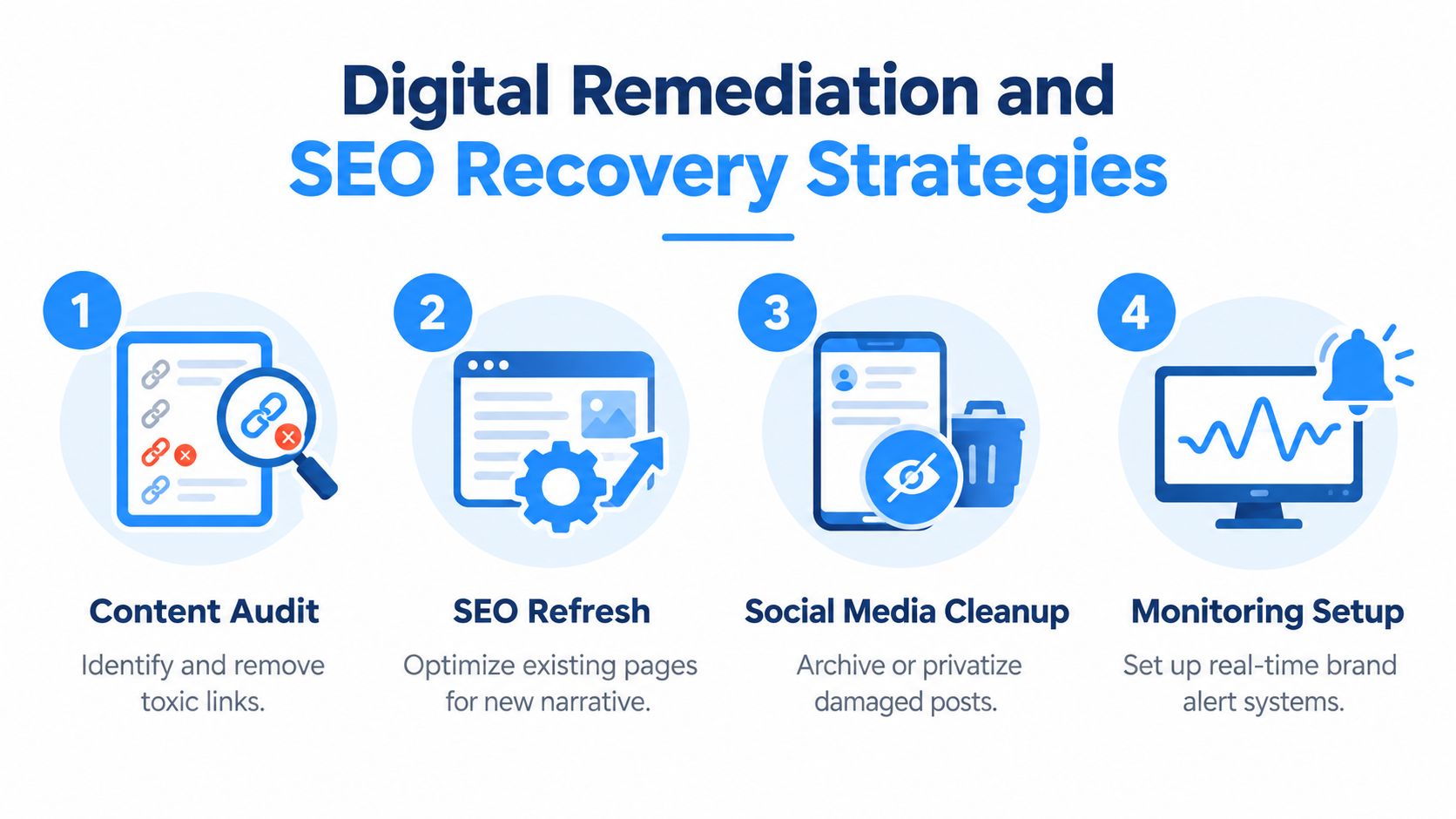
Start with a content and search audit. Identify negative articles, inaccurate pages, copied allegations, outdated statements, hostile forum threads, review patterns, image results, social profiles, and owned pages that now carry stale information. Classify each result by accuracy, authority, visibility, policy status, and whether it requires correction, removal, de-indexing consideration, or stronger accurate content.
Govern the record before promoting it
Don't try to bury accurate criticism with a flood of promotional pages. First correct the underlying facts, remove duplicated or misleading owned content, and update pages that no longer reflect the organization's actions. Where a page is defamatory, inaccurate, outdated, or violates a platform's rules, assess a direct correction, publisher request, platform report, or de-indexing request where feasible.
Google Business Profile requires particular discipline. Its policies apply to Reviews, Photos, Videos, and Posts, and Google says only reviews that violate its content policies qualify for removal. Businesses must verify their profile before replying to reviews, and Google prohibits incentives offered in exchange for reviews, review changes, or negative-review removal, as explained in its Business Profile review policy.
Google can also restrict a Business Profile after a fake-engagement violation, including blocking new reviews or ratings and temporarily unpublishing existing ones. A warning that fake reviews were removed can itself affect public confidence, so review manipulation creates a second reputation problem rather than a reliable fix, according to Google's fake engagement enforcement guidance.
Rebuild relevance and visibility
Once the record is accurate, strengthen pages that deserve to rank. Refresh service pages, leadership profiles, corporate responsibility information, help content, and incident updates with clear ownership and evidence. Link related pages into a coherent information architecture so search engines and readers can understand the current narrative without relying on a single statement.
Use the SEO for reputation management guide to structure the work around search intent, authority, technical health, and content governance. Track rankings, result composition, review sentiment, referral traffic, and whether inaccurate pages continue to appear for priority queries.
Algorithmic visibility complicates recovery. A 2026 systematic review of 300 peer-reviewed articles identified an “algorithmic turn” in public relations research, with platform architectures shaping visibility and legitimacy while longitudinal trust research remains limited. That means recovery isn't a one-time suppression exercise. It requires sustained accuracy, authority, monitoring, and evidence of changed behavior.
Coordinating Media Relations and Stakeholder Communication
A single public statement can't meet every audience's information needs. Customers want practical impact and support options. Employees need internal guidance they can use with confidence. Partners need operational clarity. Journalists need verifiable facts, a timeline, and access to an accountable source.
The choice between broad publication and direct outreach depends on the audience and the incident. Public statements work when many people need the same verified information or when silence would create a vacuum. Direct outreach works when a small group faces a specific impact, when confidentiality matters, or when a journalist has asked a focused question that a generic announcement won't answer.
Match the channel to the decision
| Approach | Strength | Risk | Best use |
|---|---|---|---|
| Public statement | Creates one accessible record | Can sound impersonal or incomplete | Broad awareness and verified facts |
| Direct stakeholder outreach | Addresses specific concerns | Can produce inconsistent explanations | Employees, customers, partners, and affected groups |
| Earned media | Adds independent distribution and context | Less control over framing | Substantive updates supported by evidence |
| Executive communication | Signals accountability and leadership | Raises scrutiny if poorly prepared | Clear decisions, responsibility, and next steps |
| Social engagement | Meets audiences where discussion is active | Replies can fragment the message | Immediate clarification and public questions |
Social channels now deserve first-class treatment. A 2026 consumer survey across the U.S., U.K., and Australia found that social media was the leading place respondents first heard about a brand controversy, and 64% said brands should respond publicly on social media rather than through a press release or website statement. A newsroom release may still matter, but it shouldn't replace visible engagement where the controversy is unfolding.
Use one approved message house, then adapt the emphasis for each group. Customer support needs approved answers and escalation criteria. Executives need a short factual brief and forbidden speculation points. Spokespeople need a timeline and proof for every material claim. A useful stakeholder management handbook can help teams organize audience needs, responsibilities, and communication expectations before the incident.
Third-party amplification works only when the source is credible and the relationship is genuine. Don't recruit commentators to repeat corporate talking points. Offer qualified experts access to facts, explain what has changed, and let independent voices make their own judgments.
For media outreach, prioritize accuracy over volume. The media relations strategy guidance should support the public record, not create a second narrative that conflicts with it.
Post-Crisis Analysis and Measurable Recovery KPIs
A crisis ends operationally before it ends reputationally. The team may stop issuing frequent updates while customers continue searching, reviewing, asking questions, and deciding whether the organization has earned back confidence. Recovery analysis should therefore connect response performance with the condition of the digital record and the quality of stakeholder relationships.
Begin with a timeline reconstruction. Compare the first alert with the first verified assessment, public acknowledgment, preliminary statement, detailed update, media briefing, customer communication, and corrective action. Identify where approval stalled, where facts changed, and where one channel moved ahead of the central fact base.
The Meltwater crisis-management guidance recommends establishing the facts, source, reach, and rate of spread before escalation, judging severity through impact, reach, sentiment, and trajectory, and assigning clear responsibilities across communications, legal, leadership, and social specialists. Use those dimensions in the review, then test whether the response team kept monitoring after publication.
Measure recovery, not applause
Likes and positive comments can be useful signals, but they don't prove that trust has returned. Track whether people are receiving accurate answers, whether search results show current information, whether review responses follow platform rules, and whether unresolved questions are declining.
| KPI Category | Metric | Target Benchmark |
|---|---|---|
| Detection | Time from first signal to internal escalation | Defined in the crisis playbook and tested during drills |
| Response | Time to public acknowledgment | Within the approved first-response window |
| Accuracy | Confirmed facts versus corrected statements | No unresolved contradiction in live channels |
| Stakeholder care | Open customer, employee, or partner concerns | A documented downward trend with assigned owners |
| Search recovery | Accuracy and relevance of priority search results | Current, authoritative information visible for key queries |
| Review governance | Policy-compliant responses and removal requests | Every action supported by platform policy |
| Media relations | Corrected or updated coverage where warranted | Outreach documented with factual evidence |
| Organizational learning | Playbook changes after the incident | Specific owners and due dates recorded |
Targets should be set from your baseline and risk profile rather than copied from another company. The most valuable KPI may be a process measure, such as the time required to approve a holding statement or the number of channels that published inconsistent information.
Close the review with a decision register. Keep the parts that worked, retire steps that caused delay, assign training where roles were unclear, and update monitoring terms based on the language audiences used. Crisis management becomes a reputation asset only when each incident leaves the organization more prepared, more accurate, and easier to trust.
TheBestReputation provides reputation audits, crisis monitoring, incident-response planning, media relations, content governance, review workflows, SEO remediation, and performance reporting for organizations managing high-risk search and social narratives. Visit TheBestReputation to request an assessment and build a practical response and recovery plan before the next incident.
